






- Trending
- Comments
- Latest

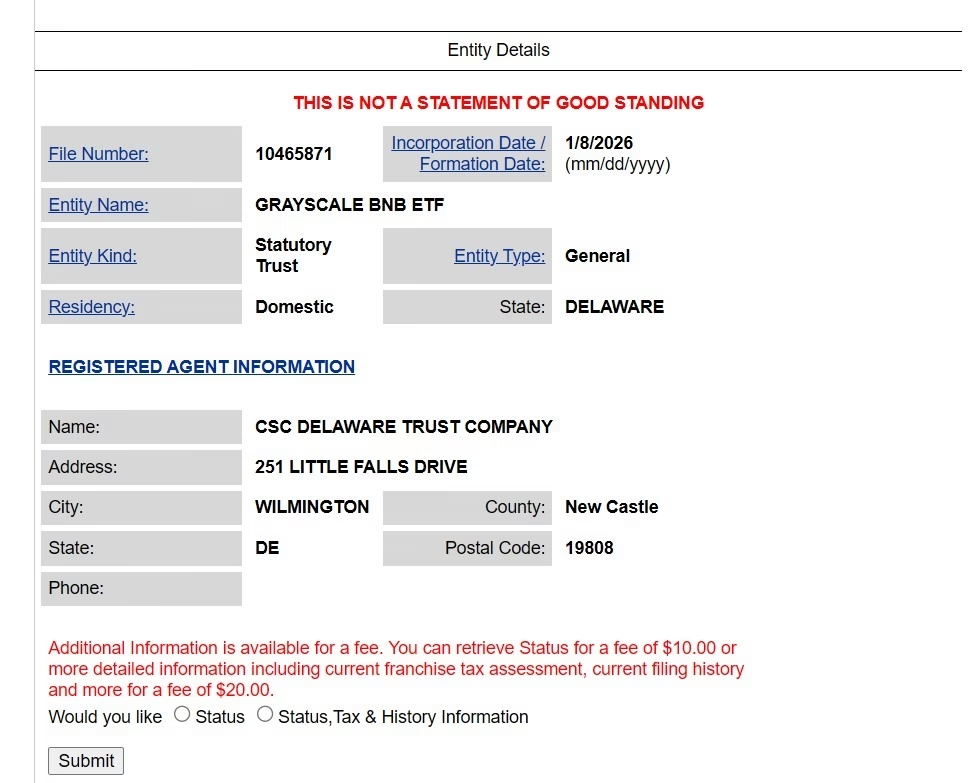
Grayscale registered statutory trusts in Delaware on Thursday for potential exchange-traded products linked to BNB and HYPE tokens, marking a preliminary step toward expanding its crypto ETF offerings beyond bitcoin and ether.
According to Delaware state records, the trusts were registered on Thursday and list CSC Delaware Trust Company as the registered agent.
Such filings are a familiar step in the ETF playbook, allowing issuers to establish a legal structure before submitting formal applications to the U.S. Securities and Exchange Commission (SEC). Still, Grayscale has not confirmed whether an ETF filing will follow, and a Grayscale Delaware registration alone does not imply regulatory approval.
Industry analysts caution against reading too much into a Grayscale Delaware registration, noting that trust formation is largely administrative.
Trust formations like these are typically preparatory work,” ETF Store president Nate Geraci said in previous commentary on similar filings, “giving issuers flexibility to move quickly if market conditions improve.
Grayscale’s latest move stands out because of the assets involved. BNB, closely associated with Binance’s ecosystem, and HYPE, the token tied to decentralized derivatives platform Hyperliquid, sit far outside the traditional comfort zone of U.S.-listed crypto ETFs. To date, most approved or proposed products have focused on Bitcoin and Ether, with only limited traction for altcoin-linked funds.
That context has made the Grayscale Delaware registration a focal point for speculation around whether institutional appetite for altcoins is quietly building.
Despite growing attention, Grayscale has not publicly commented on the purpose of the newly formed trusts. Cointelegraph reached out to the firm for clarification but had not received a response at the time of publication. The lack of confirmation leaves open multiple possibilities: the trusts could be placeholders, exploratory vehicles, or the first step toward eventual ETF applications.
Historically, Grayscale has used similar structures ahead of major product launches, but it has also formed trusts that never progressed to listed ETFs. As such, the Grayscale Delaware registration should be viewed as groundwork rather than a commitment.
The timing of the Grayscale Delaware registration is notable. It comes amid mixed signals in the U.S. crypto ETF market. While spot Bitcoin and Ether ETFs saw strong demand earlier in their lifecycles, flows turned negative toward the end of 2025. In early January alone, more than $1 billion flowed out of spot BTC and ETH ETFs, according to publicly available data.
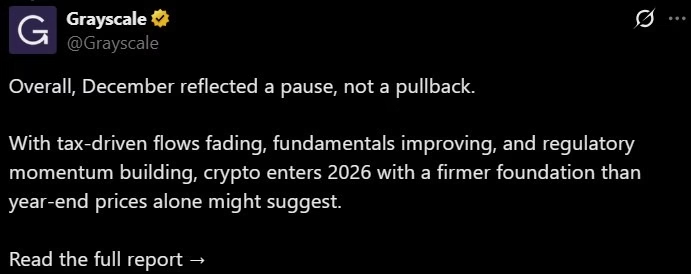
Grayscale has argued that much of the recent selling pressure is seasonal. In a research report published Monday, the firm said ETF outflows were largely tax-driven rather than a reflection of deteriorating fundamentals. The company struck a more optimistic tone for 2026, pointing to expectations of clearer regulation and renewed institutional interest.
That outlook helps explain why a Grayscale Delaware registration might surface even as headline ETF flows appear weak.
While Bitcoin and Ether ETFs have grabbed most of the spotlight, altcoin-focused products have shown smaller but steadier inflows since launch. Analysts say this trend reflects a cautious expansion of institutional crypto exposure, with investors testing the waters beyond large-cap assets.
The inclusion of BNB and HYPE in the Grayscale Delaware registration suggests the firm is monitoring demand for more diverse crypto narratives. “We’re seeing institutions become more selective, not necessarily less interested,” said a digital asset strategist at a U.S.-based asset manager. “They want differentiated exposure, and that’s where altcoins come in.”
BNB’s potential inclusion carries symbolic weight. As one of the largest cryptocurrencies by market capitalization, it underpins a vast ecosystem of applications, though regulatory scrutiny around Binance has historically complicated U.S. investment products tied to the token. Any ETF effort would likely face heightened SEC review, making the Grayscale Delaware registration particularly noteworthy.
HYPE’s presence points to a different trend: growing institutional curiosity around decentralized derivatives. Hyperliquid emerged as one of the dominant perpetuals exchanges through much of 2025, consistently ranking among the top platforms by trading volume before competitors began eroding its market share late in the year.
By registering trusts tied to both assets, Grayscale appears to be hedging its bets across established ecosystems and emerging crypto infrastructure.
This is not the first time a Grayscale Delaware registration has preceded speculation about new products. The firm has long used trust structures as a flexible tool, allowing it to respond quickly when regulatory windows open. Some of those efforts have led to landmark launches, while others remained dormant.
Michael Sonnenshein, Grayscale’s CEO, has previously emphasized patience in navigating U.S. regulation. “We build for the long term,” he said in earlier interviews. “That means being prepared when the environment changes.”
For now, the Grayscale Delaware registration should be seen as a signal rather than a statement. No SEC filings have been confirmed, and there is no guarantee that BNB- or HYPE-linked ETFs will ever reach the market. Still, the move underscores Grayscale’s intent to stay ahead of the curve as institutional crypto investing evolves.
As 2026 unfolds, regulatory clarity—and investor appetite—will determine whether these early structures translate into tradable products. Until then, the Grayscale Delaware registration remains a subtle but telling indicator of how one of crypto’s largest asset managers is positioning for the next phase of the market.



Copyright © 2025 - The Bit Gazette.