
- Trending
- Comments
- Latest

The Hong Kong Monetary Authority has issued its first stablecoin licences under the city’s new regulatory framework, approving HSBC’s Hong Kong arm and Anchorpoint Financial, a consortium backed by Standard Chartered, Animoca Brands, and Hong Kong Telecommunications, to operate as fiat-referenced stablecoin issuers.
The move represents the first real-world implementation of Hong Kong stablecoin regulation, a framework designed to bring order, transparency, and institutional credibility to fiat-referenced digital currencies.
The initial approvals highlight a deliberate and conservative rollout strategy. Rather than opening the gates to a broad pool of applicants, Hong Kong stablecoin regulation appears to favor entities with deep institutional backing and strong regulatory track records.
Anchorpoint Financial, one of the approved issuers, is a joint venture involving Standard Chartered (Hong Kong), Animoca Brands, and Hong Kong Telecommunications. This blend of traditional finance and Web3 expertise underscores the type of hybrid model regulators seem comfortable supporting.
Meanwhile, HSBC’s inclusion further reinforces the emphasis on credibility. As one of Hong Kong’s three note-issuing banks, its participation sends a strong signal that Hong Kong stablecoin regulation is being built on a foundation of trust and systemic stability.
The announcement follows weeks of speculation and a missed internal deadline. Earlier guidance from HKMA Chief Executive Eddie Yue suggested that a limited number of licences would be issued by March. However, that timeline passed without confirmation, raising questions about the pace of Hong Kong stablecoin regulation.
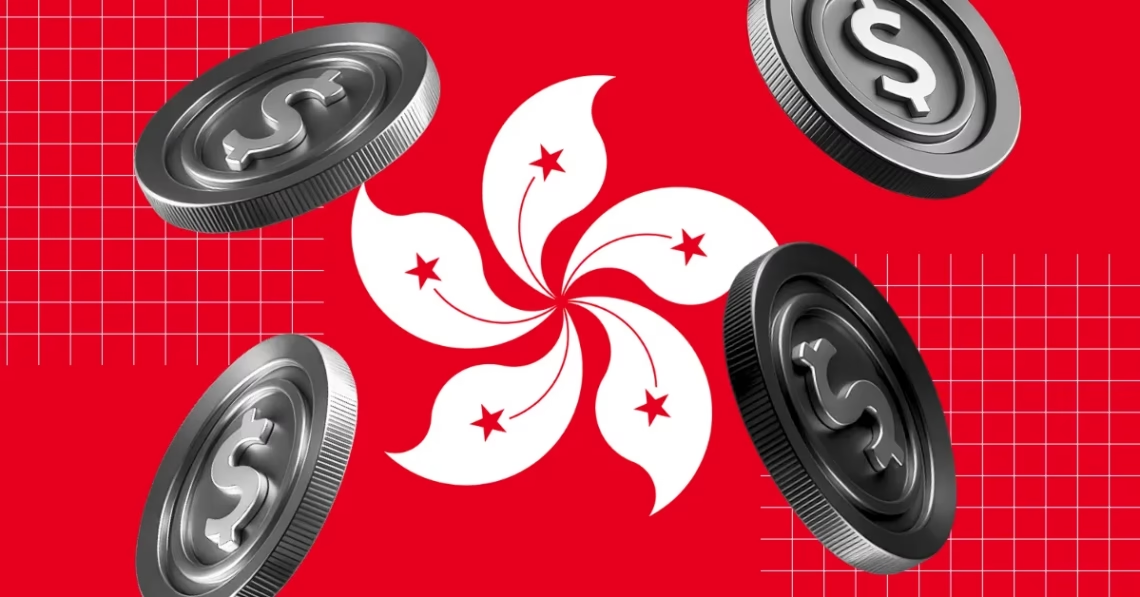
Despite the delay, the regulator reiterated its commitment. On April 1, the HKMA stated it was actively progressing the licensing process, setting the stage for the eventual approvals.
Now, with the first licences granted, Hong Kong stablecoin regulation has entered its operational phase, albeit cautiously.
At the core of Hong Kong stablecoin regulation is a comprehensive rulebook that prioritizes financial stability and consumer protection. The regime, which came into effect on August 1, 2025, requires all issuers of fiat-referenced stablecoins to secure a licence from the HKMA.
Beyond licensing, Hong Kong stablecoin regulation imposes strict requirements on reserve backing, ensuring that issued tokens are fully supported by high-quality assets. Issuers must also provide clear redemption mechanisms, allowing users to convert stablecoins back into fiat currency without friction.
Governance standards and Anti-Money Laundering (AML) controls are equally central to Hong Kong stablecoin regulation, reflecting global concerns about illicit activity in digital asset markets.
Importantly, the framework gives the HKMA significant enforcement powers. Regulators can investigate breaches and impose penalties ranging from fines to licence suspensions or outright revocations—tools that underscore the seriousness of Hong Kong stablecoin regulation.
The decision to approve only two issuers in the first batch suggests that Hong Kong stablecoin regulation is being calibrated for long-term credibility rather than short-term expansion.
By prioritizing bank-linked entities, the HKMA appears to be sending a clear message: stability and compliance come before rapid growth. This approach contrasts with earlier phases of the global crypto market, where speed often outpaced oversight.
Industry observers say this measured rollout could position Hong Kong as a leading hub for regulated digital finance in Asia.
“The emphasis on strong reserve management and institutional backing is critical,” said a senior analyst at a major digital asset research firm. “Hong Kong stablecoin regulation is clearly designed to avoid the pitfalls seen in less regulated markets.”
The newly licensed issuers are expected to begin operations in the coming months, marking the next phase of Hong Kong stablecoin regulation. Their performance will likely set the tone for future approvals and the broader adoption of stablecoins within the region.
Prior to the official announcement, multiple reports had pointed to HSBC and a Standard Chartered-backed consortium as frontrunners. However, regulators withheld confirmation until the licensing process was finalized, reinforcing the cautious nature of Hong Kong stablecoin regulation.

While the HKMA has yet to disclose detailed timelines for additional licences, the current approvals provide a clear indication of the standards applicants will need to meet.
Hong Kong stablecoin regulation arrives at a time when global policymakers are grappling with how to oversee digital currencies without stifling innovation. By establishing a clear, enforceable framework, Hong Kong is positioning itself as a jurisdiction that balances both priorities.
According to Eddie Yue, the regime is intended to give issuers a structured environment in which to operate while ensuring robust safeguards for users.
That balance could prove decisive. As stablecoins continue to play a growing role in cross-border payments and decentralized finance, jurisdictions with clear regulatory frameworks are likely to attract both capital and innovation.
For now, Hong Kong stablecoin regulation is off to a measured but meaningful start—one that emphasizes trust, compliance, and institutional strength over rapid expansion.



Copyright © 2025 - The Bit Gazette.