

- Trending
- Comments
- Latest

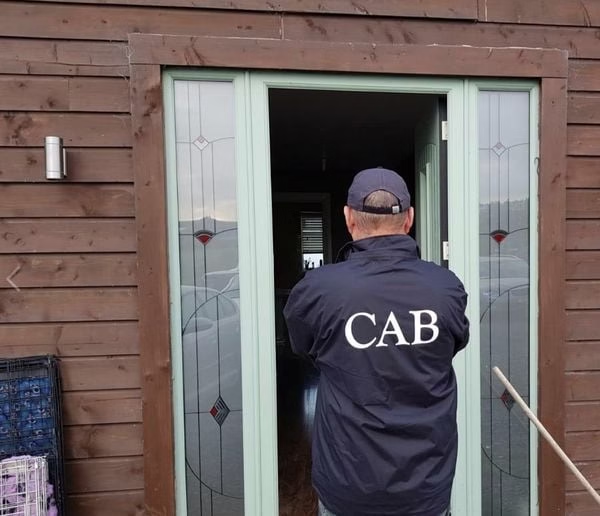
Irish authorities have recovered millions of euros worth of Bitcoin seized from a drug trafficking investigation after discovering the access password hidden inside a fishing rod case.
The case of Clifton Collins, a convicted drug offender, illustrates how even in digital crime, the most sophisticated security often fails to human error, or unconventional storage choices.
The recovery, announced this week, underscores both the opportunities and risks of cryptocurrency self-custody as criminals and law enforcement grapple with securing digital assets.
The recovery, confirmed by Irish law enforcement, highlights both the opportunities and risks associated with cryptocurrency storage.
Officials say the assets, originally seized during a broader probe into criminal activities, were nearly lost permanently due to Collins’ inability to access his own funds.
The case dates back several years, when Collins was arrested and later convicted on drug-related charges.
During the investigation, authorities discovered evidence suggesting he had invested proceeds from illegal activities into Bitcoin.
However, the funds remained inaccessible due to missing login credentials, complicating efforts to secure the assets.
According to reports, the breakthrough came after investigators revisited stored evidence and uncovered crucial details that allowed them to locate the digital wallet.
The recovery effort involved coordination between Irish police and cybercrime specialists who analyzed digital records linked to Collins’ activities.
Authorities traced the origin of the Bitcoin holdings to transactions made through cryptocurrency exchanges during the peak of early adoption.
Unlike traditional bank accounts, Bitcoin wallets are secured by private keys, complex strings of data that grant access to funds.
Without these keys, assets are effectively locked forever. In Collins’ case, the password needed to access the wallet had been written down and stored in an unconventional location.
Investigators eventually discovered that the credentials were hidden in a fishing rod case belonging to Collins.
This detail proved critical, as it allowed law enforcement to regain control of the funds.
According to Senior Garda official, Garda Siochàna, he says the case demonstrates the importance of meticulous evidence handling in digital asset investigations.
The recovery underscores how physical clues can still play a decisive role in solving high-tech financial cases.
Despite the decentralized nature of Bitcoin, human error such as poor password management remains a significant vulnerability.
The Collins case highlights a broader issue within the cryptocurrency ecosystem: the challenge of self-custody.
Unlike traditional financial systems, there is no central authority to reset passwords or recover lost accounts.
Experts warn that while self-custody offers greater control and privacy, it also places full responsibility on the user.
“Losing access to a private key is equivalent to losing cash with no chance of recovery.”
Blockchain security analyst, independent consultancy.
Millions of dollars worth of Bitcoin are believed to be permanently inaccessible due to lost keys or forgotten passwords.
The Collins case is unusual because authorities were able to locate the credentials before the funds were lost indefinitely.
For everyday users, the incident serves as a cautionary tale about the importance of secure storage practices, such as hardware wallets, backup phrases, and multi-signature authentication.
Following the recovery, the seized Bitcoin is expected to be handled under Ireland’s asset forfeiture laws.
Authorities typically liquidate such assets, with proceeds directed toward state funds or law enforcement initiatives.
Legal experts note that cryptocurrency seizures are becoming more common as governments develop frameworks to manage digital assets linked to criminal activity.
The case also raises questions about how governments store and manage seized digital assets, given their volatility and technical complexity.
Bitcoin’s value has fluctuated significantly over the years, meaning the recovered funds could be worth far more or less than at the time of seizure.
The story of Clifton Collins illustrates the double-edged nature of cryptocurrency: a powerful financial tool that can also become inaccessible with a single mistake.
While blockchain technology offers transparency and security, it does not forgive human error.
For the general public, the case provides a clear takeaway, owning digital assets requires not only technical knowledge but also disciplined security practices.
As cryptocurrencies continue to gain mainstream adoption, incidents like this serve as reminders that the risks extend beyond market volatility to include personal responsibility and digital literacy.



Copyright © 2025 - The Bit Gazette.