

- Trending
- Comments
- Latest

Lighter’s native token surged on Tuesday, Jan. 6, 2026, after the protocol confirmed the activation of its long-awaited Lit token buyback, triggering a sharp price rally and a spike in trading activity.
The move, which unfolded across spot and derivatives markets, marked a decisive shift in how the protocol returns value to token holders, linking real usage fees directly to supply reduction.
At press time, LIT was trading at $3.06, up 16% over the past 24 hours, after fluctuating between $2.33 and $3.37 during a volatile week. Market participants cited the start of the Lit token buyback as the primary catalyst behind the move.
The rally followed Lighter’s confirmation that protocol fees are now being routed into direct market purchases of LIT.
In a Jan. 6 statement, the team said that “all fees generated by its core DEX product and future services would be visible on-chain,” adding that revenues would be “allocated between growth initiatives and buybacks depending on market conditions.”
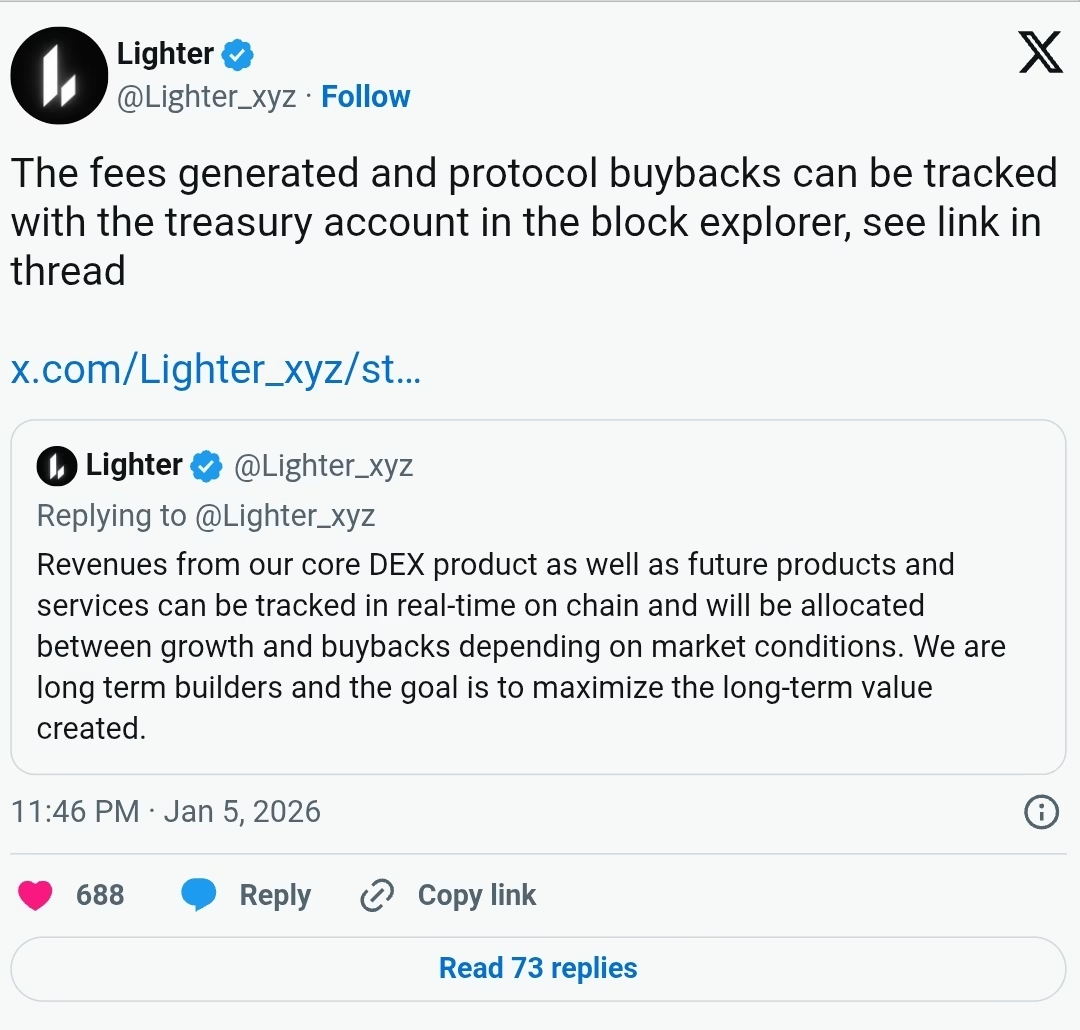
This confirmation marked the official start of the Lit token buyback, a mechanism the community had been anticipating since the token’s launch late last year.
Rather than distributing protocol revenue as dividends, Lighter’s model channels fees into buying LIT from the open market, steadily reducing circulating supply.
On-chain data shows the treasury currently holds about 180,000 LIT tokens and roughly $1.35 million in USDC, giving the protocol immediate capacity to execute purchases tied to the Lit token buyback program.
According to the team, this structure directly links protocol usage to token gʻdemand, a shift that has altered how traders assess long-term value capture.
Market data suggests the price move was supported by more than short-term speculation. Trading volume jumped to $157.8 million over the past 24 hours, representing a more than tenfold increase from the previous session.
Derivatives data from CoinGlass reinforced that trend. Futures volume climbed 87% to $21 million, while open interest rose 58% to $1.81 million. When both metrics rise together, it typically signals fresh positioning entering the market rather than traders closing existing bets.
This surge coincided closely with confirmation of the Lit token buyback, suggesting traders were repositioning in anticipation of sustained supply-side pressure. Community discussion has focused on how meaningful the impact could be if protocol revenues continue to scale.
Based on current revenue figures, some projections shared within the ecosystem suggest the protocol could eventually repurchase as many as 30 million LIT tokens, roughly 3% of total supply, through the Lit token buyback mechanism.
While the actual pace will depend on trading activity and fee generation, the structural shift has already influenced market sentiment.
Lighter launched LIT on Dec. 30 following a $68 million funding round that valued the protocol at $1.5 billion. The raise was backed by Ribbit Capital, Founders Fund, Haun Ventures, and Robinhood Ventures.
The token has a fixed supply of 1 billion units, split evenly between ecosystem incentives and team and investor allocations.
At launch, an airdrop distributed 25% of the supply, while investor tokens were locked under a three-year vesting schedule.
This structure has amplified the perceived impact of the Lit token buyback, as near-term circulating supply is already constrained.
By routing all protocol revenue into market purchases, Lighter effectively ties long-term token economics to platform usage. As the team noted in its announcement, “rather than paying out fees in the form of dividends, the model channels all revenue into buying back tokens,” reinforcing the supply-reduction thesis behind the Lit token buyback.
From a technical perspective, LIT remains in a short-term uptrend after breaking out of a consolidation zone around the mid-$2.60 range. The sequence of higher highs and higher lows suggests bullish momentum is still in control, even as the pace of gains slows.
The recent rally pushed price action toward the upper Bollinger Band near $3.18, a sign of strong upward momentum. However, that band has begun to flatten, indicating buying pressure may be easing and the market could be entering a pause rather than extending the move immediately.
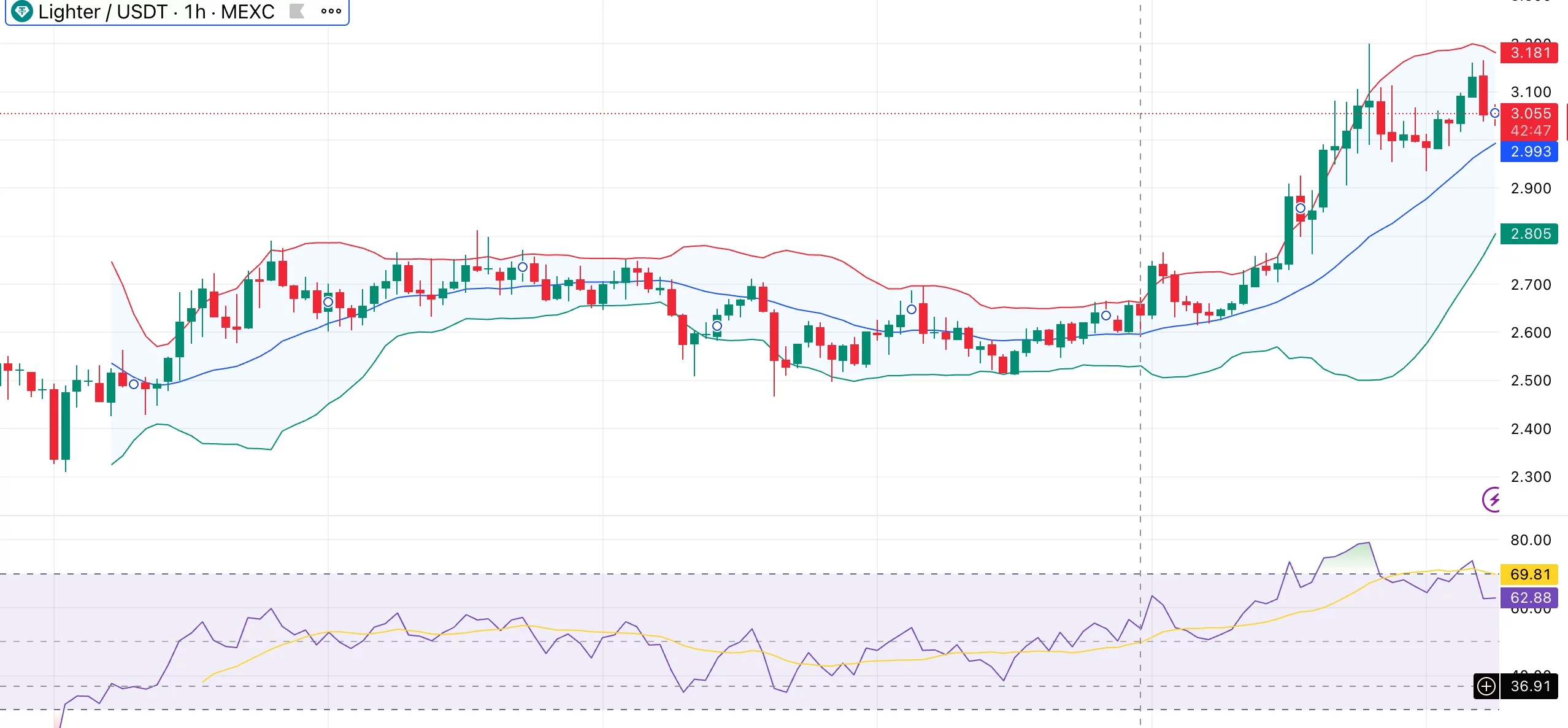
Momentum indicators reflect a similar pattern. The relative strength index briefly entered overbought territory near 70 before slipping back into the low 60s.
Historically, that kind of move signals cooling demand rather than a trend reversal, leaving room for continuation if the Lit token buyback narrative continues to support demand.
In the near term, traders are watching the $3.00 level closely. Holding above that zone could allow the Lit token buyback story to fuel another leg higher. A break below $2.95, however, may open the door to a deeper pullback toward $2.80, where earlier demand emerged.



Copyright © 2025 - The Bit Gazette.