


- Trending
- Comments
- Latest

Wallets linked to crypto entrepreneur Justin Sun now control approximately $40 million worth of LIT tokens, making him one of the largest holders of the Lighter DEX’s native asset just days after its Dec. 30 launch.
On-chain data shows the wallets accumulated roughly 15 million LIT—representing 5.3% of circulating supply—through a combination of liquidity provisioning rewards and direct market purchases totaling $33 million.
Blockchain data shows that four wallets linked to Justin Sun each received 1.6 million LIT shortly after Lighter’s token generation event, for a combined total of about 6.4 million LIT. At the time of receipt, the tokens were valued at roughly $17 million.
According to the Jan. 1 on-chain analysis, the wallets were funded between 34 and 50 minutes after Lighter’s airdrop allocation form closed, with no evidence of participation in earlier points-based farming campaigns.
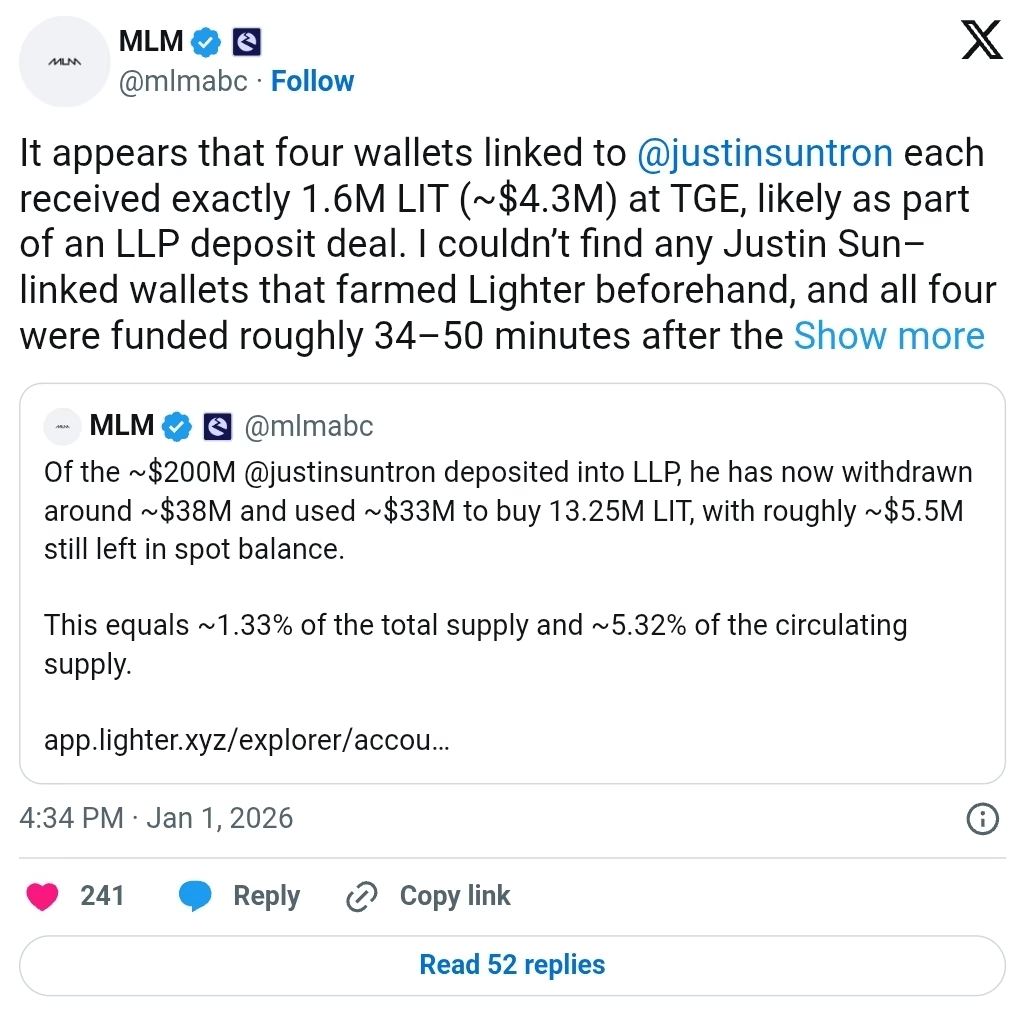
“The timing and funding patterns indicate purchases tied to liquidity provisioning rather than airdrop exploitation,” — MLM, on-chain researcher, wrote in the analysis.
Further transactions revealed that Sun deposited close to $200 million into Lighter’s Liquidity Provider Program. From that position, approximately $38 million was later withdrawn, with about $33 million used to purchase an additional 13.25 million LIT directly from the market. This second phase of Lit token accumulation significantly increased the cluster’s exposure.
In total, the wallets now hold approximately 14.89 million LIT, worth an estimated $39.8 million at prevailing prices. That stake represents about 5.32% of LIT’s circulating supply and roughly 1.33% of the total supply. An additional $5.5 million remains in spot balances associated with the same wallet cluster.
The data also suggests similar arrangements may exist among other large Liquidity Provider Program participants. One wallet that deposited $50 million USDC roughly a month earlier received 874,875 LIT, although attribution in that case remains less certain due to indirect transfers.
Still, analysts say the pattern reinforces how early liquidity incentives can shape token ownership in the opening weeks of trading.
LIT launched on Dec. 30 as the native token of Lighter, a high-performance perpetual futures decentralized exchange built as an Ethereum zk-rollup. The protocol distributed 25% of the token supply via an airdrop to early users and liquidity providers, immediately pushing the circulating supply to around 250 million tokens.
Tokenomics split the remaining supply evenly between insiders and the broader ecosystem. Investors received 24%, while the team controls 26%, both subject to a one-year cliff followed by three years of linear vesting. LIT is designed to capture protocol value through fee recycling, buybacks, staking, governance participation, and access to advanced trading features.
Despite these fundamentals, LIT has faced notable selling pressure since launch. Post-airdrop profit-taking and liquidity withdrawals weighed on price action, a familiar pattern for newly issued tokens with broad initial distributions.
LIT debuted at approximately $3.40 but soon slipped by about 30%, trading in a range between $2.45 and $2.80 in early sessions.
Market observers note that the scale of Lit token accumulation by a high-profile figure like Sun can amplify volatility perceptions, particularly during a token’s price discovery phase.
“Large, structured buying linked to liquidity programs can stabilize depth but also concentrates early ownership,” an analyst summary noted in the on-chain report.
While price volatility has dominated early headlines, Lighter’s underlying usage metrics remain strong. The protocol reported $3.7 billion in trading volume over 30 days and approximately $101 million in annualized fees, signaling active participation despite short-term turbulence.
Supporters argue that the Lit token accumulation tied to liquidity provisioning reflects confidence in Lighter’s long-term design rather than speculative flipping. Critics, however, caution that concentrated holdings can influence governance outcomes and market structure once tokens unlock.
For now, the focus remains on whether Lighter can convert early momentum into sustained adoption. Analysts say the protocol’s future will depend on continued growth in the DeFi perpetuals market, transparent revenue-sharing mechanisms, and how effectively incentives align traders, liquidity providers, and token holders.
As vesting cliffs approach in the coming year, market participants will be watching closely to see whether large holders maintain positions or gradually reduce exposure.
In the meantime, the scale and timing of Justin Sun-linked Lit token accumulation has become a defining case study in how liquidity programs and post-launch strategies shape ownership in modern DeFi ecosystems.



Copyright © 2025 - The Bit Gazette.