


- Trending
- Comments
- Latest

Cryptocurrency exchange OKX has launched a Mastercard-linked payment card across the European Union, allowing verified users to spend stablecoins at millions of merchants under the bloc’s new Markets in Crypto-Assets (MiCA) regulatory framework.
The card, issued through electronic money institution Monavate, supports payments in USDC and Paxos Global Dollar (USDG), marking one of the first major stablecoin payment products to launch under Europe’s tightened crypto oversight rules.
“Europe is one of the most important regions globally for regulated crypto innovation,” OKX Europe CEO Erald Ghoos said in comments shared with Cointelegraph. “With the Okx crypto card, we’re making it simple for people to use stablecoins for real-world purchases without sacrificing security or control.”
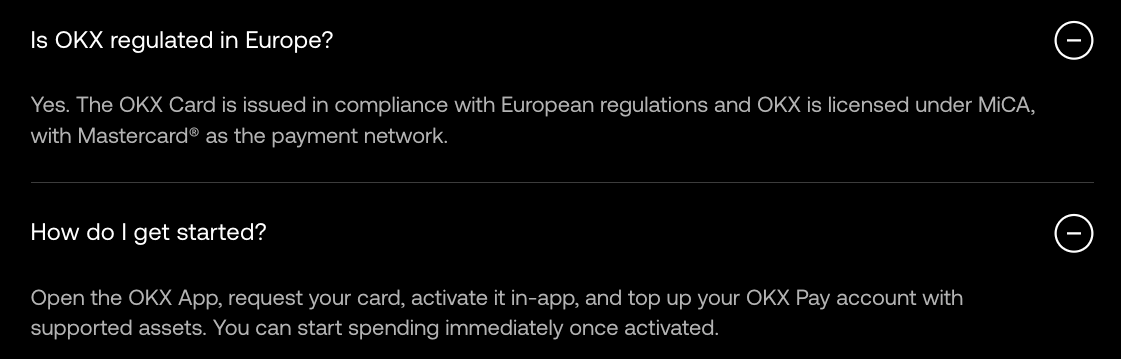
A key differentiator for the Okx crypto card is its regulatory structure. OKX operates as a regulated crypto-asset service provider (CASP) under the EU’s Markets in Crypto-Assets Regulation (MiCA), which came into force to standardize oversight across the bloc. The card itself is issued by Monavate, an EMI that runs the program on Mastercard’s global network.
Monavate, headquartered in the United Kingdom, operates across the European Economic Area while complying with stringent Anti-Money Laundering (AML) and Know Your Customer (KYC) requirements. An OKX spokesperson told Cointelegraph that this structure ensures the Okx crypto card meets both MiCA obligations and existing EU financial regulations.
In November 2025, Monavate announced a definitive agreement to be acquired by self-custodial wallet provider Exodus as part of the purchase of its parent company, W3C Corp, and affiliated firm Baanx. The deal adds another layer of credibility to the Okx crypto card, tying it to firms already familiar with regulated crypto-financial infrastructure.
At launch, the Okx crypto card supports spending in USDC and USDG, two dollar-pegged stablecoins designed to reduce volatility at the checkout counter. Payments are processed over Mastercard’s existing rails, meaning merchants do not need to adopt new crypto-specific hardware or software.
This approach aligns with a growing regulatory preference in Europe: integrating digital assets into familiar financial systems rather than creating parallel ones.
Under MiCA, stablecoin issuers and service providers face clearer rules around reserves, disclosures, and consumer protections—conditions that have encouraged exchanges like OKX to expand compliant payment products such as the Okx crypto card.
Despite its user-friendly design, the Okx crypto card is not a permissionless product. Access is restricted to verified OKX customers who complete full KYC and AML checks in line with MiCA and applicable EU directives.
While the card is linked to OKX Pay—a self-custodial wallet within the OKX app that can be funded directly from the exchange—OKX emphasized that only verified users can activate and use the Okx crypto card.

“Compliance isn’t optional in Europe,” Ghoos said. “The Okx crypto card is built to meet regulatory expectations while still delivering the convenience users expect from modern payments.”
Ghoos framed the card as a practical response to crypto’s long-standing usability challenge. While blockchain technology was designed to enable peer-to-peer payments, the technical barriers have often limited everyday adoption.
“Most people have three core financial needs: to pay and be paid, to grow wealth, and to access credit,” Ghoos told Cointelegraph. “The Okx crypto card directly addresses the first. It lets users transact freely and securely in real life while staying in control of their assets.”
By abstracting away blockchain complexity, the Okx crypto card aims to turn stablecoins into a spending medium rather than a speculative asset—an ambition shared by regulators and payment networks alike.
The timing of the Okx crypto card launch is notable. Crypto-linked payment cards are seeing renewed momentum in Europe, supported by clearer regulation and rising consumer familiarity. Visa has reported that spending via its crypto card programs surged 525% in 2025, underscoring demand for compliant crypto-to-fiat payment solutions.

Against that backdrop, the Okx crypto card positions OKX alongside other major platforms racing to capture a share of everyday crypto spending. However, OKX’s emphasis on MiCA compliance and regulated issuance could give it an edge in jurisdictions where enforcement is tightening.
For now, the Okx crypto card is limited to EU users who meet verification requirements, with stablecoin support focused on USDC and USDG. But industry observers expect further expansion as MiCA implementation matures and consumer demand grows.
As Europe becomes a proving ground for regulated crypto payments, the Okx crypto card may offer a glimpse of how digital assets integrate into mainstream finance—not as an alternative system, but as a regulated extension of the one consumers already use every day.



Copyright © 2025 - The Bit Gazette.