







- Trending
- Comments
- Latest

A sophisticated phishing campaign targeting developers of the fast-rising AI project OpenClaw is raising fresh alarms across the crypto and developer communities. The OpenClaw phishing attack leverages fake token rewards, cloned websites, and GitHub manipulation to trick users into exposing their crypto wallets.
Security researchers say the OpenClaw phishing attack is a textbook example of how attackers are increasingly blending open-source ecosystems with crypto-related exploits to maximize reach and credibility.
According to cybersecurity firm OX Security, the OpenClaw phishing attack revolves around a non-existent cryptocurrency dubbed “CLAW.” Attackers falsely claim the token is linked to the OpenClaw project and lure developers with promises of rewards worth up to $5,000.
The campaign operates through fake GitHub accounts, where malicious actors post messages in repositories they control. These posts tag developers directly, increasing visibility and urgency—key tactics that make the OpenClaw phishing attack more convincing.
Recipients are then directed to a cloned website designed to closely resemble OpenClaw’s official platform. Once there, users are prompted to connect their crypto wallets—a critical step in executing the OpenClaw phishing attack.
The mechanics behind the OpenClaw phishing attack are both simple and effective. By exploiting trust within developer communities, attackers bypass traditional security skepticism.
Once a victim connects their wallet, malicious scripts can request approvals or extract sensitive credentials. In many cases, victims unknowingly grant permissions that allow attackers to drain funds or access private data.

Cybersecurity experts warn that the OpenClaw phishing attack mirrors a growing trend in crypto-related scams, where attackers no longer rely solely on email phishing but instead infiltrate trusted platforms like GitHub.
“Developers are increasingly becoming high-value targets because they often manage wallets, APIs, and infrastructure,” a security analyst familiar with the campaign said, noting the broader implications of the OpenClaw phishing attack.
Despite the sophistication of the campaign, OX Security reported that no confirmed victims have been identified so far. Still, the scale and design of the OpenClaw phishing attack suggest it was built for wide distribution and potential mass exploitation.
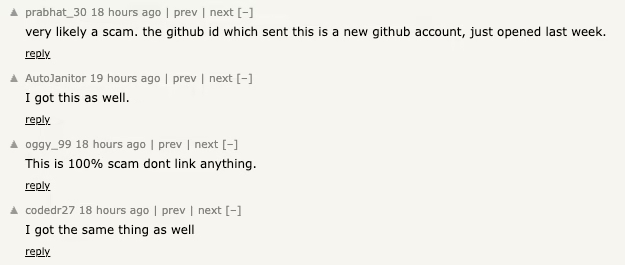
Social media activity indicates that many developers quickly recognized the scam, flagging suspicious messages and warning others. This rapid response may have limited the immediate impact of the OpenClaw phishing attack, but experts caution that similar tactics are likely to resurface.
OpenClaw creator Peter Steinberger has moved swiftly to distance the project from any crypto-related claims. In public statements, he emphasized that the project is strictly non-commercial and will never issue a token.
“We would never do that. The project is open source and non-commercial,” Steinberger said, directly addressing the claims fueling the OpenClaw phishing attack.
He also warned users to ignore any emails or messages suggesting otherwise, reinforcing that the OpenClaw phishing attack relies heavily on misinformation and brand impersonation.
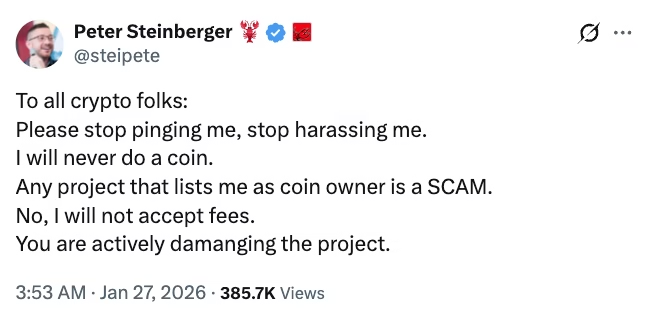
This is not the first time Steinberger has addressed potential scams. Months before the current OpenClaw phishing attack, he publicly stated that he would never launch a cryptocurrency tied to the project.
“I will never do a coin. Any project that lists me as coin owner is a scam,” he wrote in a January post, effectively predicting the tactics now being used in the OpenClaw phishing attack.
Despite these warnings, attackers have continued to exploit the project’s growing popularity, demonstrating how difficult it is to fully prevent impersonation-based scams.
Launched in November 2025, OpenClaw quickly gained traction as a powerful open-source AI agent capable of managing files, executing software tasks, and interacting with platforms like WhatsApp and Telegram.
Its rapid growth—combined with a strong developer community—has made it an attractive target for cybercriminals. The project has amassed hundreds of thousands of followers online, creating a large pool of potential victims for campaigns like the OpenClaw phishing attack.
Experts say this visibility is precisely what makes such projects vulnerable. The more popular a platform becomes, the more likely it is to be impersonated.
In response to rising threats, the OpenClaw team has taken proactive steps to reduce exposure to crypto-related fraud. Notably, the project banned discussions about Bitcoin and other cryptocurrencies in its official Discord channels earlier this year.
This move was intended to prevent exactly the kind of confusion exploited in the OpenClaw phishing attack, where attackers blur the lines between legitimate projects and fraudulent tokens.
Still, the incident highlights a broader issue within the tech and crypto space: the convergence of open-source development and financial incentives has created new attack surfaces.
The OpenClaw phishing attack underscores a critical shift in how cybercriminals operate. By targeting developers directly and exploiting trusted platforms like GitHub, attackers are evolving beyond traditional phishing methods.
While no confirmed losses have been reported, the campaign serves as a warning to both developers and crypto users: vigilance is no longer optional.
As projects like OpenClaw continue to grow, so too will the sophistication of attacks designed to exploit them. And in this environment, even a simple promise of free tokens can be the entry point for a highly coordinated OpenClaw phishing attack.



Copyright © 2025 - The Bit Gazette.