

- Trending
- Comments
- Latest

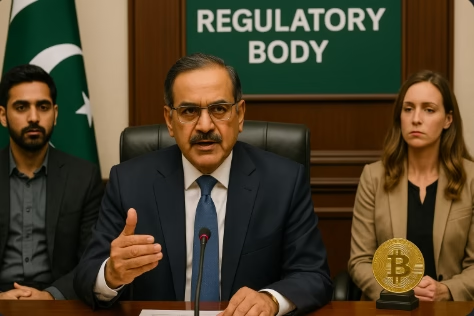
Pakistan took a bold position on digital assets this week as Minister of State Bilal bin Saqib called for a transformative national approach to cryptocurrency, urging the government to consider adopting Bitcoin as a reserve asset.
The remarks, delivered at the Global Bitcoin Conference in Abu Dhabi, placed Pakistan crypto adoption at the center of a broader economic vision aimed at preparing the country for the technological realities of the 2050s.
His comments highlight a strategic shift in how Pakistan intends to position itself within the global digital economy, making Pakistan crypto adoption a priority in future policy and investment frameworks.
Speaking to an international audience of policymakers, investors, and industry leaders, Bilal bin Saqib argued that Pakistan must accelerate innovation, remove regulatory barriers, and embrace emerging opportunities—including digital reserves and large-scale Bitcoin mining—to support long-term competitiveness.
These remarks mark one of the strongest government-linked endorsements of Pakistan crypto adoption to date.
During his address, Bilal bin Saqib stressed that Pakistan’s regulatory direction is no longer tied to outdated concerns or past policy obstacles. Instead, he outlined a tech-forward vision rooted in Pakistan crypto adoption that aims to prepare the country for technological shifts expected to dominate the global economy in coming decades.
“Pakistan’s policy on digital assets is clear and forward-looking,” — Bilal bin Saqib, Minister of State, at the Global Bitcoin Conference.
He emphasized that the government is shaping its strategy around the demands of the 2050s, not the precedents of earlier decades.
He stated that Pakistan is actively removing regulatory obstacles that previously restricted innovation, noting that a clearer and more competitive environment is essential to boost Pakistan crypto adoption and stimulate investment.
One of the most notable components of the minister’s remarks centered on Pakistan’s energy landscape. He highlighted that the country holds vast untapped electricity resources—much of it underutilized or wasted—which could be converted into economic value through Bitcoin mining.
This potential revenue stream, he suggested, could significantly enhance the country’s digital economic capacity and strengthen the case for Pakistan crypto adoption.
“Billions of dollars can be earned through this alone,” — Bilal bin Saqib, reinforcing the financial opportunities attached to mining and digital infrastructure expansion.
The minister’s focus on energy-driven mining initiatives reflects a growing recognition that Pakistan crypto adoption is not limited to consumer use or speculative investment, but can also serve as a macroeconomic tool when paired with existing national resources.

Another key pillar of the minister’s speech was the role of Pakistan’s youth in driving future digital growth. Bilal bin Saqib argued that Pakistan crypto adoption fits into a broader strategy to empower the country’s young population, shifting them from passive consumers to active global creators.
“We want to make Pakistan’s youth creators, not consumers,” — Bilal bin Saqib.
He said Pakistan’s digital policy framework seeks to attract global investment, encourage innovation, and enable the next generation to participate meaningfully in the worldwide digital economy.
By integrating digital asset literacy, blockchain development, and emerging tech infrastructure, the government aims to place Pakistan crypto adoption at the center of its long-term human capital development strategy.
Pakistan’s emerging stance on digital assets, particularly the minister’s call for Bitcoin to be considered as a reserve asset, marks a significant shift in how the country views long-term financial strategy.
The recommendations suggest a pathway where Pakistan crypto adoption could influence monetary policy, international competitiveness, and national reserves management.
For policymakers, the remarks create an urgent conversation around regulatory clarity, infrastructure investment, and cross-sector collaboration. For crypto investors, the signals from government leadership could indicate future opportunities in mining, blockchain development, and fintech partnerships.
And for the general public, the minister’s comments suggest that Pakistan crypto adoption may soon become a central component of the country’s economic transformation.
With global markets increasingly oriented toward digital assets, Pakistan’s willingness to explore new models—including Bitcoin-backed reserves and large-scale mining—positions it as a potential leader in regional crypto innovation. Whether this vision translates into policy will determine how far Pakistan crypto adoption can advance in the years ahead.



Copyright © 2025 - The Bit Gazette.