




- Trending
- Comments
- Latest

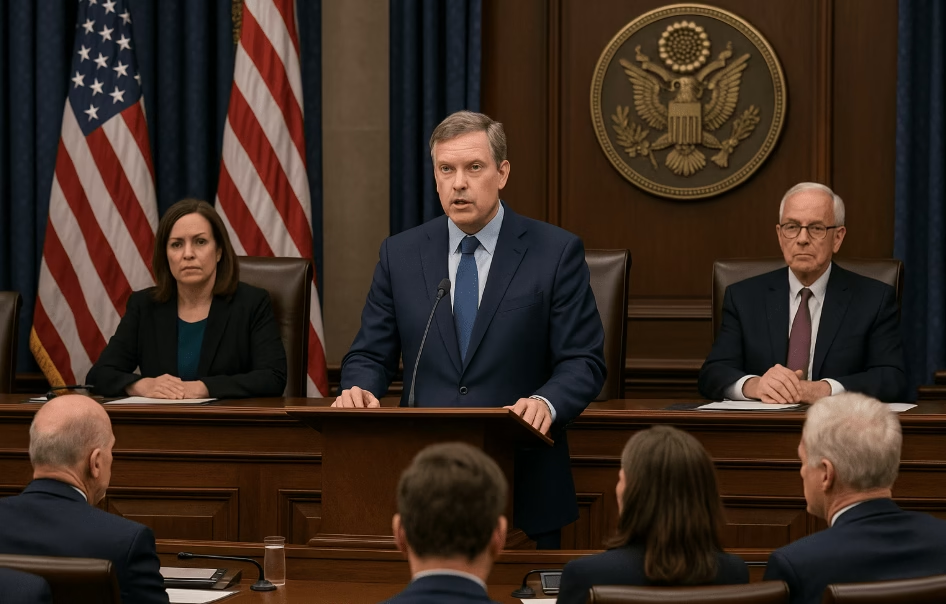
Seven U.S. House lawmakers sent a letter to CFTC Chair Michael Selig this week demanding answers on why the agency has not acted against insider trading in prediction markets, setting a response deadline of April 15.
Prediction Market Regulation took a dramatic turn this week as seven members of the U.S. House of Representatives sent a strongly worded letter to CFTC Chair Michael S. Selig.
The lawmakers questioned why the agency has not acted decisively despite having clear authority under the Commodity Exchange Act.
The letter pointed directly to the CFTC’s power to “apply its rules and regulations” to prevent evasion of swap provisions—authority that lawmakers argue is not being fully utilized.
Their concern? A growing wave of controversial event contracts tied to sensitive geopolitical events, including potential U.S. military actions in Iran and Venezuela.
Lawmakers described some of these contracts as “morally obscene,” warning that Prediction Market Regulation is failing to keep pace with the risks posed by these markets.
At the heart of the issue is a surge in suspicious trading activity that appears closely aligned with real-world political and military developments.
Recent reports show that well-timed trades ahead of major U.S. policy announcements have raised red flags across financial markets, including prediction platforms.
These patterns have intensified calls for stronger Prediction Market Regulation, particularly as anonymous traders have reportedly generated massive profits by leveraging non-public information.
“The prevalence of event contracts that appear to flout United States law is concerning,” the lawmakers wrote, emphasizing that offshore activity should not shield participants from enforcement.
The regulatory vacuum is further complicated by ongoing legal disputes between federal and state authorities.
In a landmark ruling, a U.S. appeals court recently affirmed that the CFTC holds exclusive jurisdiction over prediction markets, dealing a blow to state-level efforts to regulate platforms like Kalshi.
At the same time, federal authorities have moved to block state interventions, arguing that prediction markets fall squarely under federal commodities law.
This tug-of-war highlights a central dilemma: while Prediction Market Regulation is acknowledged at the federal level, a comprehensive framework remains unresolved.
Despite criticism, the CFTC has not ignored the issue entirely.
David Miller, Director of Enforcement at the agency, pushed back against the growing narrative that insider trading is somehow acceptable in prediction markets.
“There’s a myth in mainstream media and social media that insider trading doesn’t apply in the prediction markets… That is wrong,” Miller stated.
He emphasized that insider trading in these markets violates the Commodity Exchange Act and will be pursued aggressively.
“Insider trading in the prediction markets… is precisely the kind of serious violation that we are going after vigorously,” Miller added.
Still, the agency stopped short of announcing immediate enforcement actions, signaling a more selective approach focused on clear misuse of confidential information.
Platforms like Kalshi and Polymarket now find themselves at the center of the storm.
Industry leaders acknowledge that bad actors are inevitable but insist enforcement will catch up. Recent commentary from Kalshi’s CEO suggests federal probes into insider trading are likely.
Meanwhile, trading volumes in prediction markets continue to surge, with billions flowing through event-based contracts—further amplifying the urgency for robust Prediction Market Regulation.
The House lawmakers have given the CFTC a deadline to respond to six key questions by April 15, signaling that political patience is wearing thin.
Their message is clear: failure to act risks undermining trust in both financial markets and regulatory institutions.
“Such corrupt trades deserve swift and decisive oversight,” the letter stated, warning that inaction raises “troubling concerns” about the agency’s capacity to fulfill its global role.
As the debate intensifies, Prediction Market Regulation stands at a pivotal moment—caught between innovation, legality, and ethical boundaries.



Copyright © 2025 - The Bit Gazette.