

- Trending
- Comments
- Latest

The U.S. Department of Justice and the Commodity Futures Trading Commission have sued Illinois Governor JB Pritzker and state regulators, accusing them of illegally blocking prediction market platforms like Kalshi and Polymarket by classifying them as gambling instead of federally regulated derivatives.
The lawsuit, filed this week, escalates a national fight over whether states or federal agencies control a sector that has grown by more than 2,800% year-over-year amid explosive demand for decentralized forecasting tools.
At the core of the dispute is how prediction market regulation should be defined and enforced.
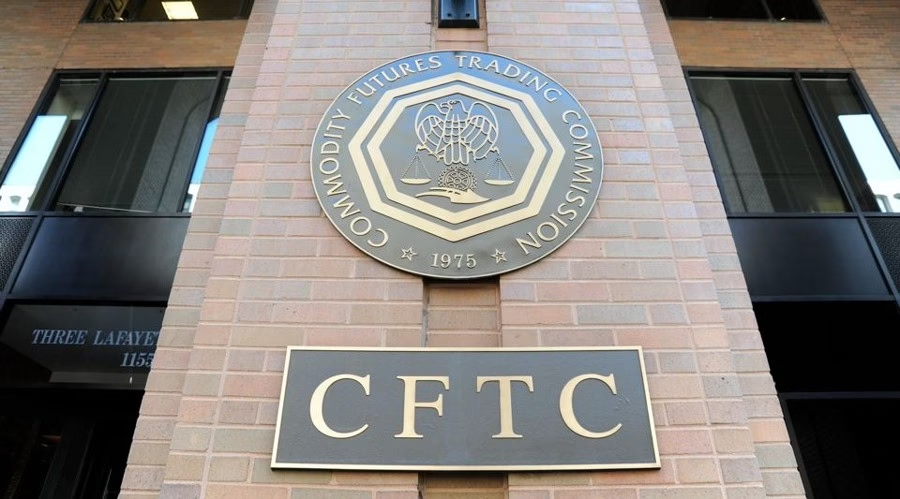
The CFTC argues that event contracts offered by platforms such as Kalshi and Polymarket fall under the category of “swaps,” making them subject to federal oversight under the Commodity Exchange Act (CEA).
In its complaint, the agency insists it holds “exclusive jurisdiction” over Designated Contract Markets (DCMs), which it says clearly includes prediction platforms.
According to the filing, Illinois improperly labeled these contracts as “wagers” or “sports betting,” triggering enforcement actions that the CFTC claims violate federal law.
The lawsuit states: “Unless restrained and enjoined by the court, defendants are likely to continue their attempts to subvert federal law and the exclusive jurisdiction to regulate event contract swaps conferred on the CFTC by Congress.”
The legal clash stems from cease-and-desist letters issued last year by multiple states against prediction platforms.
These notices argued that such platforms were operating in violation of local gambling laws and licensing requirements.
However, the federal government sees things differently. CFTC Chairman Mike Selig criticized the actions as regulatory overreach, signaling a broader battle over prediction market regulation in the U.S.
“Our action today is meant to ensure we are able to effectively regulate the markets that Congress intended us to exclusively oversee,” Selig said in a statement.
The DOJ’s involvement underscores the seriousness of the conflict, elevating prediction market regulation into a national legal priority.
Illinois is far from alone. Over the past year, at least 11 states—including Arizona, Nevada, Maryland, New Jersey, New York, and Massachusetts—have taken action against prediction market operators.
This wave of enforcement reflects growing concern among state regulators about the blurred line between financial derivatives and gambling products.
Some lawmakers are even pushing for legislation that would ban sports-related event contracts entirely, while others aim to restrict markets tied to geopolitical events such as war.
The result is a fragmented regulatory environment, with prediction market regulation becoming increasingly complex and contested across jurisdictions.
Despite mounting legal pressure, the prediction market sector is booming. Transaction volumes have surged dramatically, with activity reportedly increasing by more than 2,800% year-over-year.
This explosive growth highlights the rising demand for decentralized forecasting tools, particularly in crypto-native ecosystems where users seek alternative ways to trade on real-world outcomes.
Industry advocates argue that prediction market regulation, if handled correctly, could unlock significant innovation.
By providing clear federal guidelines, regulators could legitimize the sector and attract institutional participation.
Critics, however, warn that without strict oversight, these platforms could become indistinguishable from online gambling, raising consumer protection concerns.
The ongoing legal battle signals a striving moment for prediction market regulation in the United States.
A court ruling in favor of the CFTC could cement federal dominance over the sector, setting a precedent that limits state interference.
On the other hand, if states prevail, prediction platforms may face a patchwork of local regulations that could stifle growth and innovation.
Legal experts say the outcome could reshape not only prediction markets but also the broader digital asset ecosystem, where jurisdictional clarity remains a persistent challenge.



Copyright © 2025 - The Bit Gazette.