





- Trending
- Comments
- Latest

For years, NFTs have lived in a strange contradiction. They have commanded billions in market value, attracted global attention, and built cultural relevance, yet they have struggled to answer a simple question: what are they actually for?
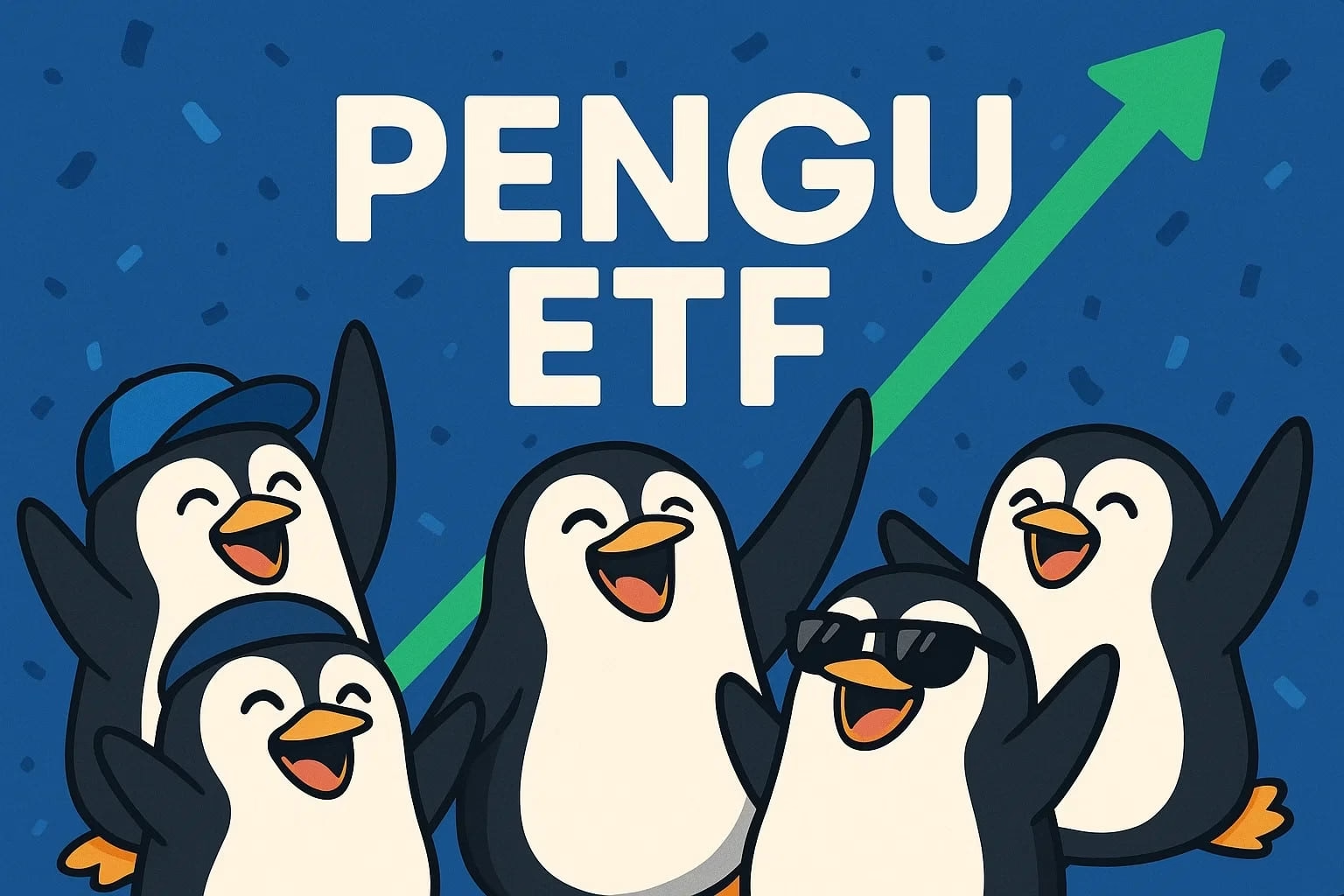
The proposed Pudgy Penguins ETF may be the first serious attempt to answer that question, not through art, not through hype, but through financial infrastructure.
And if it succeeds, it could quietly transform NFTs from speculative collectibles into something far more enduring: financial assets with measurable utility.
The proposed Pudgy Penguins ETF is unlike anything traditional finance has seen before.
Filed by Canary Capital, the fund is designed to hold both:
In some filings, up to 95% of assets are allocated to the token and NFTs combined, with a portion directly tied to the NFT collection itself (Securities and Exchange Commission).
That alone breaks convention.
“We are seeing the early stages of digital assets evolving beyond tokens into fully financialized ecosystems,” one industry analyst noted, highlighting how structured products are beginning to absorb previously illiquid assets.
ETFs are built around fungible assets, stocks, bonds, commodities, things that can be priced, traded, and arbitraged efficiently. NFTs, by contrast, are:
And yet, this ETF proposes to package them into a structure designed for daily liquidity and institutional access.
“If NFTs can be wrapped into an ETF structure, it fundamentally changes the question from ‘what are they worth?’ to ‘how can they be traded at scale,’” a digital asset strategist said, pointing to a shift from ownership to exposure.
That tension is precisely why this matters.
Pudgy Penguins began as an NFT collection in 2021, consisting of 8,000 cartoon avatars. Like many early NFT projects, it rode waves of speculation, hype, and community enthusiasm.
But unlike most collections, it didn’t disappear.
Instead, it evolved:
The result is something rare in crypto: an NFT brand that behaves like a consumer ecosystem.
The ETF is not just a financial product—it is a bridge.
It connects:
And in doing so, it introduces a new idea:
NFTs don’t need utility within Web3 — they can derive utility from financialization itself.

The biggest problem with NFTs has always been liquidity.
Owning an NFT means:
An ETF changes that completely.
By bundling NFTs into a fund:
This is not just convenience, it is transformation.
It turns NFTs from isolated digital objects into components of a broader financial system.
And that is where real utility begins.
At first glance, the Pudgy Penguins ETF looks like a niche experiment—perhaps even a speculative one.
But zoom out, and it becomes something else entirely.
It is part of a larger shift:
Each step expands the boundary of what traditional finance is willing to absorb.
According to industry analysis, this could mark the beginning of a new class of funds that directly include NFTs, rather than just companies associated with them.
If that happens, the implications are profound:
And suddenly, NFTs are no longer fringe, they are financial primitives.
There is something quietly radical about turning a collection of cartoon penguins into an institutional investment vehicle.
It suggests that value is no longer defined by:
Instead, value can emerge from:
This is not new in the internet age. Social media platforms, meme stocks, and digital brands have already shown that attention is a form of capital.
What the ETF does is formalize that idea.
It says:
Cultural assets can be packaged, priced, and traded like financial instruments.
And once that happens, the line between culture and capital disappears.
For all its potential, the Pudgy Penguins ETF raises serious concerns.
Regulators are already cautious.
The U.S. Securities and Exchange Commission has delayed decisions on the ETF, extending review periods as it evaluates risks around:
Critics argue that NFTs remain:
And they are not wrong.
Unlike Bitcoin, which has a global market and clear pricing mechanisms, NFTs rely heavily on:
This introduces a level of uncertainty that traditional ETF structures were never designed to handle.
Despite the risks, there is a reason this idea keeps resurfacing.
Markets evolve by absorbing what once seemed irrational.
At one point:
And yet, each found a place within the financial system.
The Pudgy Penguins ETF may follow the same path, not because it is perfect, but because it reflects where markets are going.
Investors are no longer just buying assets.
They are buying:
And increasingly, they want exposure to these things without the complexity of direct ownership.
For years, the NFT space has chased utility through:
But these efforts often struggled to deliver lasting value.
The ETF introduces a different kind of utility.
Not utility as function, but utility as access.
In that sense, the ETF does not just add utility to NFTs.
It redefines what utility means.
If the Pudgy Penguins ETF is approved, it will not just be a milestone for NFTs.
It will signal something larger:
The beginning of a world where:
This is not a distant future.
It is already happening.
The ETF is simply the next step.
The Pudgy Penguins ETF may seem unconventional, even absurd to some.
But history suggests that financial innovation often begins that way.
What matters is not whether cartoon penguins belong in an ETF.
What matters is what they represent:
A shift from ownership to exposure
A shift from utility to access
A shift from assets to narratives
If those shifts continue, then the question is no longer whether NFTs have utility.
It is whether we have been defining utility too narrowly all along.
And if that is the case, then the Pudgy Penguins ETF is not just another crypto experiment.
It is a preview of what the future of finance might look like.



Copyright © 2025 - The Bit Gazette.