







- Trending
- Comments
- Latest

Ripple announced a partnership with enterprise IT provider DXC Technology on Thursday to integrate blockchain custody and payment services into the Hogan core banking platform, which serves financial institutions managing more than 300 million customer accounts and $5 trillion in deposits globally.
The announcement positions Ripple’s blockchain-based payments and custody services inside core banking infrastructure used by institutions overseeing more than 300 million deposit accounts worldwide.
Market optimism around Ripple dxc technology has been building alongside growing expectations that 2026 could mark a breakout year for institutional blockchain adoption.
The latest price surge comes just days after Ripple President Monica Long outlined bullish long-term growth projections and shortly after CEO Brad Garlinghouse appeared at the World Economic Forum in Davos, where digital assets and tokenization featured prominently on the agenda.
But traders point to the Ripple dxc technology deal as the most tangible catalyst.
“This is not a pilot or proof-of-concept,” said a digital assets analyst at a European investment firm. “Embedding Ripple directly into a platform with hundreds of millions of accounts is the kind of scale markets pay attention to.”
Under the agreement, DXC Technology will integrate Ripple’s custody and payments infrastructure into its Hogan core banking platform. Hogan is widely used by tier-one banks and financial institutions and reportedly supports more than $5 trillion in deposits globally.
The Ripple dxc technology integration is designed to let banks offer digital asset custody, tokenization services, and cross-border payments without overhauling legacy systems — one of the biggest barriers to blockchain adoption in traditional finance.
“For digital assets to move into the financial mainstream, institutions need secure custody and seamless payment capabilities,” said Sandeep Bhanote, Global Head and General Manager of Financial Services at DXC Technology.
“Our work with Ripple brings those capabilities together while allowing banks to operate within their existing core environments.”
According to DXC, the Ripple dxc technology stack will be natively embedded, enabling institutions to adopt crypto services without disrupting compliance workflows or operational continuity.
Through the partnership, Ripple Payments — the company’s licensed end-to-end cross-border settlement product — and Ripple Custody will be integrated directly into DXC’s enterprise banking infrastructure.
This allows banks and fintech firms to interact with digital assets while maintaining regulatory guardrails, a key requirement as global regulators tighten oversight.
“Banks are under increasing pressure to modernize while continuing to operate on complex infrastructure,” said Joanie Xie, Vice President and Managing Director for North America at Ripple.
“Our partnership with DXC brings digital asset custody, RLUSD, and payments directly into the core banking environments institutions already trust.”
Xie added that the Ripple dxc technology collaboration enables secure, compliant digital asset use cases at enterprise scale without forcing institutions to rebuild their systems from scratch.
Industry observers say the Ripple dxc technology partnership effectively provides “last-mile connectivity” between traditional finance and blockchain networks — a gap that has slowed adoption for years.
By embedding blockchain tools into core systems, banks can experiment with tokenization, digital currencies, and settlement rails without exposing themselves to operational risk.
“This is how blockchain quietly goes mainstream,” said a former bank CTO now advising fintech firms. “Not through hype, but through infrastructure deals like Ripple dxc technology.”
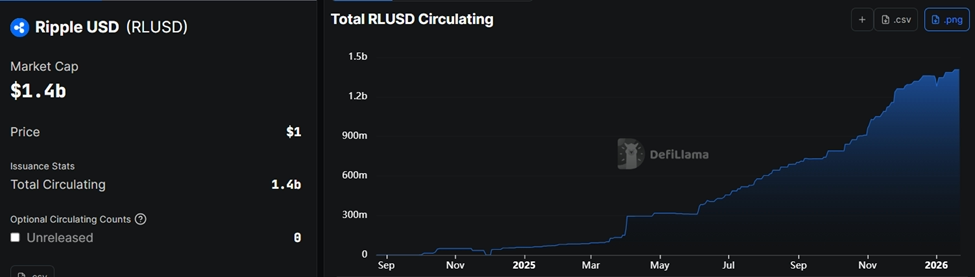
The DXC announcement also comes as Ripple expands its broader ecosystem. While the company’s RLUSD stablecoin has gained traction in regions like the UAE, its market capitalization remains modest at roughly $1.4 billion, compared to the $309 billion global stablecoin market.
Still, analysts say the Ripple dxc technology initiative strengthens Ripple’s long-term positioning, even if near-term revenue impact is limited.
XRP, meanwhile, continues to benefit from the narrative that Ripple is increasingly embedded in real-world financial plumbing rather than operating at the edges of crypto markets.
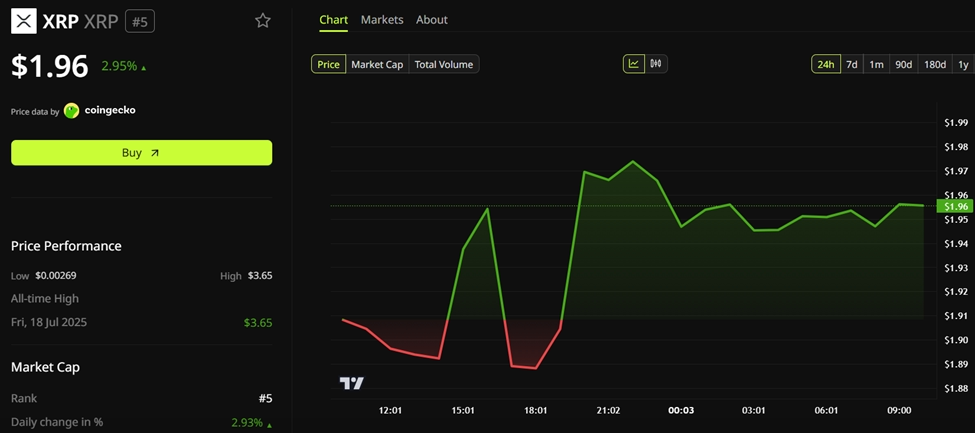
With XRP hovering just below $2, technical analysts are watching closely to see whether the rally can sustain momentum. A decisive break above the level could trigger renewed retail interest, especially if institutional headlines continue to stack up.
“The price action reflects belief in Ripple’s enterprise strategy,” said a crypto market strategist. “Deals like Ripple dxc technology reinforce the idea that XRP is tied to actual infrastructure adoption, not speculation alone.”
Ultimately, the Ripple dxc technology partnership underscores Ripple’s bet that the future of blockchain adoption lies inside regulated financial institutions, not outside them.
By aligning with established providers like DXC, Ripple is positioning itself as a bridge between legacy banking systems and digital assets a role few crypto-native firms have managed to secure at scale.
As XRP tests the $2 mark and banks explore new digital capabilities, the Ripple dxc technology alliance may prove to be one of the most consequential enterprise blockchain deals of the year.



Copyright © 2025 - The Bit Gazette.


