





- Trending
- Comments
- Latest

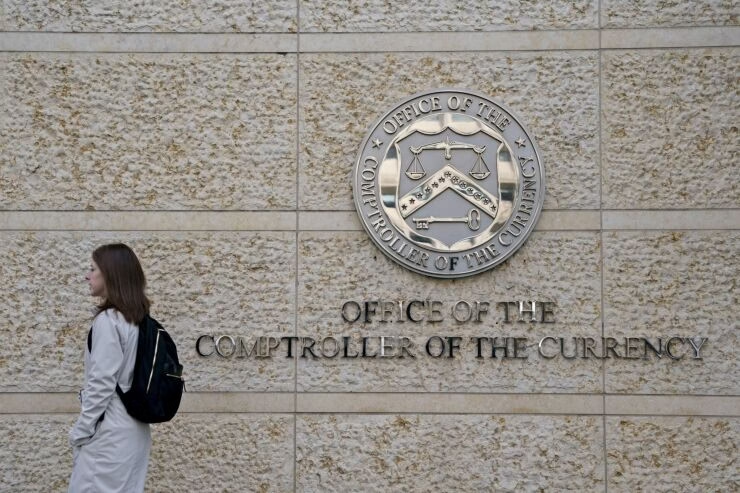
The Office of the Comptroller of the Currency authorized national banks to facilitate cryptocurrency transactions for clients without holding digital assets on their balance sheets, the agency announced in a new interpretive letter.
Under the guidance issued this week, banks can execute “riskless principal” trades—simultaneously buying crypto from one client and selling to another—allowing them to act as intermediaries while avoiding direct market exposure.
The OCC’s move marks one of its most aggressive steps yet in integrating crypto into the banking sector.
For the first time, Riskless Crypto Trading gives regulated financial institutions the authority to act as crypto intermediaries—similar to their traditional brokerage functions in securities and derivatives markets.
“Banks have always acted as financial intermediaries. Extending that framework to digital assets is both logical and necessary for innovation,” said Adam Cohen, Senior Deputy Comptroller at the OCC.
Cohen emphasized that Riskless Crypto Trading aligns with established banking practices, allowing lenders to facilitate digital asset transactions while maintaining minimal settlement and credit risks.
This isn’t about speculation, Cohen added. It’s about enabling banks to serve customers safely in emerging markets while maintaining sound risk management.
Under the new guidance, banks can execute Riskless Crypto Trading across a wide range of crypto-assets, not just those classified as securities.
The OCC highlighted that distributed ledger technology (DLT) simply modernizes traditional settlement processes, equating blockchain-based ledgers with existing book-entry systems.
Cohen clarified, “Blockchain is just the next evolution of recordkeeping—transparent, efficient, and verifiable. Banks already handle equivalent complexities daily through electronic clearing systems.”
To mitigate risks, the OCC requires participating banks to enforce KYC/AML protocols, monitor transactions, and maintain the capability to freeze or reverse transfers—features supported by compliant blockchains such as Stellar and Hyperledger.
By enabling Riskless Crypto Trading, banks gain a competitive edge over fintech rivals and crypto-native platforms, many of which lack federal oversight or deposit insurance protections.
Analysts say the decision will likely trigger a surge of institutional activity in regulated crypto markets.
Several major banks are already positioning for crypto integration. JPMorgan recently enabled customers to fund Coinbase accounts directly through Chase cards, while Bank of America has authorized advisors to recommend Bitcoin ETFs to eligible clients.
This development could catalyze the next phase of institutional adoption, noted Michael Sonnenshein, CEO of Grayscale Investments. With the OCC backing Riskless Crypto Trading, banks now have a compliant bridge into digital asset markets—something institutional investors have long demanded.
The policy shift complements parallel efforts across federal agencies. The FDIC and Federal Reserve are coordinating on stablecoin and tokenized deposit frameworks under the GENIUS Act, aiming to anchor blockchain assets to traditional finance.
Michelle Bowman, Vice Chair of the Federal Reserve, confirmed that agencies are actively building interoperability standards that ensure stability while promoting responsible innovation.
As regulatory frameworks converge, Riskless Crypto Trading could redefine how banks engage with crypto liquidity, settlement, and custody services.
The OCC’s stance signals growing confidence that blockchain technologies can coexist within the safety nets of U.S. banking regulation.
This decision closes the gap between the crypto economy and the financial system, said Sheila Warren, CEO of the Crypto Council for Innovation. “It’s a signal that digital assets are moving from the periphery into the heart of regulated finance.
With Riskless Crypto Trading, national banks are no longer spectators—they’re active participants in shaping the future of digital finance.



Copyright © 2025 - The Bit Gazette.