





- Trending
- Comments
- Latest

Solana co-founder Anatoly Yakovenko has publicly argued that Solana is now more decentralized than Ethereum and may rival Bitcoin in structural resilience — a claim that has reignited one of crypto’s most contested benchmarking arguments.
The comments, shared on social media and widely circulated across the crypto sector, have renewed scrutiny over how decentralization is defined and measured among leading blockchain networks.
Yakovenko framed his argument around the principles associated with Satoshi Nakamoto, referencing the original decentralization ethos that underpinned Bitcoin’s creation. His remarks have fueled discussion over validator distribution, hardware accessibility, and proof-of-stake mechanics—core elements at the center of the ongoing Solana decentralization debate.
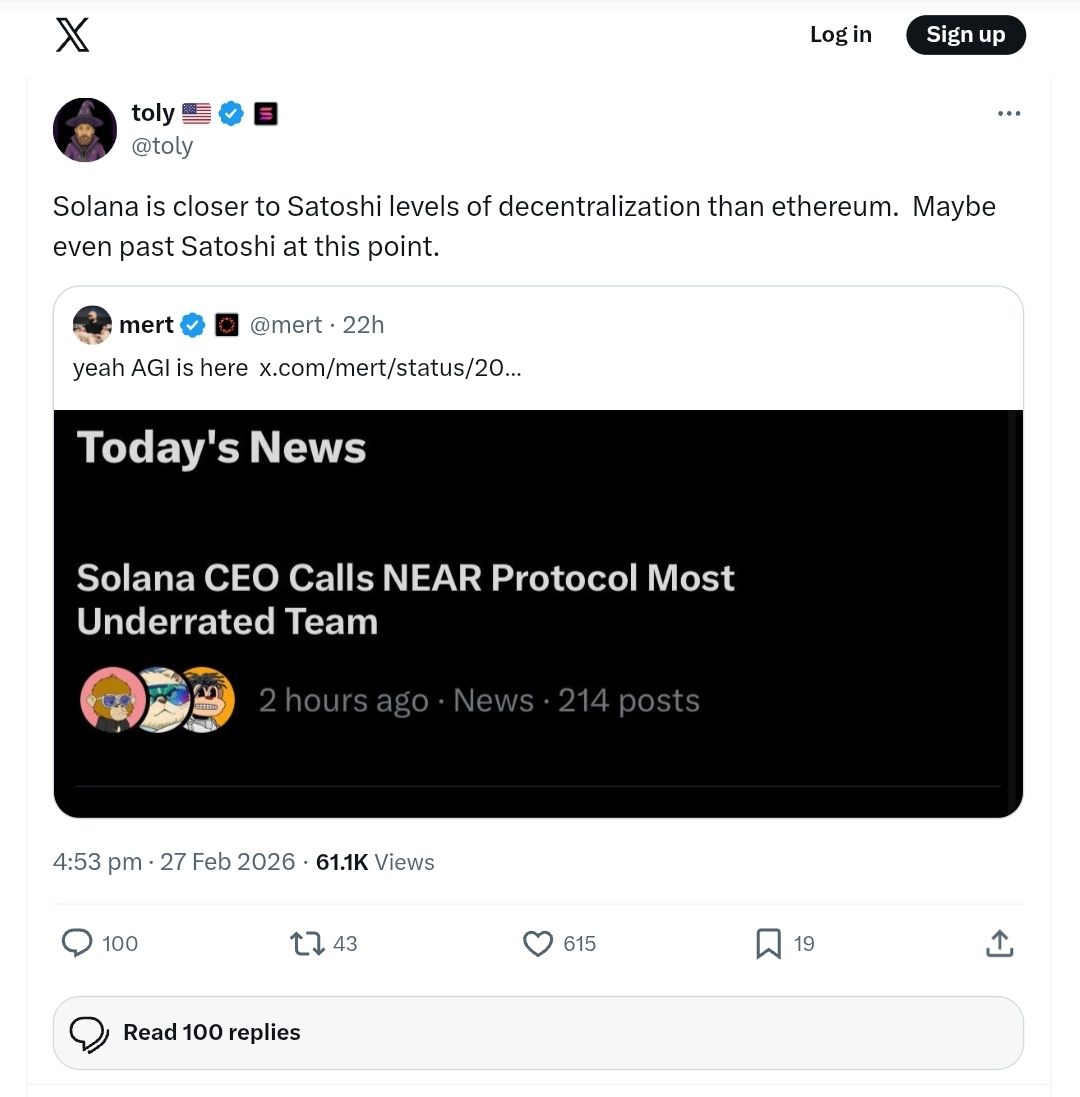
At the heart of the Solana decentralization debate is Yakovenko’s assertion that Solana’s architecture aligns more closely with Satoshi’s original decentralization vision than Ethereum’s current validator structure.
“Solana now stands ahead of Ethereum in distributed design and may even rival Bitcoin in structural resilience,” — Anatoly Yakovenko, Co-Founder, Solana.
According to Yakovenko, Solana’s design enables broader participation across the network stack. He suggested that decentralization should be evaluated not only by validator counts or token ownership distribution but also by open verification capabilities and system architecture.
“Solana’s architecture brings it closer to Satoshi’s original decentralization vision than Ethereum’s current validator model,” — Anatoly Yakovenko, Co-Founder, Solana.
By referencing Satoshi’s foundational principles, Yakovenko shifted the Solana decentralization debate toward philosophical benchmarks rather than purely quantitative metrics. His position implies that structural design choices may outweigh token concentration concerns in assessing long-term decentralization.
A key dimension of the Solana decentralization debate centers on hardware requirements and accessibility. Historically, critics have argued that running a Solana validator requires substantial computing resources, potentially limiting participation compared to other networks.
Yakovenko pushed back against those claims, emphasizing that individuals can operate a Solana node using a standard laptop. He also pointed to the availability of light clients and non-voting nodes, which allow users to independently verify ledger data without maintaining industrial-scale infrastructure.
Consequently, he framed decentralization as a matter of permissionless verification rather than raw validator count. In earlier remarks made in late 2025, Yakovenko argued that decentralization does not depend solely on token distribution patterns within proof-of-stake systems.
“Any properly constructed proof-of-stake network achieves sufficient decentralization regardless of stake ownership concentration,” — Anatoly Yakovenko, Co-Founder, Solana.
He further stated last August that a permissionless full node enables participation across the stack without exposing users to the risk of fund seizure. These comments have been widely cited in the Solana decentralization debate as a structural defense of the network’s design philosophy.
Despite Yakovenko’s confidence, the Solana decentralization debate remains far from settled. Solana has previously faced scrutiny over network outages and technical disruptions, events that critics argue undermine claims of resilience and distributed control.
Skeptics continue to measure decentralization using a combination of uptime history, validator diversity, governance transparency, and token concentration metrics. Ethereum proponents, in particular, highlight the breadth of its validator base and the distributed nature of its global node operators as indicators of robustness.
Supporters of Solana, however, view Yakovenko’s remarks as evidence that the network has matured beyond earlier reliability concerns. They argue that architectural improvements and broader participation tools strengthen Solana’s decentralization profile over time.
The broader Solana decentralization debate reflects a larger industry tension: whether decentralization should be defined by infrastructure accessibility, token distribution, governance structure, or network performance history. As blockchain ecosystems evolve, those benchmarks remain contested.
With competition intensifying among leading smart contract platforms, the Solana decentralization debate is likely to persist, shaping investor perception and developer alignment across the crypto landscape.



Copyright © 2025 - The Bit Gazette.

