

• Trending
  • Comments
  • Latest
AI People joins Dubai’s innovation one — Declares war on the forgetting of humanity

AI People joins Dubai’s Innovation One program: Declares war on the forgetting of humanity

07/22/2025 - Updated On 07/23/2025
FBI nabs Nigerian ‘tech queen’ Sapphire Egemasi in multi-million dollar fraud scheme

FBI arrests Nigerian ‘tech queen’ Sapphire Egemasi in $1.3M heist targeting U.S. government

06/05/2025 - Updated On 06/17/2025
Crypto investor and wife found dead in Dubai as police investigate possible link to digital assets

Crypto investor and wife found dead in Dubai as police investigate possible link to digital assets

11/08/2025
Polygon Discord Channel Hacked, Throws Crypto Community in Turmoil

Polygon Discord Channel Hacked, Throws Crypto Community in Turmoil

2
Bitcoin reclaims $107,000 as Iran-Israel ceasefire cools market tensions

Bitcoin reclaims $107,000 as Iran-Israel ceasefire cools market tensions

2

Hello world!

1
Staking vs lending in crypto: what's the difference and which is safer?

Staking vs lending in crypto: what’s the difference and which is safer?

01/28/2026
UK-based crypto entrepreneur

UK regulator approves first retail crypto staking ETPs as Valour launches on LSE

01/28/2026
ERC-20 stablecoins

ERC-20 stablecoins market cap falls $7 billion in first major drawdown since 2025

01/28/2026
  • Trending
  • Comments
  • Latest
AI People joins Dubai’s innovation one — Declares war on the forgetting of humanity

AI People joins Dubai’s Innovation One program: Declares war on the forgetting of humanity

07/22/2025 - Updated On 07/23/2025
FBI nabs Nigerian ‘tech queen’ Sapphire Egemasi in multi-million dollar fraud scheme

FBI arrests Nigerian ‘tech queen’ Sapphire Egemasi in $1.3M heist targeting U.S. government

06/05/2025 - Updated On 06/17/2025
Crypto investor and wife found dead in Dubai as police investigate possible link to digital assets

Crypto investor and wife found dead in Dubai as police investigate possible link to digital assets

11/08/2025
Polygon Discord Channel Hacked, Throws Crypto Community in Turmoil

Polygon Discord Channel Hacked, Throws Crypto Community in Turmoil

2
Bitcoin reclaims $107,000 as Iran-Israel ceasefire cools market tensions

Bitcoin reclaims $107,000 as Iran-Israel ceasefire cools market tensions

2

Hello world!

1
Staking vs lending in crypto: what's the difference and which is safer?

Staking vs lending in crypto: what’s the difference and which is safer?

01/28/2026
UK-based crypto entrepreneur

UK regulator approves first retail crypto staking ETPs as Valour launches on LSE

01/28/2026
ERC-20 stablecoins

ERC-20 stablecoins market cap falls $7 billion in first major drawdown since 2025

01/28/2026
Wednesday, January 28, 2026
  • Login
The Bit Gazette
  • Home
  • Crypto News
  • Expert Analysis
  • Finance
  • Tech
  • Sponsored
  • Press Release
  • Opinion
No Result
View All Result
The Bit Gazette
No Result
View All Result
Home Crypto Explained

Staking vs lending in crypto: what’s the difference and which is safer?

Most crypto exchanges use "staking" to describe any yield product—but if you're earning 8% on USDT, you're actually lending, not staking. The difference matters because the risks are completely different.

by Ayuba Haruna
17 minutes ago
in Crypto Explained
Reading Time: 5 mins read
0
Staking vs lending in crypto: what's the difference and which is safer?

Staking vs lending in crypto: what's the difference and which is safer?

Share on FacebookShare on Twitter

In crypto, words have specific technical meanings, until marketing departments get hold of them. The biggest casualty of this trend is the word “staking.”

Open almost any exchange app, and you’ll see a button that says “Stake your USDT for 8% APY.”

Here’s the problem: You cannot stake USDT. It is technically impossible.

What you’re actually doing is lending. While both earn you passive yield, the mechanics, and critically, the risks are completely different.

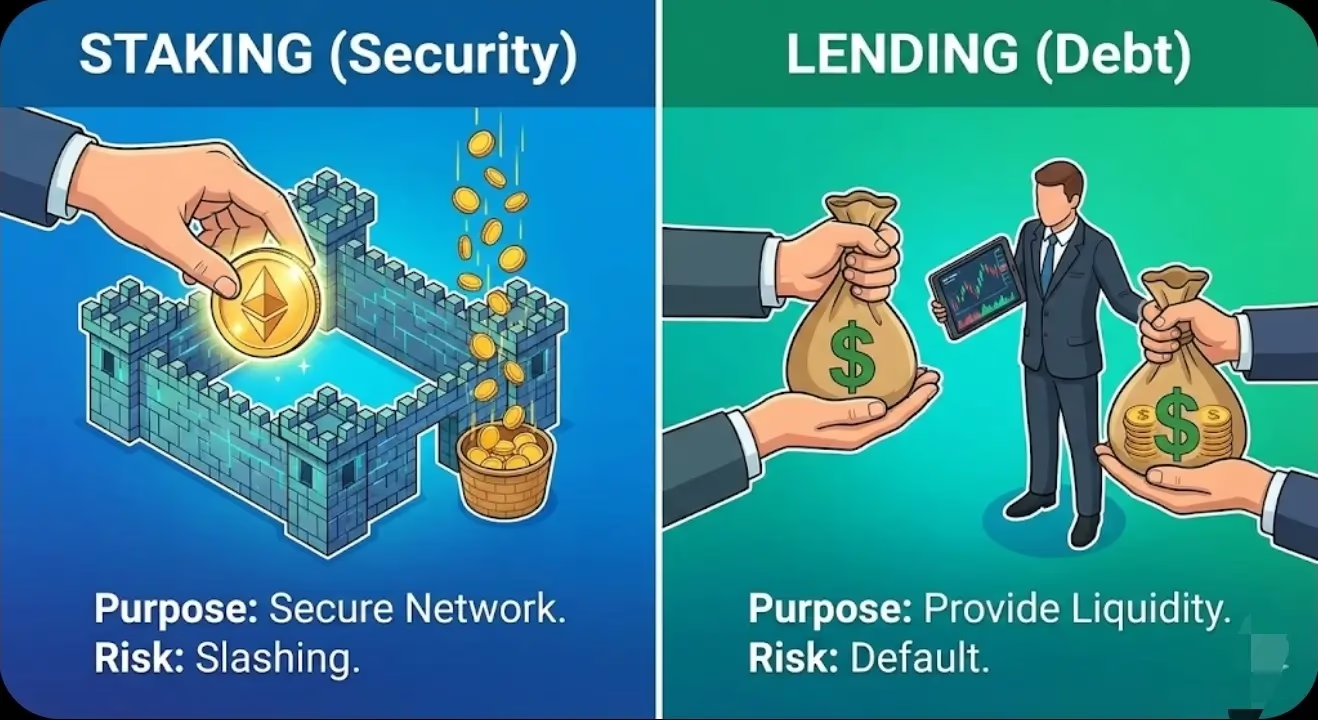
What is staking?

True staking is a technical contribution to the security of a blockchain.

How it works: You lock up a native asset (like Ethereum, Solana, or Cardano) to a validator node. This acts as a “security deposit” that helps the network approve transactions.

Where yield comes from: The network pays you newly created coins (protocol inflation) and transaction fees for securing the system.

The risk: Slashing. If your validator misbehaves or goes offline, the network can penalize your deposit, you lose a portion of your principal.

Key constraint: You can only stake Proof-of-Stake assets. You cannot stake Bitcoin (Proof-of-Work) or stablecoins (no blockchain to secure).

Example: When you stake ETH, you’re securing Ethereum’s network. If your validator approves fraudulent transactions, the protocol can slash 0.5-1 ETH (or more for serious violations). Current ETH staking APY: ~3-4%.

What is lending?

Lending is exactly what it sounds like: you’re acting as a bank.

How it works: You deposit assets (USDC, USDT, BTC) into a pool like Aave or give them to a platform like Kraken. They lend those funds to borrowers, usually traders seeking leverage.

Where yield comes from: Borrowers pay interest. That interest is passed to you.

The risk: Counterparty and credit risk. If borrowers default and liquidations fail, or if the platform gets hacked or goes insolvent, your money is gone.

Key feature: You can lend almost anything, including stablecoins and Bitcoin.

Example: When you deposit USDC into Aave, traders borrow it for leverage. If markets crash faster than the liquidation system can handle, you could face losses. Current Aave USDC APY: ~5-8%.

Simple analogy

Staking = Security guard

  • Paid (in new coins) to protect the building
  • Get fined if you fall asleep (slashing)
  • Predictable income from the protocol

Lending = Bank

  • Paid (in interest) by borrowers
  • Lose money if they don’t repay
  • Income depends on borrower demand

Why the confusion exists

Exchanges call everything “staking” because it sounds safer and more legitimate than “lending.”

“Lending” reminds users of credit risk and platform failures like Celsius and BlockFi, which collapsed in 2022 and wiped out billions in user funds, funds marketed as “staking” or “earn” programs.

By grouping all yield products under “Staking” or “Earn,” platforms simplify their interface but obscure fundamental risk differences.

Comparison at a glance

Feature Staking Lending
Purpose Securing blockchain Providing borrower liquidity
Yield Source Protocol inflation + fees Borrower interest payments
Assets Only PoS coins (ETH, SOL) Any asset (USDT, BTC, etc.)
Main Risk Slashing penalties Defaults, platform insolvency
Typical APY 3-7% 5-15%
Withdrawal 1-21 days (unbonding) Often instant or same-day

The litmus test

You ARE staking if:

  • You hold a PoS coin (ETH, SOL, ADA)
  • There’s an unbonding period (days to weeks)
  • Platform mentions validators or slashing
  • APY is modest (2-7%)

You’re NOT staking (you’re lending) if:

  • You deposited stablecoins or Bitcoin
  • Withdrawal is instant
  • APY is 10%+
  • No mention of validators or slashing

Quick rule: Earning yield on USDT, USDC, or BTC? You’re lending.

Common questions

Which is more profitable?

Lending typically offers higher yields (5-15%) because it carries more risk. Staking yields are lower (3-7%) but more predictable.

Can I lose everything?

With custodial platforms (exchange holds your keys), yes, if they go bankrupt like Celsius or FTX. With self-custodial staking/DeFi, you face technical risks (bugs, slashing) but not platform bankruptcy.

Which is safer?

Neither is “safe.” Staking has protocol-level risks (slashing, usually <1% losses). Lending has counterparty risks (defaults, hacks, insolvency, potentially 100% loss).

What about liquid staking tokens?

Products like Lido’s stETH let you stake ETH while maintaining liquidity. You can then lend these tokens, combining both risk profiles.

The bottom line

When you click “Stake USDT” and earn 8%, you’re lending to borrowers and taking on credit risk.

When you stake ETH to run a validator, you’re securing the network and risking slashing penalties.

Both are legitimate ways to earn passive income. Both carry risk. The problem is platforms using the same word for fundamentally different activities.

Understanding the difference is the first step to managing your risk appropriately.

Tags: aavecrypto staking explainedcrypto yieldDeFi Lendingproof-of-stakeRisk Managementstablecoinsstaking vs lending
Share196Tweet123
Ayuba Haruna

Ayuba Haruna

Ayuba Haruna is a crypto and finance writer, and also an editor with over 5 years experience. He specializes in regulatory enforcement, DeFi protocols, and market analysis, delivering rigorous, well-sourced journalism. His editorial philosophy: let the facts speak for themselves. Specific figures, named sources, and balanced perspectives over sensationalism. When he's not editing breaking news, Ayuba enjoys watching films.

  • Trending
  • Comments
  • Latest
AI People joins Dubai’s innovation one — Declares war on the forgetting of humanity

AI People joins Dubai’s Innovation One program: Declares war on the forgetting of humanity

07/22/2025 - Updated On 07/23/2025
FBI nabs Nigerian ‘tech queen’ Sapphire Egemasi in multi-million dollar fraud scheme

FBI arrests Nigerian ‘tech queen’ Sapphire Egemasi in $1.3M heist targeting U.S. government

06/05/2025 - Updated On 06/17/2025
Crypto investor and wife found dead in Dubai as police investigate possible link to digital assets

Crypto investor and wife found dead in Dubai as police investigate possible link to digital assets

11/08/2025
Polygon Discord Channel Hacked, Throws Crypto Community in Turmoil

Polygon Discord Channel Hacked, Throws Crypto Community in Turmoil

2
Bitcoin reclaims $107,000 as Iran-Israel ceasefire cools market tensions

Bitcoin reclaims $107,000 as Iran-Israel ceasefire cools market tensions

2

Hello world!

1
Staking vs lending in crypto: what's the difference and which is safer?

Staking vs lending in crypto: what’s the difference and which is safer?

01/28/2026
UK-based crypto entrepreneur

UK regulator approves first retail crypto staking ETPs as Valour launches on LSE

01/28/2026
ERC-20 stablecoins

ERC-20 stablecoins market cap falls $7 billion in first major drawdown since 2025

01/28/2026
No Result
View All Result
  • Home
  • Crypto News
  • Expert Analysis
  • Finance
  • Tech
  • Sponsored
  • Press Release
  • Opinion

Copyright © 2025 - The Bit Gazette.

Are you sure want to unlock this post?
Unlock left : 0
Are you sure want to cancel subscription?