




Tag: EL Salvador

  • Bitcoin approaches $83,800 support as ARK Invest and El Salvador buy $110 million

    Bitcoin approaches $83,800 support as ARK Invest and El Salvador buy $110 million

    Bitcoin traded near $91,000 Tuesday as a bearish ABCD harmonic pattern targets the $83,800 level, even as ARK Invest and El Salvador deployed a combined $110 million into cryptocurrency assets.

    Cathie Wood’s ARK Invest purchased $10.2 million in shares of crypto exchange Bullish on Monday, while El Salvador added 1,090 bitcoin worth approximately $100 million to its national holdings, defying previous commitments to the International Monetary Fund to limit purchases.

    The institutional and sovereign buying occurred as bitcoin declined from above $126,000 in early October to current levels, erasing approximately $600 billion in market capitalization.

    ARK buys during crypto stock selloff

    ARK Invest acquired $10.2 million in Bullish shares across its flagship ETFs—ARKK, ARKW, and ARKF—as crypto-linked stocks declined. Bullish stock fell 4.5% to $36.75 on Monday, extending a six-month decline of nearly 46%.

    The purchase came one day before Bullish’s third-quarter earnings report. The timing signals confidence in a potential recovery despite short-term sector volatility, according to market observers.

    El Salvador defies IMF guidance with $100 million purchase

    El Salvador purchased 1,090 bitcoin worth more than $100 million, raising its holdings to over 7,474 BTC from 5,968 BTC in December 2024, according to government data.

    The acquisition contradicts El Salvador’s $1.4 billion loan agreement with the IMF, which included restrictions on bitcoin purchases. The IMF had claimed earlier this year that El Salvador had not purchased additional bitcoin since the loan arrangement was finalized.

    The IMF previously requested that El Salvador reduce risks by limiting bitcoin publicity and minimizing the public sector’s involvement in the Chivo wallet. The recent large-scale purchase raises questions about the country’s compliance with the agreement terms.

    Technical pattern points to $83,800 demand zone

    Bitcoin remains under selling pressure as a bearish ABCD harmonic pattern unfolds on the daily chart, targeting potential completion near $83,800—a demand zone that previously triggered rebounds in early 2024.

    Bitcoin approaches $83,800 support as ARK Invest and El Salvador buy $110 million
    Bitcoin Price Chart – Source: Tradingview

    The pattern’s “AB” leg declined from $115,200 to $99,000, mirroring the ongoing “CD” leg and suggesting downside momentum may near exhaustion. The 20-day exponential moving average crossing below the 50-day EMA confirms short-term bearish control, while the relative strength index hovering around 30 indicates oversold conditions.

    Candlestick patterns show long lower wicks, suggesting buyers are entering near support levels. If the $83,800 zone holds, a rebound toward $96,000 and potentially $99,000 could follow, with the broken trendline acting as resistance.

    Failure to maintain support above $83,000 would expose bitcoin to deeper declines toward $74,500, aligning with the lower boundary of the broader accumulation range, according to technical analysis.

    For traders, confirmation through a bullish engulfing or hammer candlestick pattern at the demand zone could signal a turning point. Despite current weakness, bitcoin’s structure supports potential recovery heading into 2026, with the ABCD pattern potentially marking the final leg of this correction before the next upward phase.

  • MicroStrategy’s 640,031 Bitcoin now valued at $77.4B as price recovers to $120K

    MicroStrategy’s 640,031 Bitcoin now valued at $77.4B as price recovers to $120K

    Michael Saylor’s digital asset treasury firm, Strategy Inc., has reached a new all-time high in its crypto reserves, with its Bitcoin holdings now valued at $77.4 billion. The milestone comes as Bitcoin prices climbed back to $120,000 this week, fueling renewed interest in the scale of Strategy Bitcoin holdings.

    “Our journey began with $0.25 billion in Bitcoin — and an immediate $0.04 billion unrealized loss,” — Michael Saylor, CEO, Strategy Inc.

    Despite Bitcoin still being 3% below its August peak, Strategy’s aggressive accumulation of 11,085 BTC over the last seven weeks has propelled its balance sheet to historic levels. The most recent purchase of 196 BTC was made on Monday, demonstrating the company’s continued conviction.

    Source: Michael Saylor

    Bigger than banks and nations

    At $77.4 billion, Strategy Bitcoin holdings now surpass the market capitalization of established banks including Barclays, Deutsche Bank, BNY Mellon, and ING. The scale of the holdings also places Strategy in rare company, with a reserve comparable to the gross domestic product (GDP) of mid-sized nations such as Uruguay, Sri Lanka, and Slovenia.

    The firm currently holds 640,031 BTC — equivalent to 3.2% of Bitcoin’s circulating supply. This far outpaces the next-largest corporate holder, MARA Holdings, which owns 52,477 BTC valued at approximately $6.3 billion.

    “With $77 billion worth of Bitcoin, you could buy 2,566,667 cars at $30,000 each or 385,000 houses at $200,000 each,” noted Saylor, underlining the scale of Strategy Bitcoin holdings in relatable terms.

    Comparison with nation-state reserves

    While Strategy leads the corporate space, the largest nation-state reserve remains with El Salvador, whose Bitcoin holdings currently stand at 6,338 BTC, worth about $762.5 million. According to the El Salvador Bitcoin Office, this is slightly below its August peak of $770 million.

    The Central American nation has maintained a slower accumulation pace, reportedly adding one Bitcoin per day; though the consistency of its strategy is still debated within crypto policy circles. By contrast, Strategy Bitcoin holdings represent nearly half of all Bitcoin treasuries combined across public and private entities.

    Dominating corporate treasuries

    According to BitcoinTreasuries.NET, the total Bitcoin held by public and private companies is around 1.32 million BTC, valued at $159 billion. Of this, Strategy alone controls an extraordinary 48%.

    The dominance of Strategy Bitcoin holdings underscores its influence within the digital asset treasury (DAT) space, where only 266 public and private firms are actively engaged in large-scale accumulation. This concentration raises questions about the decentralization of Bitcoin reserves and their potential impact on market liquidity.

    Saylor, however, frames the achievement as validation of long-term conviction. “It’s about time to bring traditional finance and Bitcoin together,” he has repeatedly emphasized, pointing to Bitcoin’s role as both an asset and a strategic reserve.

    The broader implications

    The record valuation of Strategy Bitcoin holdings not only reflects bullish market conditions but also signals how digital asset treasuries are challenging conventional financial metrics. For crypto investors, the comparison with banks and sovereign economies highlights Bitcoin’s growing integration into institutional and macroeconomic narratives.

    As Bitcoin hovers near $120,000, Strategy’s positioning places it as the clear leader in corporate adoption — a move likely to influence both competitors and policy discussions around digital assets worldwide.

  • El Salvador total BTC holding surpasses $700 million amid IMF scrutiny

    El Salvador total BTC holding surpasses $700 million amid IMF scrutiny

    El Salvador has expanded its cryptocurrency reserves, with the government confirming the El Salvador total BTC holding now stands at 6,313.18 BTC. The latest addition came through a 21 BTC purchase executed on Sept. 7, a date celebrated locally as Bitcoin Day.

    Based on current market prices, the stash is valued at just over $700 million, according to figures released by the country’s Bitcoin Office, the administrative unit responsible for managing digital assets.

    Source: X [formerly twitter]
    Unlike the daily one-Bitcoin purchase policy adopted after the passage of the 2021 Bitcoin Law, the recent buy carried symbolic weight which is a nod to Bitcoin’s fixed supply of 21 million coins. Officials described the move as a reaffirmation of national commitment to the project despite economic and political pressures.

    “Even with fiscal headwinds, El Salvador continues to signal its intent to align policy with Bitcoin’s principles,” — Jaime Rodríguez, a blockchain policy analyst at the Latin American Finance Observatory, told Bloomberg.

    Four years into a high-risk experiment

    The El Salvador total BTC holding milestone comes four years after President Nayib Bukele pushed through legislation making Bitcoin legal tender. The move marked a historic first in global finance, but it has faced sharp criticism from economists who argue that the country is overly exposed to cryptocurrency volatility.

    The International Monetary Fund (IMF) has been among the most vocal critics. Since 2021, the Fund has warned that adopting Bitcoin as legal tender could complicate monetary policy and undermine financial stability. Those warnings materialized into concrete conditions in 2025, when El Salvador sought a $1.4 billion loan package.

    As part of the IMF agreement, the government scaled back its public-facing Bitcoin ambitions, halting state-run wallet operations and repealing the mandate requiring merchants to accept Bitcoin. Officially, the state also committed to suspending fresh Bitcoin acquisitions.

    Yet controversy persists. A July IMF review alleged that the El Salvador total BTC holding had not materially changed since February 2025, suggesting that some reported acquisitions were internal wallet transfers rather than genuine market purchases. The Bitcoin Office has rejected those claims, insisting that every announced transaction reflects real accumulation.

    Renewed push on education and regulation

    Despite IMF conditions, El Salvador has sought to strengthen its domestic crypto ecosystem. In early September, officials announced that nearly 80,000 public servants had received Bitcoin certifications, part of broader training initiatives tied to digital finance and artificial intelligence.

    Last month, lawmakers passed the Investment Banking Law, enabling select investment banks to operate as licensed Bitcoin service providers under the supervision of the Central Reserve Bank (BCR) and the Superintendency of the Financial System (SSF).

    Government representatives say the aim is to integrate digital assets more securely into the financial system.

    “We are building frameworks that allow responsible Bitcoin adoption without compromising financial oversight,” — María Luisa Hayem, El Salvador’s Minister of Economy, told El Mundo.

    Such steps suggest the administration remains committed to keeping Bitcoin central to its policy platform, even if headline purchases are scaled back.

    Global attention and investor outlook

    The El Salvador total BTC holding has also attracted attention abroad. Countries such as Pakistan and Bolivia have reportedly consulted Salvadoran officials about designing their own Bitcoin strategies. For some observers, this underscores how even a small economy can influence international debates on digital asset adoption.

    For investors, the nation’s holdings serve as a high-profile case study in sovereign crypto exposure. While critics highlight governance challenges and macroeconomic risks, supporters argue that El Salvador is pioneering a model of national-level Bitcoin integration.

    “With Bitcoin trading above $110,000, the government’s 6,313 BTC stash represents one of the largest sovereign-level digital reserves in the world,” — Diego Castaño, Senior Researcher at Coin Metrics, said. “The real test will be whether this bet remains politically and fiscally sustainable.”

    As markets watch closely, the El Salvador total BTC holding remains both a financial experiment and a political statement. Its trajectory could shape how other emerging economies approach Bitcoin in the years ahead.

  • El Salvador splits $4.9B Bitcoin reserve into 14 wallets amid rising security risks

    El Salvador splits $4.9B Bitcoin reserve into 14 wallets amid rising security risks

    El Salvador has moved to restructure its national reserves by redistributing its Bitcoin into 14 new wallets, a decision that reshapes the way El Salvador Bitcoin holdings are secured. The announcement was made Friday by the country’s official Bitcoin Office through a post on X, formerly Twitter.

    According to the office, the redistribution aims to minimize potential exposure to quantum computing threats in the long term. The country had previously stored its 6,274 BTC — currently valued at about $678 million — in a single wallet for transparency purposes. Now, with funds spread across multiple addresses, each holding roughly 500 BTC, officials say the risk of a large-scale breach is reduced.

    “Once funds are spent from an address, its public keys are revealed and vulnerable. By splitting funds into smaller amounts, the impact of a potential quantum attack is minimized,” — Bitcoin Office of El Salvador, in a statement on X.

    Source: X @thebitcoinoffice
    Source: X @thebitcoinoffice

    Quantum threat prompts precautionary move

    At the core of El Salvador’s move is the growing debate around whether future quantum computers could crack Bitcoin’s elliptic curve cryptography (ECC). In theory, quantum machines running Shor’s algorithm could reverse-engineer private keys from exposed public keys, enabling attackers to redirect funds.

    The Bitcoin Office explained that “when a Bitcoin transaction is signed and broadcast, the public key becomes visible on the blockchain, potentially exposing the address to quantum attacks.” Splitting the reserves, therefore, is a way to limit potential exposure.

    However, most experts argue that such concerns remain theoretical. A recent report by quantum research firm Project Eleven noted that no quantum computer has managed to crack even a 3-bit key using Shor’s algorithm, far short of Bitcoin’s 256-bit encryption standard. The report estimated that more than 6 million BTC — valued at around $650 billion — could theoretically be at risk if such breakthroughs ever materialized.

    Experts downplay immediate risks

    Despite the cautious move, many within the crypto industry believe El Salvador Bitcoin holdings face no immediate quantum danger. Michael Saylor, co-founder of MicroStrategy and one of Bitcoin’s most vocal advocates, described the fears as overblown.

    “The quantum computing threat to Bitcoin is mere hype. If it ever became a genuine concern, the answer is simple: network hardware and software upgrades, just like Microsoft, Google, or the U.S. government do,” — Michael Saylor, Executive Chairman, MicroStrategy, in a June interview.

    Other experts share the same view, pointing out that Bitcoin’s open-source nature ensures that upgrades could be rapidly implemented if required. As a result, El Salvador Bitcoin holdings remain secure under current global technological conditions.

    Balancing transparency and security

    By diversifying its reserves, the Salvadoran government faces the challenge of maintaining the same level of transparency that came with a single wallet. To address this, officials confirmed they will continue to use a public dashboard managed by the Bitcoin Office to monitor the new wallets.

    This approach ensures that the public and investors can track El Salvador Bitcoin holdings in real time, while also protecting against risks associated with repeatedly exposing the same public keys.

    The decision also underscores how the country is attempting to balance innovation with responsibility. Since adopting Bitcoin as legal tender in 2021, El Salvador has been under global scrutiny — especially from the International Monetary Fund (IMF).

    IMF pressure adds another layer of tension

    The redistribution of El Salvador Bitcoin holdings comes at a time of ongoing disputes with the IMF. In July, the organization published a report suggesting the country had not purchased any new Bitcoin since February, raising questions about the government’s transparency.

    El Salvador previously secured a $1.4 billion funding arrangement with the IMF in December 2024, agreeing to scale back some of its Bitcoin-related initiatives. While the government accepted conditions allowing Bitcoin to remain legal tender, it resisted other measures viewed as restrictions on its digital currency strategy.

    For crypto investors, the redistribution of El Salvador Bitcoin holdings signals a dual strategy: proactive steps to address speculative risks while navigating the political and financial realities of international oversight.

    Implications for investors

    The move highlights broader questions about the security and future-proofing of state-level crypto reserves. While El Salvador Bitcoin holdings remain relatively small compared to the global market, the country’s policies serve as a test case for other governments considering similar strategies.

    If quantum threats remain a distant prospect, El Salvador’s decision could be viewed as an overcautious but instructive step. If, however, breakthroughs accelerate in quantum computing, the diversification of wallets may prove to be a model for safeguarding national digital assets.

    For now, investors can expect El Salvador Bitcoin holdings to remain a focal point in both global policy debates and discussions about the resilience of crypto infrastructure in an uncertain technological future.

  • Pakistan establishes diplomatic ties with El Salvador, 1st to adopt Bitcoin as legal tender

    Pakistan establishes diplomatic ties with El Salvador, 1st to adopt Bitcoin as legal tender

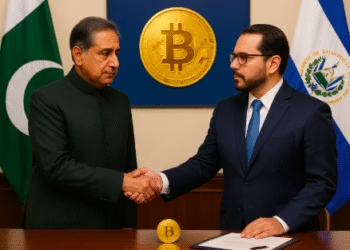
    Pakistan and El Salvador have formed a new bilateral partnership centered on cryptocurrency policy. Pakistan establishes diplomatic ties with El Salvador through a high-level meeting between Pakistan’s crypto envoy Bilal Bin Saqib and El Salvador’s President Nayib Bukele, focusing on shared strategies for Bitcoin adoption under IMF restrictions.

    The two nations—both operating under billion-dollar IMF bailout programs—view Bitcoin as a pathway to financial sovereignty despite institutional pushback.

    Why Bitcoin bonds these IMF-restricted economies

    Pakistan establishes diplomatic ties with El Salvador at a critical juncture. Both countries face IMF-imposed limits on crypto policies:

    • Pakistan secured a $7 billion IMF bailout in 2024 but now pushes for a strategic Bitcoin reserve and mining subsidies, drawing IMF scrutiny.

    • El Salvador, the first to adopt Bitcoin as legal tender, agreed to halt further BTC purchases under its $1.4 billion IMF deal.

    “This partnership is about sovereignty,” said Bilal Bin Saqib, CEO of the Pakistan Crypto Council. “Bitcoin lets us rewrite the rules of engagement with global finance.”

    El Salvador’s success with Bitcoin infrastructure, like its Chivo wallet and volcano-powered mining, offers Pakistan a blueprint.

    Pakistan establishes diplomatic ties with El Salvador as Bitcoin takes center stage
    Pakistan establishes diplomatic ties with El Salvador as Bitcoin takes center stage

    IMF’s shadow looms over crypto ambitions

    The collaboration defies pressure from the International Monetary Fund, which has warned both nations against crypto-related fiscal risks.

    When Pakistan establishes diplomatic ties with El Salvador, it gains access to Salvadoran expertise in navigating IMF pushback—a lifeline as Islamabad faces heat for its proposed crypto mining subsidies.

    “The IMF sees crypto as a threat to monetary control,” noted financial analyst Elena Tonoyan (Geopolitical Monitor). “But these countries are betting on Bitcoin to bypass dollar dependency.”

    Critics argue such moves could jeopardize IMF funding. Yet, with Pakistan eyeing mining-friendly policies and El Salvador holding 5,750 BTC ($350 million), their defiance signals a broader trend of crypto-driven economic nationalism.

    The U.S. factor: Trump’s influence on Pakistan’s crypto pivot

    Pakistan establishes diplomatic ties with El Salvador as part of a wider strategy influenced by global shifts. The country’s proposed “Bitcoin Reserve” mirrors efforts by the U.S. under President Trump, who has endorsed crypto as a tool for economic dominance.

    “Pakistan won’t sit on the sidelines of the digital asset revolution,” Saqib stated, referencing Trump’s pro-crypto stance.

    Meanwhile, El Salvador’s Bukele—fresh from reelection—has doubled down on Bitcoin despite IMF warnings. His advice to Pakistan: “Innovation requires ignoring outdated institutions.”

    What’s next for the Bitcoin Alliance?

    As Pakistan establishes diplomatic ties with El Salvador, observers watch for:

    1. Joint crypto-mining ventures: Leveraging Pakistan’s surplus energy and El Salvador’s tech.

    2. Lobbying for IMF reforms: A unified front could pressure policy changes.

    3. Domestic backlash: Public skepticism persists in both nations over Bitcoin’s volatility.

    “This isn’t just about technology—it’s a challenge to the global financial order,” said Tonoyan.

    With the IMF unlikely to relent, the partnership tests whether Bitcoin can truly empower nations under economic strain.

  • El Salvador Bitcoin Holdings Grow by 162 BTC as Nation Deepens Ties with Crypto Market

    El Salvador Bitcoin Holdings Grow by 162 BTC as Nation Deepens Ties with Crypto Market

    El Salvador has expanded its Bitcoin holdings by an additional 162 BTC, continuing its strategy of daily purchases and deepening its ties to the cryptocurrency market. This growth in El Salvador Bitcoin Holdings show the nation’s ongoing commitment to Bitcoin, led by President Nayib Bukele, who has made integrating the cryptocurrency into El Salvador’s financial system a central goal. The increase in holdings further solidifies El Salvador’s position as a trailblazer in the crypto space, capturing global attention and highlighting the country’s ambition to leverage Bitcoin as a key component of its economic strategy.

    Daily Accumulation: A Strategic Move

    According to blockchain analytics firm Arkham Intelligence, the Salvadoran government has been steadily accumulating Bitcoin, purchasing one BTC every day since March 16, 2024. This steady accumulation strategy has bolstered El Salvador Bitcoin holdings, bringing the total to 5,851 BTC, currently valued at approximately $356.4 million.

    The growth of El Salvador Bitcoin holdings is a testament to Bukele’s unwavering belief in the cryptocurrency’s potential to transform the nation’s economy. “This daily acquisition underscores Bukele’s long-term vision for the country,” noted EmberCN, a prominent crypto analyst. “By consistently increasing the nation’s Bitcoin holdings, El Salvador is not only hedging against traditional financial instability but is also positioning itself as a key player in the global digital economy.”

    The Vision Behind the Purchases

    Bukele’s strategic approach to bolstering El Salvador Bitcoin holdings is rooted in his broader vision of financial independence and economic innovation. The initiative to make daily Bitcoin purchases, which began with a transfer of 5,689 BTC into a cold storage wallet on March 16, 2024, represents the country’s first official “Bitcoin piggy bank.”

    “This is more than just an investment; it’s a statement,” Bukele has previously declared. “El Salvador is charting its course toward economic sovereignty, and Bitcoin is the vessel that will take us there.”

    El Salvador Bitcoin Holdings
    El Salvador Bitcoin Holdings. Credit: Reuters

    This aggressive accumulation has drawn mixed reactions from the international community. Supporters of Bukele’s approach hail it as a visionary step toward financial autonomy, especially for a country that has historically struggled with economic instability. Detractors, however, caution against the risks of tying the nation’s economic future so closely to the volatile cryptocurrency market.

    Transparency and Global Implications

    In response to concerns about transparency and accountability, Bukele’s administration has taken steps to ensure that El Salvador Bitcoin holdings are open to public scrutiny. The government has implemented a mempool space, which allows for real-time public auditing of the nation’s Bitcoin reserves. This initiative is part of Bukele’s broader effort to demonstrate responsible stewardship of public funds and to build trust both domestically and internationally.

    “The introduction of public auditing mechanisms is a critical step in maintaining transparency,” stated Alejandro Zelaya, El Salvador’s Minister of Finance. “We want the world to see that our Bitcoin holdings are managed with the utmost integrity and accountability.”

    Beyond just purchasing Bitcoin, El Salvador has also ventured into Bitcoin mining, utilising the country’s abundant volcanic geothermal energy. Since 2021, this sustainable mining operation has yielded 474 BTC, valued at approximately $29 million. Although a smaller component of the country’s overall strategy, this eco-friendly approach to Bitcoin mining aligns with Bukele’s vision of leveraging El Salvador’s natural resources to support technological advancement.

    El Salvador Bitcoin Holdings Grow by 162 BTC as Nation Deepens Ties to Crypto Market
    El Salvador Bitcoin Holdings Grow by 162 BTC as Nation Deepens Ties to Crypto Market. Credit: Crypto News

    Bukele’s Continued Influence

    The expansion of El Salvador Bitcoin holdings comes at a time when President Bukele’s influence in the country is stronger than ever. Following a landslide victory in the February elections, Bukele was sworn in for another five-year term, solidifying his mandate to continue his crypto-centric policies.

    “The people of El Salvador have spoken, and they have chosen a path of innovation and progress,” Bukele stated in his victory speech. “Our commitment to expanding our Bitcoin holdings is a crucial part of this journey.”

    As El Salvador deepens its commitment to Bitcoin, the world watches closely. The country’s Bitcoin holdings are not just a financial strategy; they are a symbol of Bukele’s broader vision for a future where El Salvador stands at the forefront of the digital economy. With each new Bitcoin purchase, the country’s financial future becomes increasingly intertwined with the unpredictable, yet promising, crypto market.

    The evolution of El Salvador Bitcoin holdings will likely continue to be a topic of intense scrutiny and debate. Whether viewed as a daring leap into the future or a risky gamble on a volatile asset, one thing is certain: El Salvador’s journey with Bitcoin is far from over, and the world will be watching as this unique experiment unfolds.

    El Salvador’s decision to expand its Bitcoin holdings through daily purchases is a clear reflection of President Bukele’s ambitious vision for the nation. As the country’s Bitcoin holdings grow, so does its influence in the global crypto market, solidifying its role as a pioneer in the digital economy. The future of El Salvador’s Bitcoin experiment remains uncertain, but its impact on the global financial landscape is undeniable. The Bit Gazette has the latest crypto news and expert analysis.

  • El Salvador Bitcoin City Project Secures $1.6 Billion Investment from Yilport Holding

    El Salvador Bitcoin City Project Secures $1.6 Billion Investment from Yilport Holding

    El Salvador Bitcoin City project has taken a significant step forward with a $1.6 billion investment from Yilport Holding, a subsidiary of the Turkish conglomerate Yildirim Group. This investment marks the largest private capital infusion in El Salvador’s history, signaling a pivotal moment in President Nayib Bukele’s plan to transform the nation into a global cryptocurrency hub. The strategic partnership will not only modernize two critical seaports but also lay the groundwork for the much-anticipated Bitcoin City.

    A Historic Investment and Its Implications

    President Bukele announced the partnership on his social media platform X (formerly known as Twitter), highlighting the importance of Yilport Holding’s investment. According to Stacy Herbert, Director of El Salvador’s Bitcoin Office, this landmark agreement is the culmination of President Bukele’s 2022 visit to Turkey, where discussions around economic collaboration first began. This investment is a testament to El Salvador’s growing appeal to international investors, particularly in the realm of cryptocurrency.

    Yilport Holding, established in 2011 to consolidate Yildirim Group’s port and container terminal operations, has been expanding its reach into Latin America since 2016. With this investment, Yilport aims to modernize the port of Acajutla and the Port of Union, two critical infrastructures that will play a central role in the development of Bitcoin City. President Nayib Bukele previously announced the idea of Bitcoin City in 2021. Construction of this project will rely on funds from government-issued Bitcoin bonds.

    El Salvador Bitcoin City Project Secures $1.6 Billion Investment from Yilport Holding
    El Salvador Bitcoin City Project Secures $1.6 Billion Investment from Yilport Holding

    Global Significance of El Salvador Bitcoin City

    The development of El Salvador Bitcoin City represents more than just an infrastructure project; it’s a bold experiment in national economic policy. By embracing Bitcoin and blockchain technology, El Salvador aims to attract foreign investment, boost tourism, and position itself as a leader in the global digital economy. The $1.6 billion investment from Yilport Holding is a clear indication that international stakeholders believe in this vision.

    Moreover, the success of Bitcoin City could set a precedent for other countries considering the adoption of cryptocurrency as part of their economic strategy. As Max Keiser pointed out, this investment is not just a win for El Salvador but for the global Bitcoin community. “Bitcoin City is more than a city—it’s a blueprint for the future of finance,” Keiser remarked.

    Modernizing Infrastructure for El Salvador Bitcoin City

    The first phase of the project will focus on the port of Acajutla, where Yilport Holding will spearhead efforts to enhance infrastructure and reduce operational bottlenecks. These improvements are crucial for facilitating the flow of goods and services that will support the burgeoning Bitcoin City. Once the Acajutla upgrades are underway, attention will shift to the Port of Union, which has languished underutilized for over two decades. The modernization of these ports is not just an economic necessity but also a symbolic gesture, showcasing El Salvador’s commitment to becoming a global leader in the cryptocurrency space.

    El Salvador Bitcoin City:Turkish Conglomerate’s $1.6 Billion Investment Sparks El Salvador’s Bitcoin City Vision
    El Salvador Bitcoin City:Turkish Conglomerate’s $1.6 Billion Investment Sparks El Salvador’s Bitcoin City Vision

    Max Keiser, Senior Bitcoin advisor to President Bukele, celebrated the investment as a monumental milestone for El Salvador Bitcoin City. He emphasized that this capital injection solidifies the city’s foundation and bolsters El Salvador’s position on the global cryptocurrency stage. “Bukele’s Turkey trip paid off bigly! Qatar on deck,” Keiser hinted, suggesting that more international partnerships could be on the horizon.

    Challenges and the Road Ahead

    Despite the excitement surrounding El Salvador Bitcoin City, challenges remain. The global cryptocurrency market is notoriously volatile, and the success of Bitcoin City will depend heavily on the continued adoption and stability of Bitcoin itself. Furthermore, the project’s reliance on international partnerships underscores the importance of maintaining strong diplomatic and economic ties with other nations.

    Nevertheless, President Bukele’s administration remains optimistic. With the backing of significant investments like Yilport Holding’s $1.6 billion, the dream of El Salvador Bitcoin City is becoming increasingly tangible. As construction progresses and the city begins to take shape, all eyes will be on El Salvador as it pioneers a new era in digital finance.

    In conclusion, the $1.6 billion investment from Yilport Holding is a crucial step forward for El Salvador Bitcoin City, reinforcing the country’s commitment to becoming a global leader in cryptocurrency. As this ambitious project moves closer to realization, it has the potential to reshape the economic landscape of El Salvador and set a new standard for digital innovation worldwide. The Bit Gazette has the latest crypto news and expert analysis

Are you sure want to unlock this post?
Unlock left : 0
Are you sure want to cancel subscription?