





- Trending
- Comments
- Latest

Taiwan has emerged as one of the world’s most prominent Bitcoin-Holding Governments after officially disclosing that it controls 210.45 Bitcoin in seized digital assets, according to figures confirmed by the Ministry of Justice.
The disclosure, covering holdings accumulated through law enforcement actions “as of October 31, 2025,” positions Taiwan among the top 10 known sovereign Bitcoin holders globally and highlights how cryptocurrencies are increasingly intersecting with public finance, criminal enforcement, and regulatory policy.
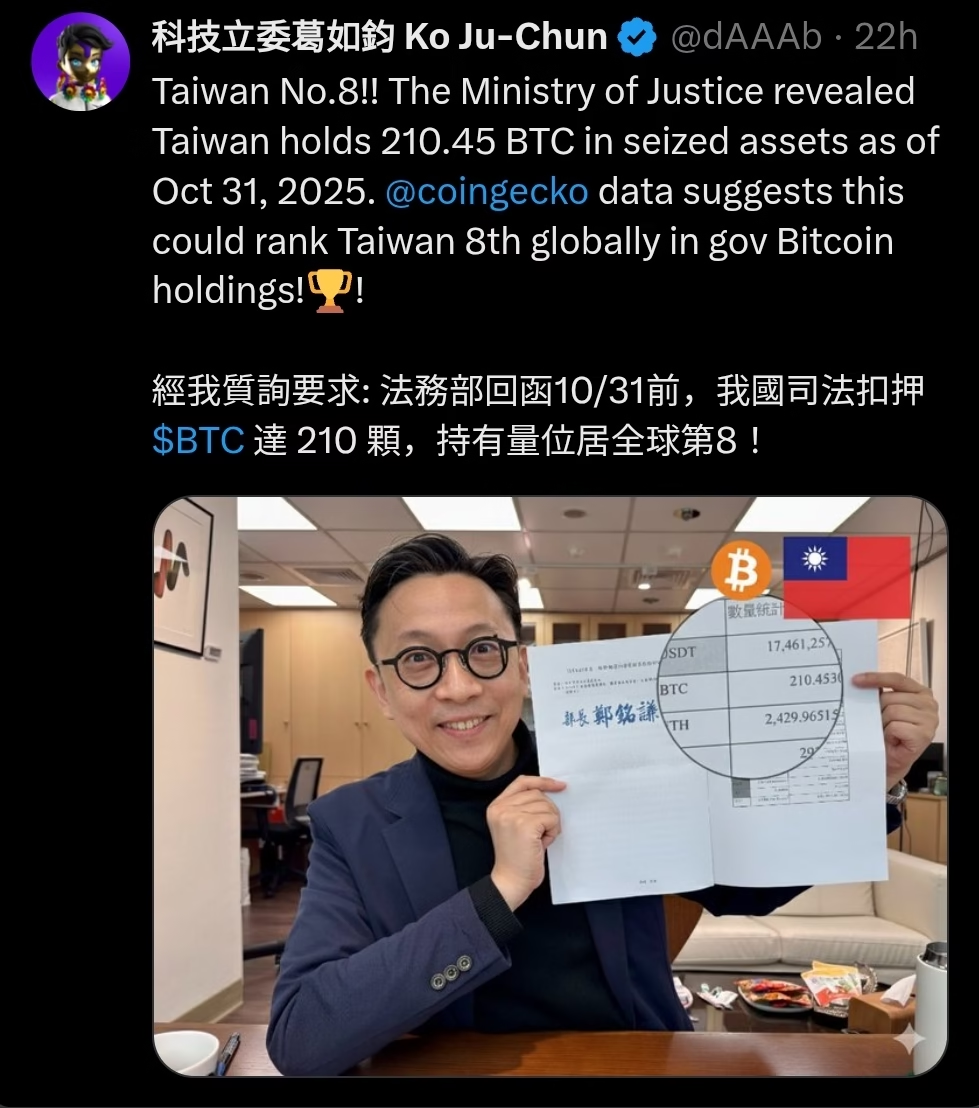
The announcement, made public this week, was highlighted by Ko Ju-Chun, a member of Taiwan’s Legislative Yuan, who said the amount could rank the island as the eighth-largest government holder of Bitcoin worldwide.
While Taiwan has not adopted Bitcoin as a reserve asset through market purchases, its inclusion among major Bitcoin-Holding Governments reflects the scale of digital assets now flowing through criminal investigations and into state custody.
Among Bitcoin-Holding Governments, Taiwan’s position is unusual. Unlike countries that have deliberately accumulated Bitcoin through strategic purchases, Taiwan’s holdings are the byproduct of enforcement actions against financial crime.
The Ministry of Justice confirmed that the state currently holds “210.45 Bitcoin”, all of which were seized during investigations into online scams, cyber fraud, and illegal digital asset operations.
Ko Ju-Chun drew attention to the broader significance of the disclosure, noting that the scale of the assets could place Taiwan among the world’s largest sovereign holders.
By publicly accounting for these assets, Taiwan has taken a step that many Bitcoin-Holding Governments have yet to make: formal transparency around the size and origin of seized cryptocurrencies.
For years, confiscated Bitcoin and other digital assets were stored by individual district prosecutors’ offices, often in cold wallets managed at the local level. According to the Ministry of Justice, the lack of centralized oversight became increasingly problematic as both the value and volume of seized assets grew.
The rise of Taiwan among Bitcoin-Holding Governments has forced structural changes in how authorities manage digital assets. The Ministry of Justice said the Bitcoin holdings were accumulated through cases involving fraud, cybercrime, and illicit financial activity, reflecting how deeply cryptocurrency has penetrated modern criminal ecosystems.
Previously, seized crypto assets were held without a unified reporting system. As digital assets became more significant, authorities consolidated oversight and introduced clearer procedures for custody and disclosure. The confirmation that holdings stood at “as of October 31, 2025” signals a move toward routine accounting rather than ad-hoc reporting.
This shift aligns with Taiwan’s broader regulatory reforms. In recent years, the government has strengthened anti-money-laundering measures and tightened controls on decentralized finance platforms and unlicensed exchanges. These reforms aim to ensure that Taiwan’s growing role among Bitcoin-Holding Governments does not undermine consumer protection or financial stability.
Taiwan’s disclosure has also fueled debate over how Bitcoin-Holding Governments should manage seized digital assets. Traditionally, confiscated assets are auctioned and converted into fiat currency.
However, lawmakers and regulators are now questioning whether that approach remains appropriate for volatile but strategically significant assets like Bitcoin.
Ko Ju-Chun has advocated for a staged policy roadmap that would begin with research and regulatory clarification, followed by a pilot program that could utilize existing seized Bitcoin rather than new purchases.
Taiwan’s Premier’s Office and Central Bank have reportedly committed to evaluating this approach within the context of the country’s broader reserve strategy.
Taiwan currently holds roughly $577 billion in foreign reserves, primarily in U.S. Treasuries and gold. Even so, its growing profile among Bitcoin-Holding Governments raises questions for policymakers: should seized Bitcoin remain a temporary asset, or does it warrant longer-term management frameworks similar to other state-held reserves?
The disclosure is expected to resonate beyond Taiwan. As cryptocurrencies continue to blur the line between crime, innovation, and finance, other Bitcoin-Holding Governments may face pressure to publicly account for their own seized digital assets. Taiwan’s move sets a regional precedent for transparency and standardized reporting.
As Taiwan joins the ranks of major Bitcoin-Holding Governments, its experience illustrates how enforcement-driven accumulation can carry strategic implications, even without an explicit investment mandate.
The disclosure marks not just a data point, but a signal that sovereign interaction with Bitcoin is entering a more transparent and consequential phase.



Copyright © 2025 - The Bit Gazette.