







- Trending
- Comments
- Latest

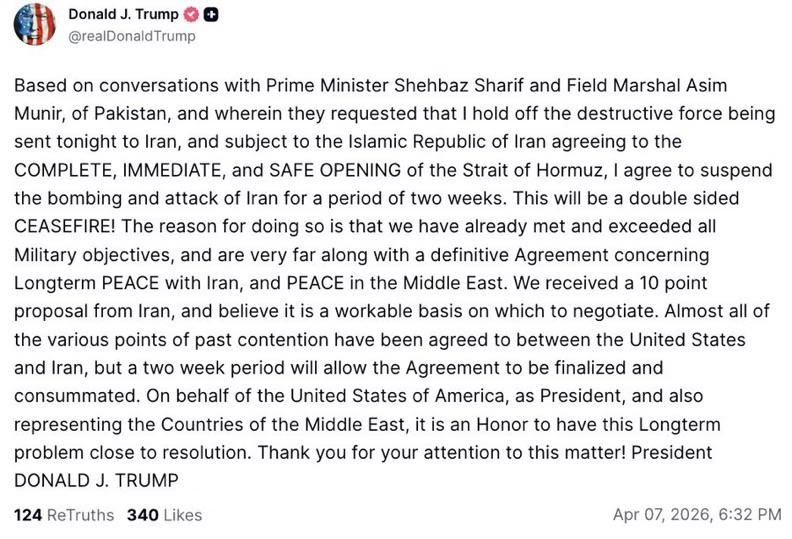
It was 6:32 p.m. Eastern time. Markets were bracing. For weeks, President Donald Trump had threatened to flatten Iranian infrastructure if the Strait of Hormuz, the narrow waterway carrying one-fifth of the world’s seaborne oil, remained closed. The deadline was 8 p.m. The world was watching.
Then came the post.
“Based on conversations with Prime Minister Shehbaz Sharif and Field Marshal Asim Munir of Pakistan, and wherein they requested that I hold off the destructive force being sent tonight to Iran,” Trump wrote on Truth Social, “I agree to suspend the bombing and attack of Iran for a period of two weeks. This will be a double-sided CEASEFIRE!”
Within minutes, the crypto market erupted. Bitcoin jumped to $72,700, up 5 percent in 24 hours, with broader crypto and U.S. stock futures rallying simultaneously. Oil prices tumbled more than 10 percent, with West Texas Intermediate crude falling to about $95 a barrel as the ceasefire eased fears over disruptions in Middle East energy supplies.
It was not the first time ceasefire news had moved Bitcoin. As The Bit Gazette previously reported, Bitcoin had already reclaimed $107,000 during an earlier Iran-Israel ceasefire that cooled broader market tensions, establishing a clear pattern: de-escalation is now a Bitcoin catalyst.
For traders betting against Bitcoin, known as short sellers, the ceasefire was not relief. It was a trap. A short position profits when prices fall. When prices surge instead, exchanges automatically close those positions to prevent losses beyond a trader’s collateral. This forced liquidation and then lead to a liquidation cascade, forcing buy, pushing prices higher and ultimately triggering the next wave of liquidations.
That is exactly what happened on the night of April 7.
The surge in Bitcoin triggered nearly $600 million in leveraged crypto futures liquidations, mostly from short sellers, signaling a powerful short squeeze and reinforcing bullish momentum. Bearish short positions accounted for $420 million of the total, as the sudden de-escalation reversed the market’s downward momentum. Bears had been positioned for intensification of military conflict. The ceasefire caught them on the wrong side of the market entirely.
Bitcoin climbed as much as 5 percent to $72,841, its highest level since March 18, before paring some gains. Ether rose as much as 7.5 percent to $2,273. The liquidation cascade had done its work. It did not just wipe out short sellers, it accelerated the very rally that destroyed them.
The short positioning made a certain kind of sense before April 7. Trump’s earlier posts had promised “Power Plant Day” and “Bridge Day” if Iran did not comply. Trump warned that “a whole civilization will die tonight” if Iran did not agree to open the Strait, a post that sent shockwaves across global markets. Traders positioned for escalation, not a diplomatic off-ramp negotiated through Pakistani intermediaries hours before the deadline.
The options market told the same story. Greeks.live captured the sentiment bluntly: “The world’s understanding of Trump is less than 5 percent. Just yesterday he was threatening to wipe out Iran, and today there is a ceasefire agreement.”
This is Bitcoin’s new geopolitical reality. As The Bit Gazette has explored in its analysis of how the digital dollar became the ultimate weapon against sanctions, the intersection of U.S. foreign policy and crypto markets is no longer peripheral. It is structural. Iran sanctions, Strait of Hormuz tensions, and dollar weaponization now sit on the same risk dashboard as funding rates and open interest.
Market analysts called the rebound a validation of Bitcoin’s maturing macro role. No longer just “digital gold” in a vacuum, it now behaves like a leveraged bet on global stability. When headlines signal war, BTC dips. When diplomacy emerges, it surges.
The $600 million Bitcoin short liquidation event of April 7 is not an outlier. It is a template.
Zeus Research analyst Dominick John described the current rally as a “short-term liquidity impulse” that requires persistent liquidity expansion, rate cuts, and structural ETF inflows to translate into a sustained bull run.
“Crypto upside remains capped by rate pressures and potential geopolitical flare-ups that trigger risk-off flows,” John told The Block. “Sustained gains will hinge on persistent liquidity, stable macro conditions, and structural capital inflows aligning to fuel the next wave.”
The two-week clock is already ticking. When the ceasefire expires, markets will face the same choice again: escalation or negotiation. Traders will be waiting cautiously for the ceasefire to end in a fortnight to see whether a deal can be reached or conflict resumes. Bitcoin will need to trade above $75,000 to confirm a breakout, while a rejection could signal a move back toward $65,000.
For now, the lesson is clear and costly. In 2026, the most dangerous trade in crypto is not a bad chart setup or a missed earnings call. It is being short when a president tweets peace.
Geopolitical risk is no longer a black swan for Bitcoin. It is the market structure. Traders who fail to model it will keep funding the liquidation cascade of those who do.



Copyright © 2025 - The Bit Gazette.