






- Trending
- Comments
- Latest

Trump's Greenland ultimatum exposes the new battleground for Bitcoin mining and rare earth dominance
President Donald Trump’s latest ultimatum over Greenland isn’t just a diplomatic provocation, it’s exposing a fundamental shift in how nations compete for strategic advantage in the digital age.
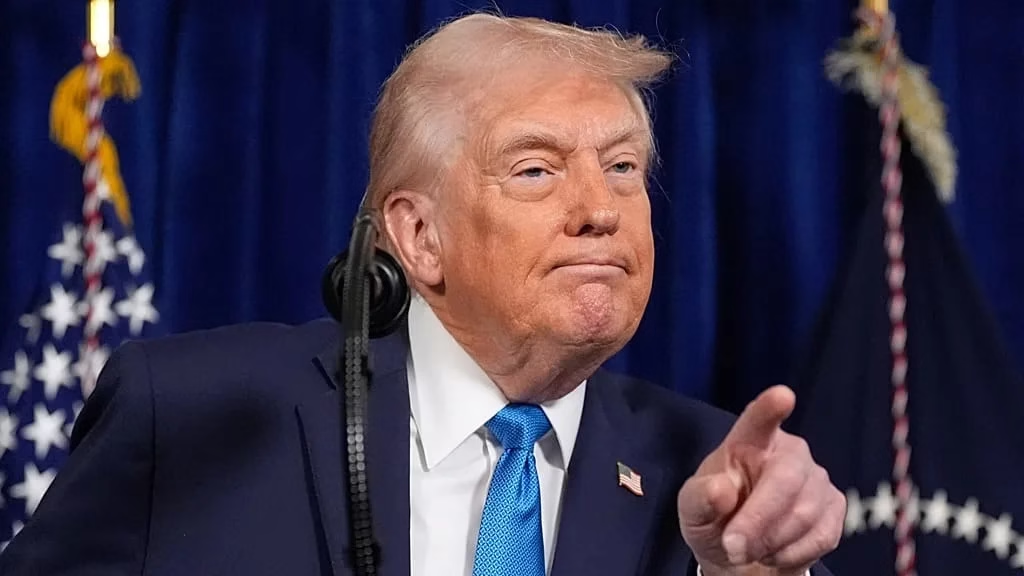
Speaking to reporters Friday, Trump declared U.S. ownership of the Arctic territory ‘non-negotiable,’ warning he would pursue acquisition ‘the hard way’ if Denmark refused to negotiate.
But beneath the territorial bluster lies a more complex calculation: Greenland’s unique combination of renewable energy potential, rare earth minerals, and year-round cold climate could make it the world’s most valuable piece of real estate for Bitcoin mining and critical technology supply chains.
What began as rhetorical saber-rattling has rapidly evolved into a flashpoint connecting NATO stability, crypto infrastructure, and the global race for resources that power both blockchain networks and advanced semiconductors.
“I would like to make a deal, you know, the easy way,” Trump said. “But if we don’t do it the easy way, we’re going to do it the hard way,” — Donald Trump, President of the United States.
The comments mark the most aggressive escalation yet in a dispute that now stretches far beyond diplomacy, touching sovereign law, Arctic security, digital infrastructure, and global financial stability.
As Washington’s rhetoric intensifies, Greenland’s economy is quietly slipping into distress.
According to a new assessment by Søren Bjerregaard, head of securities and balance of payments at Denmarks National bank, economic growth slowed to 0.8% in 2025, down sharply from 2% in 2022, and is expected to remain flat through 2026.
The slowdown reflects the completion of major infrastructure projects, including airport construction, while planned investments in energy and industrial sectors remain stalled.
At the same time, Greenland’s core shrimp industry is under pressure from declining stocks, while dividends from state-owned companies have dried up. These factors have pushed the Greenland Treasury to critically low liquidity levels, prompting warnings that fiscal tightening is now unavoidable.
Demographics present an even deeper challenge. Greenland’s population of 56,699 is shrinking rapidly and is projected to fall by 20% by 2050, driven by emigration and an ageing workforce — trends that threaten the sustainability of public finances regardless of geopolitical outcomes.
Trump has shown little interest in international legal constraints.
“I don’t need international law,” he said, adding that his own judgment and morality were sufficient. He dismissed Denmark’s historical claims outright, arguing that “a boat landing 500 years ago doesn’t mean you own it.”
Despite existing agreements granting the U.S. broad military access to Greenland, Trump insists leasing is insufficient. “You defend ownership,” he said, using the argument to criticize temporary international deals more broadly.
Meanwhile, Greenland’s foreign minister, Vivian Motzfeldt, has publicly suggested that Nuuk could pursue direct talks with Washington, potentially bypassing Copenhagen — a move that could fracture the existing Danish-Greenlandic political framework. U.S. Secretary of State Marco Rubio is expected to meet both Danish and Greenlandic officials next week.
“We must respect the law, and we have rules for how to resolve issues in the Kingdom,” — Vivian Motzfeldt, Foreign Minister of Greenland, said in an interview with Sermitsiaq.
The escalating rhetoric has spilled into financial markets, particularly crypto. Bitcoin and Ethereum faced selling pressure following Trump’s remarks, with Bitcoin struggling to break above $94,000 as traders moved toward traditional safe-haven assets such as the U.S. dollar and gold.
Analysts point to a growing “geopolitical risk premium,” with fears that confrontation involving a NATO ally could trigger broader market instability.
In the short term, the dominant mood is caution. The threat of military coercion — even if largely rhetorical — introduces a black-swan scenario that discourages risk-taking across global markets.
Beyond short-term volatility, Greenland has become the center of a longer-term speculative narrative in crypto policy circles.
Pro-crypto advisers and analysts argue that the island could play a pivotal role in a future U.S. digital asset strategy. Its year-round cold climate offers natural cooling for Bitcoin mining operations, significantly reducing energy costs.
Greenland also possesses vast untapped hydroelectric and wind energy potential, opening the door to carbon-neutral, industrial-scale mining infrastructure.
Some proponents describe the territory as a potential “strategic Bitcoin reserve” — a physical anchor for U.S. hashrate dominance that could decentralize mining away from domestic hotspots while strengthening American control over digital infrastructure.
Speculation has spilled into prediction markets such as Polymarket, where trading volumes surged following Trump’s statements. Odds of a U.S. Greenland acquisition in 2026 reportedly jumped to 15%, reflecting heightened uncertainty rather than confidence.
At the same time, volatility has increased in politically themed memecoins linked to Trump and U.S. election narratives. These assets, while highly speculative, have increasingly become proxies for trader sentiment around political risk and policy direction.
Greenland’s significance extends beyond crypto mining. The island holds substantial reserves of rare earth elements, including lithium and cobalt, critical for mining hardware, batteries, and advanced semiconductors.
Securing access to these resources could reduce U.S. dependence on Chinese supply chains, a factor that quietly underpins Washington’s strategic interest.
| Factor | Impact | Long-term outlook |
|---|---|---|
| Market prices | Negative (volatility) | Potential rebound if U.S. formalizes digital asset policy |
| Mining efficiency | Strongly positive | Greenland could become the world’s lowest-cost mining hub |
| Regulation | Neutral | Likely alignment with U.S. crypto frameworks |
| Geopolitics | High risk | NATO tensions could destabilize global markets |
What began as a provocative territorial claim has evolved into a complex intersection of geopolitics, economics, and digital finance.
Greenland’s fiscal fragility, combined with Trump’s confrontational posture and the crypto industry’s strategic ambitions, has turned the Arctic island into a flashpoint far larger than its population or GDP might suggest.
Whether the episode ends in negotiation, stalemate, or escalation, the message to global markets is clear: sovereignty disputes are no longer just about land — they are about data, energy, and who controls the infrastructure of the future.



Copyright © 2025 - The Bit Gazette.

