






- Trending
- Comments
- Latest

The United Arab Emirates has tokenized 23 properties worth approximately $129 million—more than any other country by count—though the United States still leads in total dollar value with 10 properties worth $145 million, according to new data from RWA.XYZ showing how regulatory clarity and blockchain infrastructure are driving the Gulf state’s emergence as the global center for on-chain real estate despite the sector’s modest $356 million total market size across 57 properties in 10 countries.
RWA.XYZ data shows the UAE has tokenized 23 individual properties valued at approximately $129 million, giving it the top spot by number of tokenized real estate assets. The United States follows with 10 tokenized properties but edges ahead in total value at roughly $145 million.
“The UAE’s lead reflects a deliberate regulatory strategy rather than a coincidence,” said an analyst at RWA.XYZ. “Clear frameworks, proactive regulators, and close collaboration between developers and tokenization platforms are driving real deployment, not just pilot projects.”

Other countries with active tokenized real estate assets include Canada, Mexico, Italy, Spain, Greece, Romania, and several emerging European markets. However, none match the pace or regulatory alignment currently seen in the UAE.
A major driver of the UAE’s dominance is Mantra Chain, a regulated blockchain network focused on compliant tokenization. According to the report, Mantra Chain accounts for $117.7 million worth of tokenized real estate assets, the largest share among all networks.
Base follows with $81.5 million in tokenized real estate value, while Stellar accounts for $71.7 million. Analysts say the data highlights how regulatory clarity, rather than raw blockchain popularity, is shaping where tokenized real estate assets are being issued.
“Real estate is highly sensitive to compliance, investor protections, and jurisdictional certainty,” said a digital assets researcher focused on RWAs. “Networks that can meet those requirements are winning market share.”
On the platform side, Ctrl Alt emerged as the leading tokenization provider by total real estate value, with $124 million in tokenized real estate assets issued to date.
Several landmark developments have already been brought on-chain, further reinforcing the UAE’s leadership. According to the data, properties in Dubai’s World Islands project represent the largest cluster of tokenized real estate assets by count.
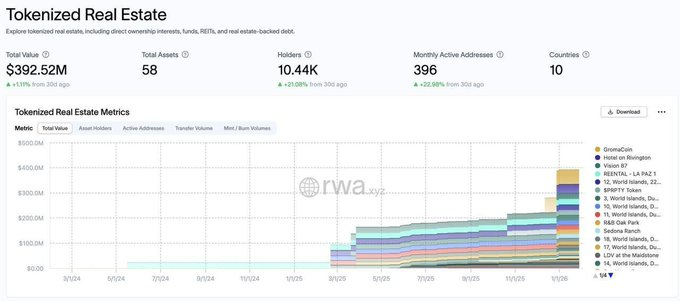
Other notable examples include the DAMAC City tower, Kensington Waters, Sobha Creeks, and the Dubai Marina Hotel, the latter of which was tokenized on the XRP Ledger by Ctrl Alt. These projects demonstrate that tokenized real estate assets are no longer limited to experimental or low-value properties.
“Tokenization allows developers to fractionalize ownership and reach a broader investor base without sacrificing regulatory oversight,” said a Dubai-based real estate executive involved in one of the projects. “That combination is especially attractive in premium markets.”
Despite the momentum, the overall market for tokenized real estate assets remains modest when compared to other tokenized categories. Stablecoins dominate the RWA landscape with an estimated market value of $293 billion, while tokenized U.S. Treasuries account for roughly $10 billion.
Even so, tokenized real estate assets are rapidly closing the gap with tokenized equities, which currently stand at around $942 million in total value. Analysts say real estate’s complexity has slowed adoption but could ultimately support larger long-term growth.
“Real estate has higher friction than cash or bonds, but once the infrastructure is in place, the upside is enormous,” said a senior consultant at a global advisory firm.
Looking ahead, forecasts suggest the sector’s growth could be dramatic. Industry projections, including analysis from Deloitte, estimate that tokenized real estate assets could exceed $4 trillion in market value by 2035, growing at a compound annual rate of approximately 27%.

Tokenized real estate debt is expected to represent the largest segment, potentially reaching $2.39 trillion by 2035. Private real estate funds could follow, with projections near $1 trillion. Direct property ownership tokens are also expected to expand as legal and technical standards mature.
“These projections assume institutional participation,” Deloitte noted in a recent outlook. “And that participation depends heavily on regulation, custody, and interoperability.”
While the UAE currently dominates the region, competition is emerging. Saudi Arabia has begun laying the groundwork for its own tokenized real estate assets ecosystem through a new blockchain-based property registry developed by SettleMint.
The registry, overseen by the Real Estate Registry Authority under REGA, has already attracted nine PropTech firms building applications in its regulatory sandbox. Market observers say Saudi Arabia’s entry could reshape the regional balance over the next few years.
“The UAE has first-mover advantage, but Saudi Arabia has scale,” said a MENA-focused fintech analyst. “Both are likely to become major centers for tokenized real estate assets.”
The RWA.XYZ data reinforces a broader narrative: tokenized real estate assets are transitioning from concept to infrastructure. While still small in absolute terms, the sector is now backed by real capital, regulated blockchains, and institutional-grade platforms.
As regulatory clarity improves and secondary markets develop, analysts expect tokenized property to become a permanent feature of global finance rather than a passing trend.
“The question is no longer if real estate will be tokenized,” one industry executive said. “It’s where and how fast — and right now, the UAE is setting the pace.”



Copyright © 2025 - The Bit Gazette.