






- Trending
- Comments
- Latest

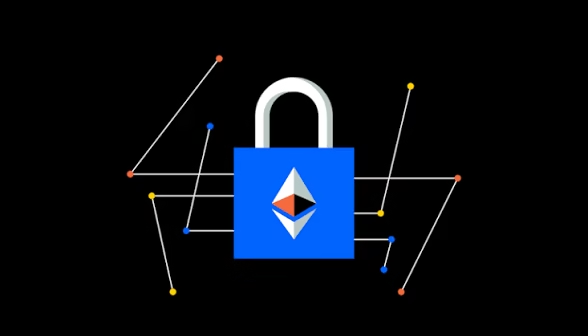
Crypto wallets were designed with a simple premise: access without permission. No borders, no identity requirements, no distinction between users based on geography or politics, a private key was enough.
That premise is now under pressure. Increasingly, access is no longer defined purely by cryptography. Where you are, and who you are associated with, is starting to matter again.
Modern sanctions regimes are not built to interact with decentralized systems. They are designed to control institutions such as banks, payment processors, intermediaries.
But crypto introduces a complication: value can move without those intermediaries.
The response has been indirect but effective. Instead of targeting wallets themselves, regulators focus on the infrastructure surrounding them such as exchanges, on-ramps, off-ramps, and service providers.
The geopolitics crypto wallet restriction dynamic emerges from this approach. Wallets may still exist independently, but their ability to interact with the broader financial system becomes constrained.
This creates a new reality:
Few environments illustrate this tension more clearly than Russia.
Since the expansion of international sanctions, Russian-linked wallets and entities have faced increasing scrutiny across the crypto ecosystem. Exchanges have restricted accounts, platforms have implemented geo-blocking measures, and compliance frameworks have tightened significantly.
The geopolitics crypto wallet restriction trend is particularly visible here. Wallets associated directly or indirectly with sanctioned jurisdictions encounter friction at multiple points:
What makes this significant is not just the enforcement itself, but what it reveals: crypto infrastructure is more connected to geopolitical systems than its original design suggested.
As compliance pressures increase, the crypto ecosystem is beginning to fragment along geopolitical lines.
Different regions are developing:
The geopolitics crypto wallet restriction effect is turning what was once a unified network into a patchwork of partially connected zones.
A wallet that operates freely in one jurisdiction may face limitations in another. Service providers must navigate conflicting legal requirements, often choosing to restrict access rather than risk non-compliance.
This introduces a subtle but powerful shift: the network remains technically global, but functionally segmented.
At the center of the geopolitics crypto wallet restriction debate is a growing conflict between privacy and compliance.
To meet regulatory expectations, platforms are implementing:
These measures aim to align crypto activity with existing financial regulations. But they also move the ecosystem closer to the very systems it was designed to bypass.
For users, this creates a trade-off:
The borderless wallet is not disappearing but it is being forced to choose sides.
What is emerging is not the end of crypto wallets, but a redefinition of their sovereignty.
The geopolitics crypto wallet restriction trend suggests that wallets are becoming conditionally sovereign:
Users still control their keys. But their ability to use those keys within the broader ecosystem depends on external factors regulation, compliance, and geopolitical alignment.
This hybrid reality challenges one of crypto’s foundational narratives. Ownership remains decentralized, but access is increasingly mediated.
The geopolitics crypto wallet restriction dynamic is not about eliminating crypto wallets as it is about reshaping how they function within a world defined by borders.
Geopolitics is not breaking the technology. It is redefining its limits.
As sanctions expand and regulatory frameworks tighten, the gap between what crypto promises and what users experience may continue to widen. Wallets will still exist, private keys will still grant control, and transactions will still be possible.
But the conditions under which those transactions occur are changing.
In the end, the question is no longer whether crypto wallets are borderless. It is how much of that borderlessness can survive contact with the realities of global power.



Copyright © 2025 - The Bit Gazette.

