
- Trending
- Comments
- Latest

Justin Sun, founder of Tron, has publicly demanded that World Liberty Financial disclose the identities controlling wallets linked to its smart contract infrastructure, alleging that a single guardian account may have the power to freeze user assets unilaterally, a claim WLFI has not directly addressed as its token fell to a record low of $0.077.
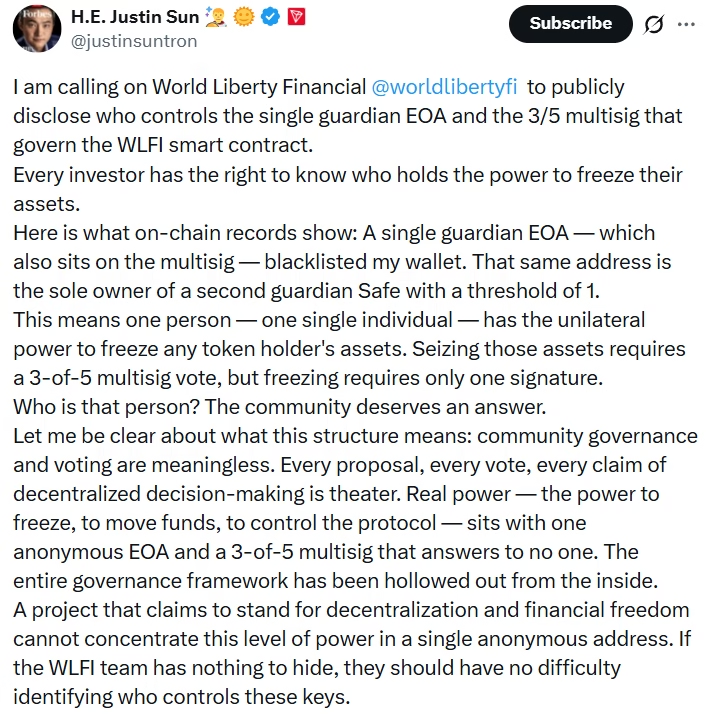
In a series of public statements, Sun claimed that the WLFI Justin Sun dispute stems from a governance structure that may allow a single party to exercise disproportionate control over the platform.
According to Sun, a guardian Externally Owned Account (EOA) linked to WLFI’s multisignature wallet appears to have effective control over a secondary guardian safe. This setup, he argued, could enable unilateral decisions including freezing user assets without broader consensus.
“The structure raises serious concerns,” Sun said in a post, suggesting that the WLFI Justin Sun dispute highlights deeper risks tied to centralized control within decentralized systems.
WLFI has yet to issue a detailed response addressing the technical claims raised in the WLFI Justin Sun dispute, leaving questions around governance unresolved.
The WLFI Justin Sun dispute intensified after Sun alleged that his wallet had been unfairly blacklisted by the platform. Blockchain data had previously flagged a transaction of approximately $9 million linked to his address, which WLFI cited as justification for the action.
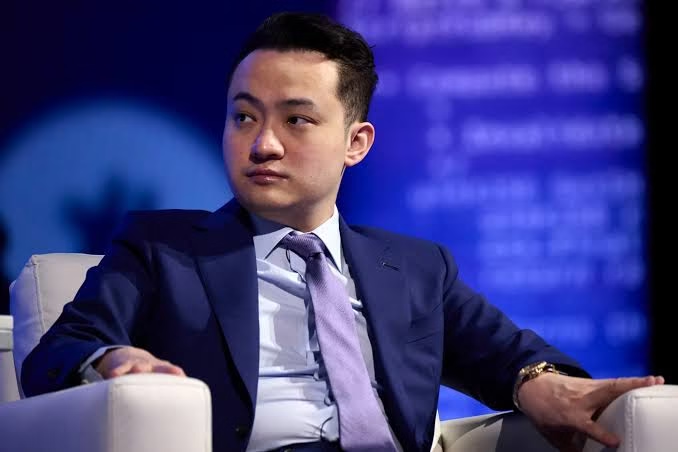
Sun, however, maintains that the freeze was unwarranted and has called for the immediate release of his presale tokens. The incident has become a focal point in the WLFI Justin Sun dispute, raising broader concerns about user protections and the criteria for enforcement actions.
Beyond the wallet freeze, the WLFI Justin Sun dispute has amplified scrutiny of the platform’s governance model. A March governance vote revealed that roughly 76% of voting power was concentrated among just 10 wallets, a statistic Sun described as “alarming.”
Critics argue that such concentration undermines the decentralized ethos that many crypto projects claim to uphold. The WLFI Justin Sun dispute has therefore become a case study in how governance design can impact both perception and trust.
In response to Sun’s allegations, WLFI accused him of spreading misinformation to deflect from his own actions and hinted at potential legal measures. The exchange of accusations has further intensified the WLFI Justin Sun dispute, keeping it in the spotlight across the crypto community.
Complicating matters, the WLFI Justin Sun dispute comes at a time when the platform is facing scrutiny over its decentralized finance (DeFi) activities.
Onchain data tracked by Arkham Intelligence revealed that wallets linked to WLFI deposited approximately 5 billion tokens as collateral on Dolomite, a protocol associated with WLFI’s chief technology officer.
These deposits were used to borrow around $75 million in stablecoins, including USDC, with over $40 million reportedly transferred to Coinbase Prime.
The scale of these transactions has added another layer to the WLFI Justin Sun dispute, as analysts question the potential risks to lenders if WLFI’s token price continues to decline.
The WLFI Justin Sun dispute has coincided with a significant drop in the platform’s token value. According to data from CoinGecko, WLFI fell to approximately $0.077, marking a new low and extending its downward trend.
Market participants point to a combination of governance concerns, collateral exposure, and uncertainty around treasury transparency as key drivers behind the decline.
While WLFI has stated that its lending positions remain safely above liquidation thresholds, the ongoing WLFI Justin Sun dispute continues to weigh on investor sentiment.
The WLFI Justin Sun dispute highlights a recurring challenge in the crypto sector: balancing decentralization with effective control mechanisms.
Incidents involving wallet freezes and concentrated voting power have sparked wider debates about how projects should structure governance to maintain both flexibility and fairness.
For some observers, the WLFI Justin Sun dispute underscores the importance of transparency, particularly when significant financial decisions can be executed through multisignature wallets or guardian accounts.
The controversy is unfolding alongside volatility in other Trump-linked tokens, including the Official Trump and Official Melania coins, both of which have recently hit new lows.
Despite this, some large holders have resumed accumulation of TRUMP tokens ahead of a planned event at Mar-a-Lago hosted by Donald Trump, where top token holders are expected to attend.
This broader backdrop adds another dimension to the WLFI Justin Sun dispute, tying it to both market dynamics and political narratives.
As the WLFI Justin Sun dispute continues, attention is likely to focus on whether WLFI provides the transparency Sun has demanded. A detailed explanation of wallet control structures and governance processes could help restore confidence—or deepen concerns if left unaddressed.



Copyright © 2025 - The Bit Gazette.