- Trending
- Comments
- Latest

Decentralized finance (DeFi) projects are increasingly moving away from public Discord servers, citing the platform as a growing liability rather than a community hub.
The trend was highlighted on Wednesday after Morpho, a prominent DeFi lending protocol, transitioned its public Discord server to read-only mode and directed users to alternative support channels.
“This was not an easy choice,” said Merlin Egalite, co-founder of Morpho, adding that users were frequently targeted by phishing attacks despite active moderation and safeguards. “Even with monitoring, users were being scammed while seeking help.”
The move signals a broader pattern of Defi protocols Discord exit, where builders aim to prioritize user safety over open chat engagement.
DeFi data platform DefiLlama has also quietly reduced its reliance on Discord. Its pseudonymous founder, 0xngmi, explained that structured support tools, such as live chat systems and email ticketing, offer greater control and security.
“Even if you ban scammers instantly, they still DM users directly to scam them,” 0xngmi noted in a post. “Discord makes it impossible to fully protect users.”
Morpho is experimenting with solutions like Intercom, which provides ticket management, AI-assisted responses, and a more controlled interface for user support.
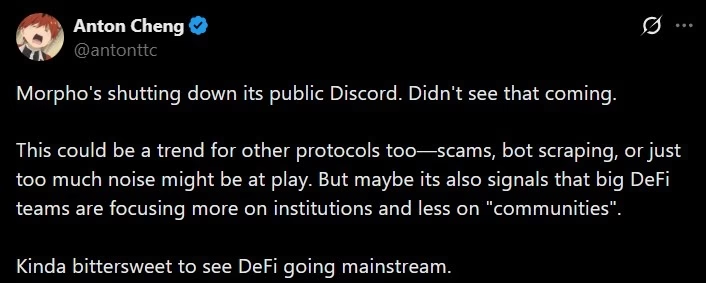
Such approaches highlight the shift driving the Defi protocols Discord exit moving from always-on, public communication to structured, secure channels.
Industry leaders have largely supported the move. Richard Rodairos, talent partner at Dragonfly, said, “Public Discord servers have become one of the lowest signal surfaces in the space.
Clear documentation and reliable communication channels will benefit users far more.”
Marc Zeller, founder of the Aavechan Initiative, added that Discord is “full of scammers,” and called Morpho’s decision a positive precedent. Similarly, Duncan Cock Foster, co-founder of Nifty Gateway, described moderating Discord as a major drain on mental health and praised the protocol’s approach as “smart.”
Such endorsements reinforce the rationale behind the Defi protocols Discord exit: safeguarding users while maintaining operational efficiency.
Not all members of the DeFi ecosystem support abandoning Discord. Some argue that open, peer-to-peer collaboration is central to the sector’s identity.
“One of DeFi’s core appeals is being able to pop into a project’s Discord to share experiences, provide feedback, and follow development discussions,” said X user Llamaonthebrink, urging that the Defi protocols Discord exit should not become a widespread trend.
Others, such as X user nft_dreww, argue that the issue lies in execution rather than the platform itself, noting that “well-run Discord servers with proper security can remain safe and vibrant.”
Walter_Su11ivan echoed this view, emphasizing that some projects maintain healthy, moderated communities despite Discord’s challenges.
As the DeFi sector continues to weigh the benefits of public Discord communities against the risks, hybrid models are emerging.
Some projects are combining secure, ticketed support systems with curated community spaces to balance accessibility and safety.
Analysts suggest that protocols adopting these hybrid systems could set a precedent for safer, more efficient community management, reducing the reliance on always-on public chat while maintaining active user engagement.
The Defi protocols Discord exit also carries implications for governance participation.
Users who previously relied on open Discord channels for voting discussions, protocol feedback, and development updates may need to adapt to structured communication platforms.
However, experts argue that this shift could ultimately improve governance quality, as engagement will move to environments with better moderation, clearer documentation, and reduced exposure to scams, potentially strengthening trust across DeFi ecosystems.



Copyright © 2025 - The Bit Gazette.