


- Trending
- Comments
- Latest

US and Israeli strikes on Iranian targets sent Bitcoin sliding toward $63,000 over the weekend, with crypto the only major market open to price in the geopolitical shock — triggering more than $250 million in liquidations within four hours as traders unwound leverage with no equity or commodity markets to absorb the fallout.
With US equity futures offline and global stock exchanges shuttered, digital assets were left to price in the geopolitical fallout alone. The result was swift volatility across crypto, underscoring Bitcoin’s growing role as a real-time barometer for global risk during off-market hours following the Trump Iran Strike.
Data from TradingView showed BTC/USD sliding sharply as news broke of coordinated US and Israeli strikes on Iranian targets. The sell-off drove Bitcoin to test the $63,000 support zone, a level closely watched by traders after weeks of fragile price action. Market participants described the move as a textbook reaction to geopolitical shock amplified by thin weekend liquidity linked to the Trump Iran Strike.
In a video address released shortly after the strikes, Donald Trump said the operation was aimed at degrading Iran’s nuclear infrastructure. He then pivoted to a direct message to the Iranian public, urging them to take control of their government once the military action concluded.
“When we are finished, take over your government; it will be yours to take,” Trump said. “This will be, probably, your only chance for generations. For many years, you have asked for America’s help, but you never got it.”
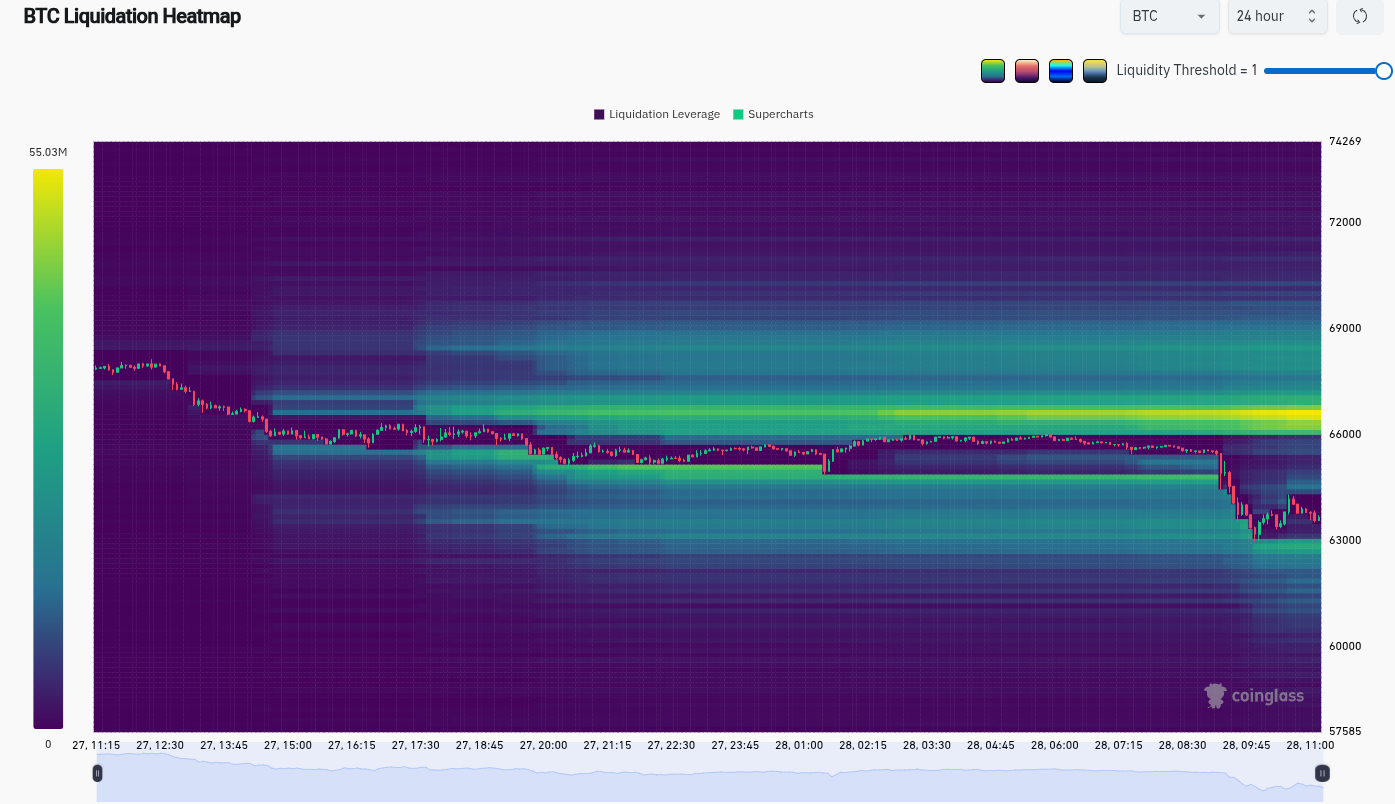
Those remarks added a regime-change narrative to the Trump Iran Strike, deepening uncertainty over how Iran might respond and how long tensions could persist. For crypto traders, the rhetoric reinforced the likelihood of prolonged instability rather than a limited, short-lived exchange.
Because the Trump Iran Strike unfolded over a weekend, crypto markets became the first—and only—arena for immediate price discovery. While gold and oil markets remained largely inaccessible to retail traders, Bitcoin and other digital assets absorbed the brunt of speculative repositioning.
According to CoinGlass, liquidations exceeded $250 million within just four hours of the initial reports. Both long and short positions were flushed out as leverage unwound rapidly, a familiar pattern during surprise geopolitical events tied to the Trump Iran Strike.
“The US and Israel now appear to be at war with Iran for the second time in eight months,” wrote The Kobeissi Letter in a post on X, pointing to the speed and scale of the market reaction.
The commentary referenced an earlier Iran-related escalation in 2025, which also sparked violent swings across crypto and broader risk assets. Traders drew parallels between that episode and the current Trump Iran Strike, noting that Bitcoin again served as the first outlet for global risk-off sentiment.
Beyond the headlines, the timing of the Trump Iran Strike is especially sensitive for Bitcoin from a technical standpoint. The latest dip arrived just hours before the February monthly close, a period that often sets the tone for medium-term trend direction.
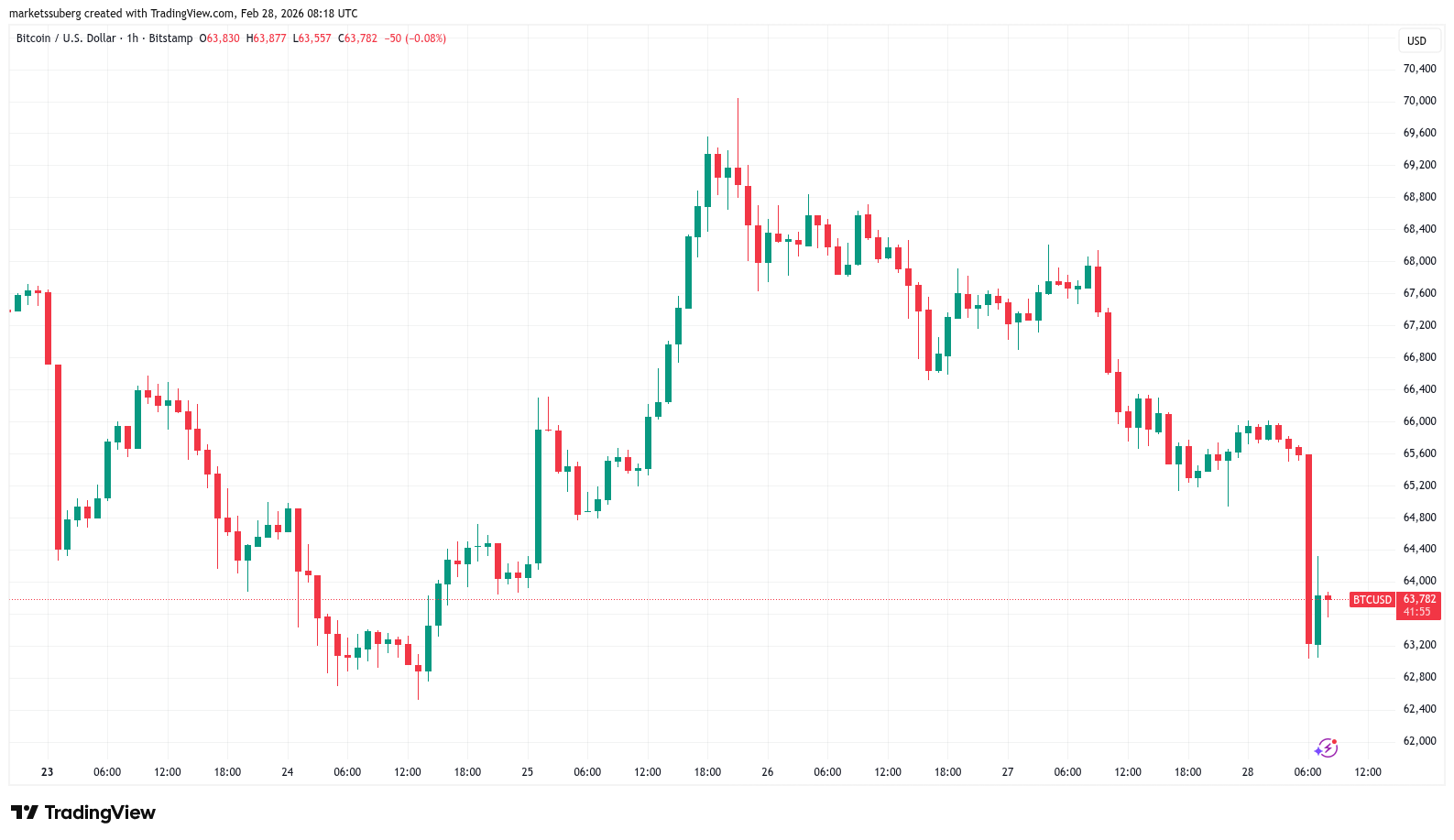
Despite the sell-off, Bitcoin has so far held its core support range, preventing a deeper breakdown below $60,000. Still, BTC/USD is now on track to mirror losses last seen in February 2025. If confirmed, the current trajectory would mark Bitcoin’s fifth consecutive monthly decline—something not seen in nearly seven years.
Analysts note that geopolitical pressure from the Trump Iran Strike compounded an already fragile setup. On Friday, hotter-than-expected US inflation data weighed on risk assets, frustrating Bitcoin bulls who had attempted to reclaim resistance closer to $70,000.
The convergence of macroeconomic stress and geopolitical escalation has left traders cautious. Elevated inflation keeps interest rate expectations restrictive, while the Trump Iran Strike injects fresh uncertainty into global energy markets and international diplomacy.
Historically, Bitcoin’s response to military conflict has been mixed. Initial drops are often followed by stabilization if broader markets interpret the event as contained. However, rhetoric surrounding the Trump Iran Strike suggests a wider political objective, raising the risk of retaliation and prolonged volatility.

For now, crypto markets remain in a holding pattern, awaiting signals from Iran and the reopening of traditional markets. Once equities, bonds, and commodities resume trading, Bitcoin’s weekend move following the Trump Iran Strike will be tested against broader investor sentiment.
The episode reinforces Bitcoin’s evolving role as a 24/7 macro asset. When geopolitical shocks like the Trump Iran Strike hit outside standard trading hours, crypto becomes the first venue where fear, speculation, and hedging collide.
Whether Bitcoin ultimately rebounds or breaks lower will depend on how the situation develops in the days ahead. What is clear is that the Trump Iran Strike has once again highlighted crypto’s unique position at the intersection of global politics and financial markets—reacting instantly, absorbing leverage, and broadcasting sentiment long before Wall Street opens its doors.



Copyright © 2025 - The Bit Gazette.