




- Trending
- Comments
- Latest

The White House and Ripple CEO Brad Garlinghouse are publicly pressuring U.S. banks to support digital asset regulation, with the administration accusing financial institutions of attempting to ‘hold the Clarity Act hostage’ for competitive advantage.
On March 4, 2026, Garlinghouse amplified the White House’s ultimatum on X, framing the legislation as necessary consumer protection rather than industry rivalry.
Garlinghouse amplified the administration’s ultimatum on X, framing the Digital Asset Market Clarity Act as a matter of public interest rather than industry advantage. The White House, in turn, accused banks of attempting to “undercut The Genius Act, or hold The Clarity Act hostage,” even as those institutions report record profits.
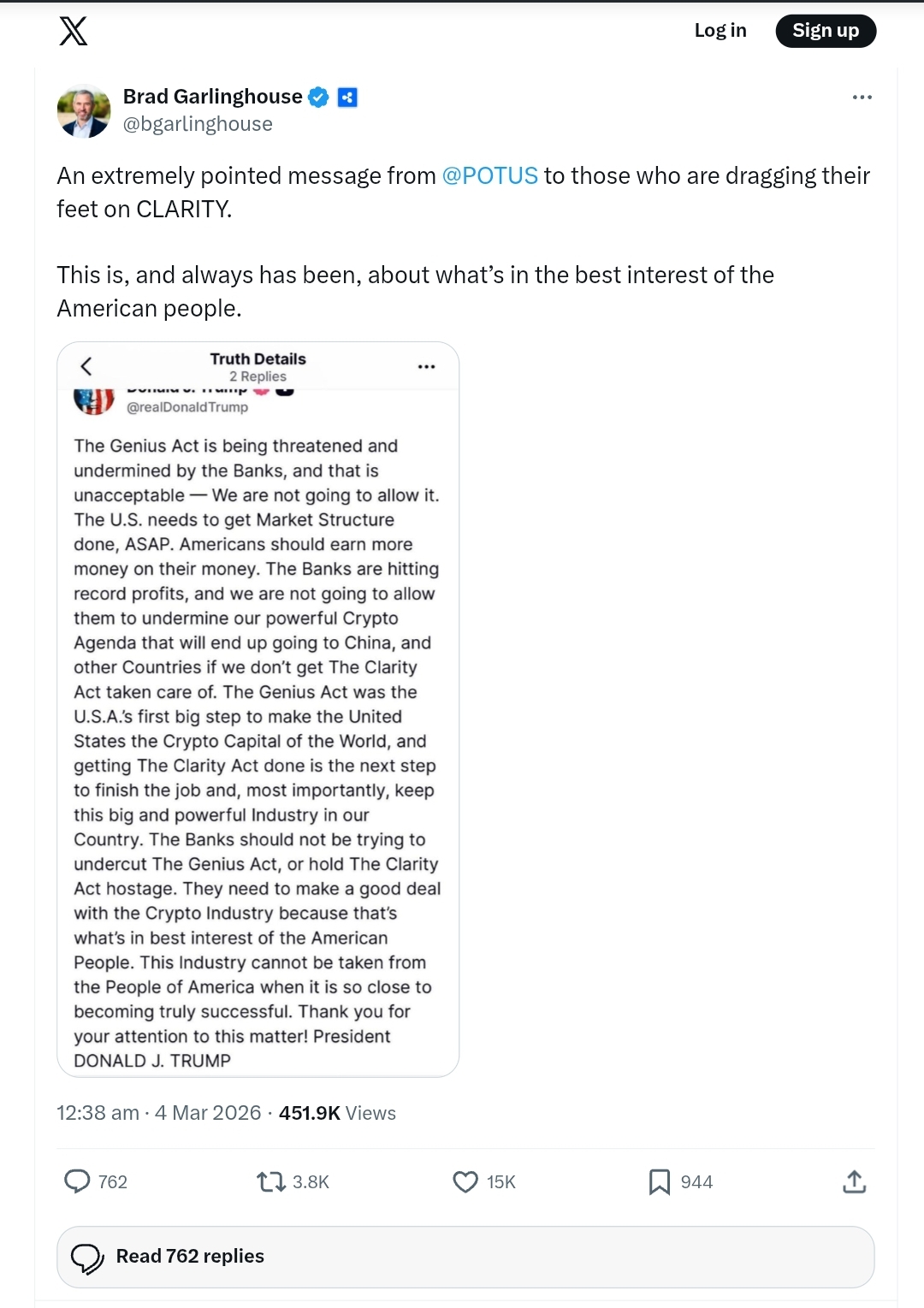

The Biden administration’s message to the banking lobby was described by Garlinghouse as unusually direct. Calling it an “extremely pointed message,” the Ripple executive emphasized that the debate over the Digital Asset Market Clarity Act transcends corporate rivalry.
“This is, and always has been, about what’s in the best interest of the American people,” — Brad Garlinghouse, CEO, .
The White House statement suggested that banks should not seek to weaken parallel crypto legislation or delay passage of the Digital Asset Market Clarity Act for competitive reasons. The administration noted that legacy financial institutions are “hitting record profits,” questioning the rationale behind efforts to resist clearer crypto rules.
While the full legislative text continues to evolve, the Digital Asset Market Clarity Act is broadly viewed as a framework intended to define regulatory boundaries for digital assets in the United States. Supporters argue that the absence of clear rules has hindered innovation and left both companies and consumers exposed to uncertainty.
Garlinghouse has spent recent weeks advocating for swift approval of the Digital Asset Market Clarity Act, urging industry leaders not to allow disagreements over details to derail broader progress. He has repeatedly stressed that “clarity is better than chaos,” signaling a pragmatic approach to regulation even if the bill does not satisfy every sector demand.
Currently, the Ripple chief estimates an 80% to 90% probability that the Digital Asset Market Clarity Act will pass by the end of April 2026. He has also called on banks to negotiate in “good faith,” arguing that compromise remains achievable.
His stance, however, has drawn criticism from some corners of the crypto community. Among the more vocal skeptics is , founder of Cardano, who has taken issue with what he sees as excessive pragmatism in accepting imperfect legislation. The debate underscores broader tensions within the digital asset industry about how aggressively to push for regulatory concessions.
Still, Garlinghouse maintains that progress on the Digital Asset Market Clarity Act is essential to providing certainty for businesses operating in the U.S. Without it, companies face an evolving patchwork of enforcement actions and ambiguous guidance.
The controversy surrounding the Digital Asset Market Clarity Act intensified following remarks by , CEO of . Dimon argued that digital assets offering yield should be regulated under traditional banking laws.
“If you’re going to be holding balances and paying interest, that’s a bank. You should be regulated like a bank,” — Jamie Dimon, CEO, JPMorgan Chase.
Dimon’s comments reflect concerns within the traditional financial sector that certain crypto products replicate banking functions without being subject to comparable oversight.
However, Patrick Witt, a senior White House adviser on crypto-related issues, publicly rejected that interpretation. He characterized Dimon’s reasoning as misleading.
He argued that the “deceit” in Dimon’s statement is the idea that paying yield on a balance automatically necessitates bank-like regulations. — Patrick Witt, White House crypto adviser.
This exchange illustrates the philosophical divide shaping the Digital Asset Market Clarity Act debate: whether digital asset platforms should be folded into existing banking frameworks or governed by a distinct regulatory structure tailored to blockchain-based systems.
The debate over the Digital Asset Market Clarity Act has also drawn in other industry leaders. A delegation from , including CEO , visited the White House this week. The visit is notable given Armstrong’s earlier rejection of certain Senate stablecoin provisions, suggesting ongoing negotiations across multiple legislative fronts.
As discussions continue, the Digital Asset Market Clarity Act has become a symbol of the broader recalibration underway in U.S. financial policy. For crypto firms, the legislation promises long-sought certainty. For banks, it raises questions about competitive parity and regulatory consistency.
With an April deadline looming, the coming weeks could determine whether the Digital Asset Market Clarity Act reshapes America’s digital asset landscape — or becomes another stalled attempt at reform. What remains clear is that the outcome will influence not only crypto companies and financial institutions, but millions of Americans navigating an increasingly digital economy.



Copyright © 2025 - The Bit Gazette.