

- Trending
- Comments
- Latest

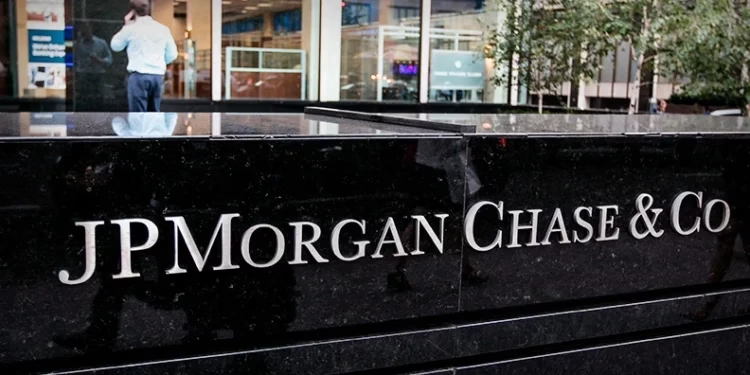
Investors filed a class action lawsuit against JPMorgan on March 10, 2026, alleging the bank facilitated a $328 million Ponzi scheme operated by Goliath Ventures.
According to federal prosecutors, CEO Christopher Delgado orchestrated the fraud from January 2023 to January 2026, collecting funds from over 2,000 investors through JPMorgan accounts before transferring approximately $253 million to crypto wallets. The case raises questions about bank compliance systems when handling crypto-linked accounts.
According to the complaint filed in the United States District Court for the Northern District of California, JPMorgan allegedly ignored clear warning signs that Goliath Ventures was running a crypto Ponzi scheme targeting thousands of investors.
The proposed class action claims the bank allowed Goliath to collect investor funds through wire transfers despite suspicious account activity.
“Chase, by virtue of its Know Your Customer actually knew that Goliath was acting as a ‘private equity’ cryptocurrency pool operator investing money for investors, without being licensed at all to sell these investments,” the complaint states.
Investors argue that JPMorgan’s compliance systems should have flagged the transactions tied to the crypto Ponzi scheme, particularly because the company was allegedly soliciting funds without proper regulatory authorization.
The legal battle intensified after the United States Attorney’s Office for the Middle District of Florida announced the arrest of Christopher Delgado, the CEO of Goliath Ventures.
Prosecutors allege that Delgado orchestrated the crypto Ponzi scheme between January 2023 and January 2026. If convicted on all counts, he could face up to 30 years in federal prison.
Authorities say Goliath Ventures — previously known as Gen-Z Venture Firm — promised investors strong returns through cryptocurrency investments.
However, investigators believe the company was running a classic crypto Ponzi scheme, using new investor funds to pay earlier participants.
Legal experts say the arrest marks another major enforcement action targeting fraudulent crypto operations.
Court filings claim JPMorgan served as the sole banking institution for Goliath Ventures from January 2023 until mid-2025.
During that period, the crypto-ponzi scheme allegedly raised $328 million from more than 2,000 investors.
The complaint details how approximately $253 million was deposited into a JPMorgan account linked to Goliath, representing nearly two-thirds of the funds raised through the alleged crypto Ponzi scheme.
Investigators say roughly $123 million was then transferred from the bank account to crypto wallets held at Coinbase, raising questions about how the crypto-ponzi scheme moved funds between traditional banking and digital asset platforms.
Plaintiffs argue that the large and repeated transfers should have triggered compliance checks designed to stop financial crimes.
The federal criminal complaint also revealed that Goliath Ventures maintained accounts with Bank of America.
Prosecutors allege Delgado was a co-signatory on one of the accounts, which was used to move funds tied to the crypto Ponzi scheme.
According to investigators, Goliath directors told at least one investor that Delgado directly controlled the account.
The dual banking relationships could become a focal point of the broader crypto-ponzi scheme investigation as authorities track how investor money moved across financial institutions.
The JPMorgan lawsuit underscores the growing scrutiny facing banks over their role in preventing crypto-related fraud.
Financial institutions are legally required to monitor transactions and report suspicious activity. Critics argue that the alleged crypto-ponzi schemes highlight potential weaknesses in those systems when dealing with crypto-linked businesses.
Meanwhile, Dimon has repeatedly warned about cryptocurrency risks. In a past Senate hearing, he described certain crypto tokens as “dangerous,” emphasizing fraud concerns within the industry.
The unfolding crypto Ponzi scheme case may now test how effectively banks enforce their own safeguards.
If the allegations are proven in court, the lawsuit could reshape how banks monitor crypto-related accounts and strengthen oversight aimed at preventing the next major crypto-ponzi scheme.



Copyright © 2025 - The Bit Gazette.