

- Trending
- Comments
- Latest

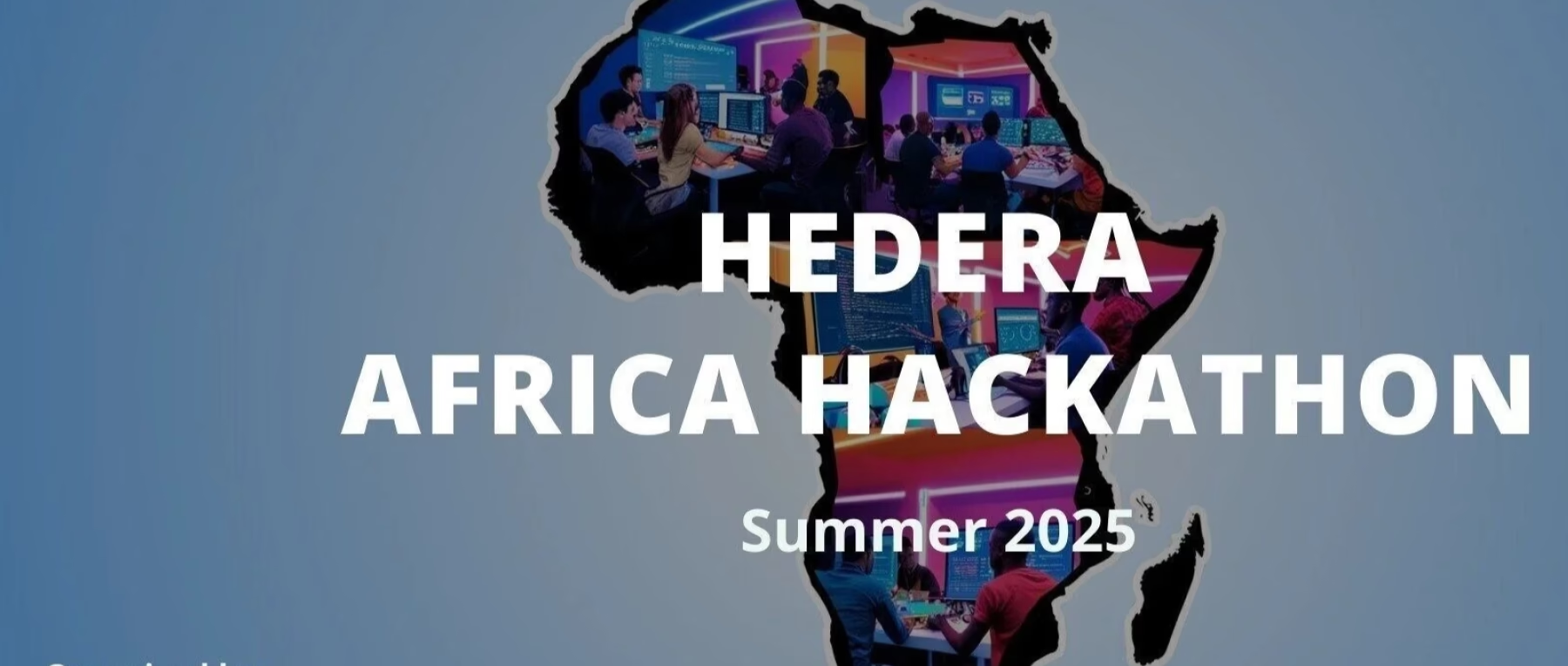
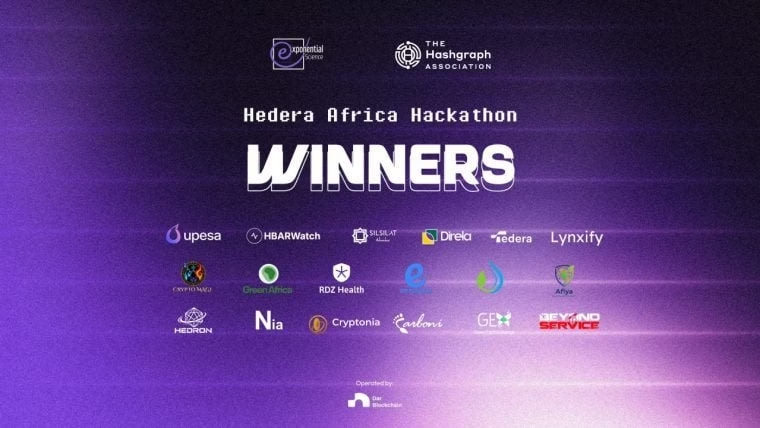
Nigeria’s Greenafrica walked away with the $100,000 grand prize at the Hedera Africa Hackathon, the continent’s largest Web3 competition to date, after a record-breaking event that drew more than 45,000 participants and distributed $1 million across four tracks.
Organized by The Hashgraph Association in collaboration with Exponential Science, the hackathon spanned 20 physical hubs across Africa alongside a strong online presence. The scale of participation reflects a growing appetite for blockchain-driven solutions to real-world problems.
The Hedera Africa Hackathon generated more than 1,300 project submissions, each built using Hedera’s distributed ledger technology to tackle infrastructure challenges across emerging markets. From financial systems to healthcare tools, the range of ideas reflected both technical depth and practical focus.
A $1 million prize pool was distributed across four tracks: on-chain finance and real-world assets, distributed ledger technology for operations, immersive experiences, and artificial intelligence integrated with decentralized physical infrastructure networks (DePIN).
For many participants, the hackathon served as a launchpad into building scalable solutions rather than experimental prototypes.
Greenafrica, a Nigeria-based environmental verification platform, emerged as the overall “cross-track champion,” securing the top $100,000 award. The platform focuses on improving transparency in sustainability initiatives by enabling verifiable tracking of environmental impact.
Its win reflects a broader trend among submissions, where projects focused on measurable real-world use cases rather than purely theoretical blockchain applications.
Although centered in Africa, the hackathon attracted participants from across multiple regions, creating a cross-border innovation environment.
Egypt’s Carboni Renewable Energy Certificate Platform placed second, offering infrastructure for tracking renewable energy credits. Mexico’s Effisend X Africa secured third place with an AI-powered payment routing system designed to improve cross-border transaction efficiency.
These outcomes highlight how the hackathon is blending global expertise with region-specific problem-solving.
Organizers noted a clear evolution in the type of projects submitted. Compared to earlier blockchain cycles, this edition showed a stronger emphasis on deployable infrastructure.
Solutions increasingly addressed areas such as cross-network payments, digital identity systems, and secure medical data management. This shift signals a maturing developer ecosystem moving beyond experimentation toward planned implementation.
“The Hedera Africa Hackathon reached historic heights, scaling the depths of talent and ambition across the continent and beyond,” said Kamal Youssefi. “Hedera has a longstanding commitment to enabling global innovation and powering real utility.”
Alongside the awards, organizers announced the creation of a new investment committee designed to support promising projects emerging from the hackathon event.
The initiative will provide access to funding, mentorship, and strategic partnerships, helping developers transition from prototypes to fully operational platforms. This reflects a growing focus on long-term ecosystem development rather than one-off competition outcomes.
Education played a central role in the hackathon’s structure, with many participants entering through training programs and technical workshops. Paolo Tasca emphasized the importance of this foundation.
“Any strong, innovative and responsible technical ecosystem begins with education,” Tasca said. “We have seen that approach materialize at scale, with participants advancing from learning to the development of meaningful infrastructure.”

This emphasis on skill-building ensures that the hackathon contributes to sustained growth within the developer community.
The event was co-funded by The Hashgraph Association and Exponential Science, with additional support from Orange Digital Center, Sygnum Bank, and Nairobi Securities Exchange.
Operational execution was handled by Dar Blockchain, ensuring coordination across multiple locations and participants expecially in African countries.
The combination of public and private sector involvement highlights the increasing institutional interest in Africa’s blockchain ecosystem.



Copyright © 2025 - The Bit Gazette.