







- Trending
- Comments
- Latest

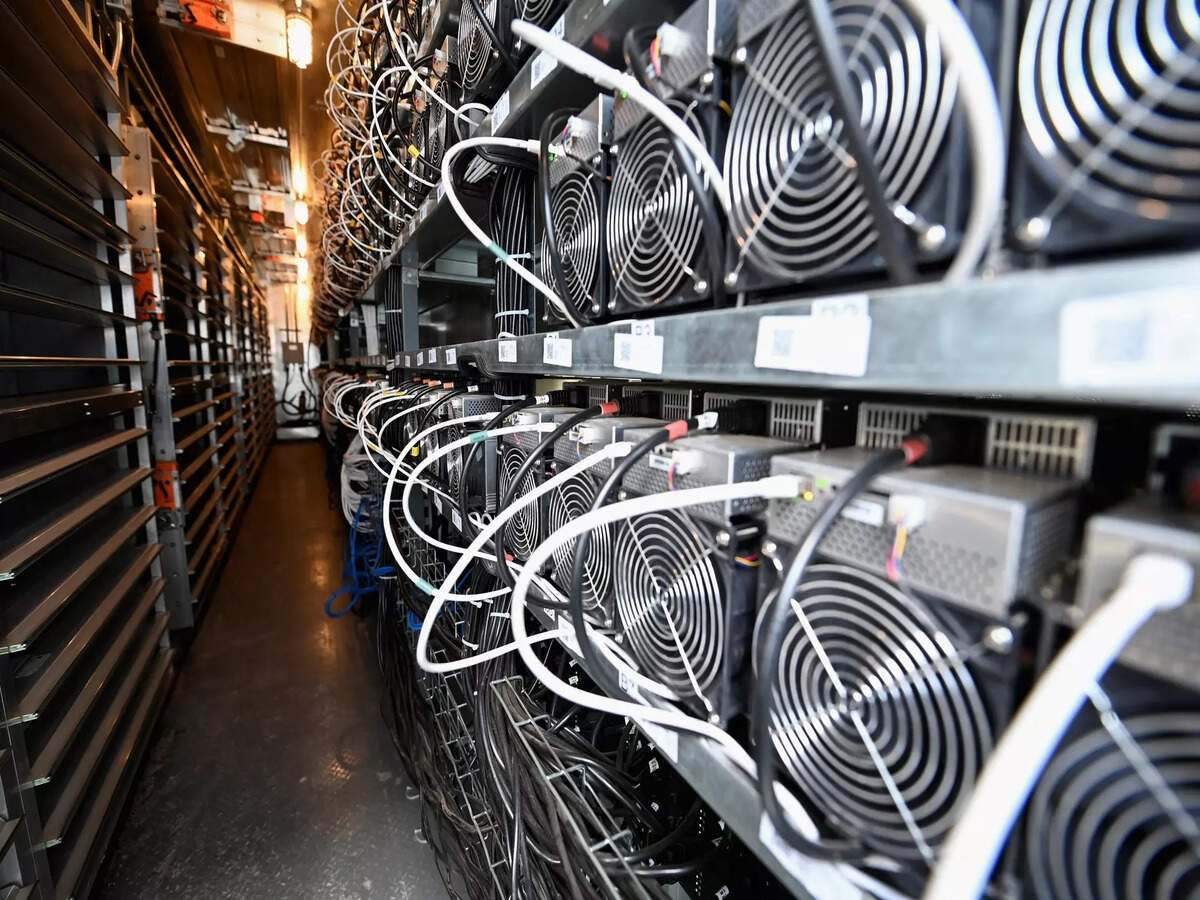
Large Bitcoin mining companies including Core Scientific and MARA Holdings are shifting operations toward artificial intelligence data centers, exploiting a significant profitability gap: AI workloads generate $200–$500 per megawatt of electricity compared to Bitcoin mining’s $57–$129 per megawatt.
Core Scientific recently secured $1 billion in credit financing tied to AI infrastructure expansion, while MARA Holdings disclosed potential Bitcoin sales to fund AI projects. The pivot raises concerns among analysts about network security if large-scale mining operations continue abandoning Bitcoin.
Crypto trader Ran Neuner argues that the economics increasingly favor AI workloads over Bitcoin mining.
“AI has killed Bitcoin forever,” Neuner said in a social media post on Sunday. “AI is willing to pay much more for it,” –he added, referring to electricity used to power computing infrastructure.
According to Neuner, mining Bitcoin generates roughly $57 to $129 in revenue per megawatt of electricity, while AI data center workloads can generate between $200 and $500 per megawatt.
That profitability gap, he argues, is encouraging companies to shift away from Bitcoin mining toward AI hosting services.
Recent industry moves appear to support this trend. Core Scientific secured up to $1 billion in credit financing tied to AI hosting expansion, while MARA Holdings filed a disclosure with the U.S. Securities and Exchange Commission indicating it could sell part of its Bitcoin holdings as it explores AI-related opportunities.
Despite warnings that an exodus of miners could weaken the network, some researchers and cryptographers say the design of Bitcoin mining already accounts for changes in participation.
Adam Back, a cryptographer and early Bitcoin pioneer, argues that the protocol’s built-in difficulty adjustment mechanism would automatically stabilize Bitcoin mining profitability if some miners leave the network.
“What happens to Bitcoin is simple: tick tock, next block! Difficulty adjusts downwards, the least efficient and AI switchers move out, and Bitcoin mining profitability converges to AI profitability,” — Adam Back, CEO of Blockstream.
Bitcoin’s network adjusts its mining difficulty approximately every two weeks to ensure blocks continue to be produced roughly every ten minutes.
When miners shut down operations, the difficulty falls, making Bitcoin mining more profitable for remaining participants.
Investor and analyst Fred Krueger also emphasized that the protocol’s economic incentives are designed to handle competition for energy.
“If AI outbids miners for electricity, miners just turn off until the difficulty adjusts and it’s profitable again that’s literally how Bitcoin works,” Krueger said.
Supporters say this adaptive system has allowed Bitcoin mining to remain resilient through multiple market cycles, including previous bear markets where miner participation temporarily declined.
Some analysts point to recent changes in network activity as evidence of pressure on Bitcoin mining economics.
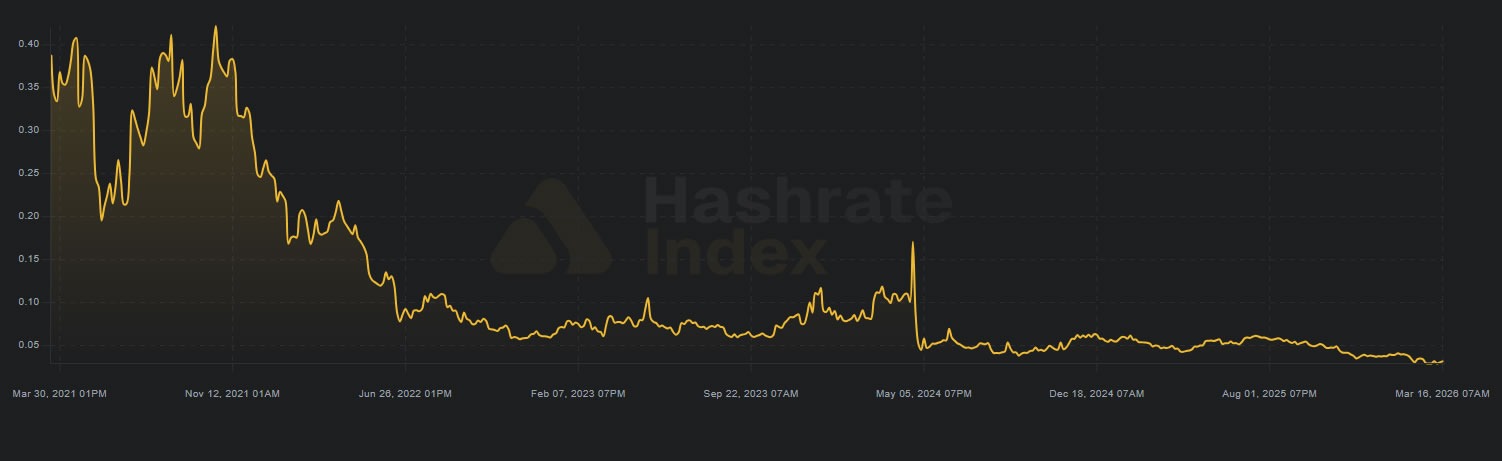
Hashrate is the total computing power securing the network has reportedly fallen about 14.5% from its peak in October.
Neuner warns that a declining hashrate could reduce the security of Bitcoin mining, increasing the theoretical risk of a “51% attack,” where a single actor gains control of the majority of computing power on the network.
However, environmental researcher Daniel Batten argues the relationship between AI and Bitcoin mining may be more cooperative than competitive.
“The evidence tells us that AI is dependent upon Bitcoin for its expansion,” Batten said, noting that miners often build large-scale energy infrastructure that can later support other computing industries.
Unlike traditional data centers, Bitcoin mining operations frequently rely on stranded or underutilized energy sources, including excess renewable power and remote energy supplies that would otherwise go unused.
This flexibility allows miners to operate where electricity is cheaper or intermittently available, a model that AI data centers cannot always replicate.
Market analysts say the future of Bitcoin mining may ultimately depend on Bitcoin’s price trajectory. Higher prices increase mining revenue, potentially offsetting competition from AI computing.
Neuner suggested that a strong rally could quickly reverse the trend of miners exploring alternatives.
“What I hope is that Bitcoin has one green candle. Maybe because of the war, maybe because of the regulation who knows?” Neuner said.
Recent market data indicates Bitcoin has experienced five consecutive monthly declines, a pattern last seen during the 2018 bear market.
However, early signs of recovery have appeared, with the asset posting gains of roughly 8% so far this month, according to data from CoinGlass.
For now, industry observers say the tension between artificial intelligence infrastructure and Bitcoin mining highlights a broader shift in global computing demand.
Whether that competition weakens or ultimately strengthens Bitcoin mining will likely depend on energy markets, hardware innovation, and the cryptocurrency’s long- term price performance.



Copyright © 2025 - The Bit Gazette.

