







- Trending
- Comments
- Latest

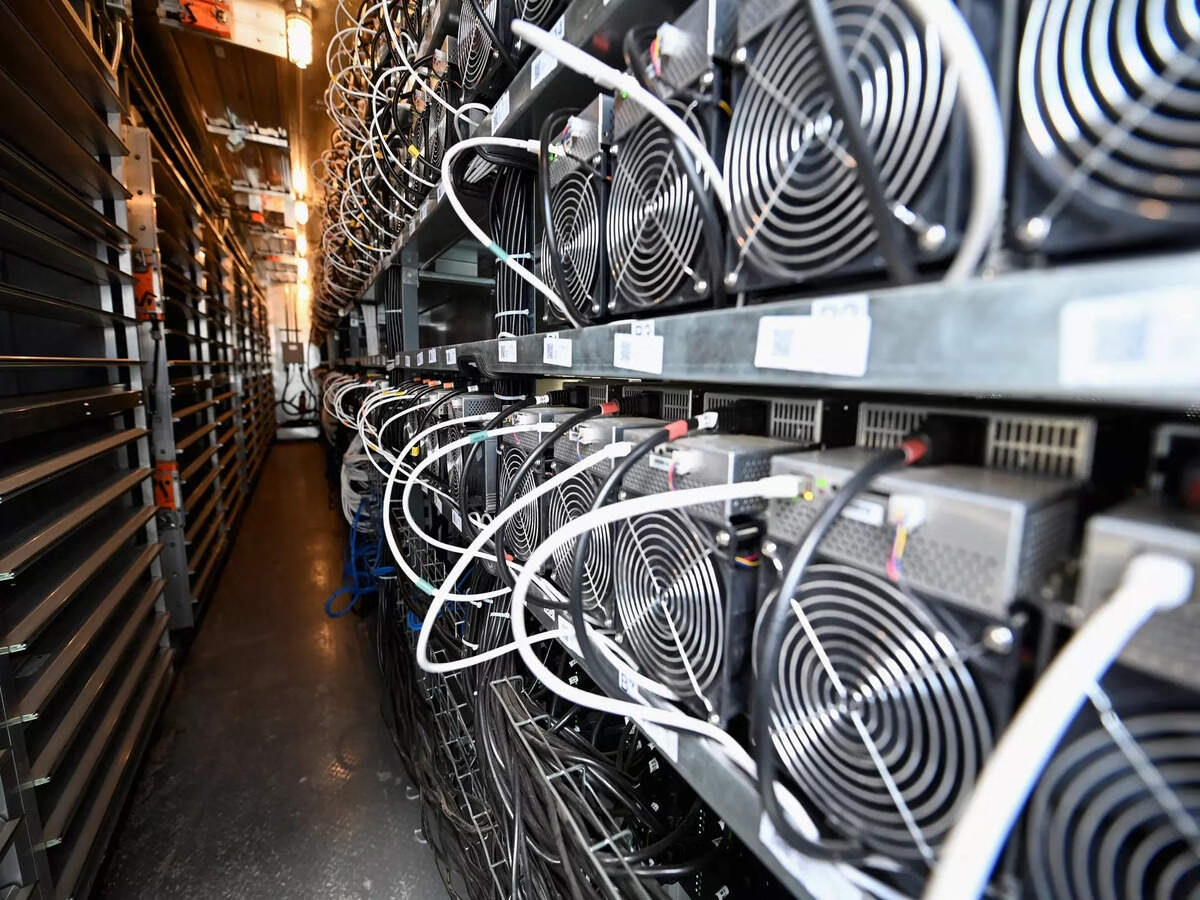
Bitcoin mining used to be a commodity business: find cheap grid power, run rigs at scale, repeat. Now miners are bypassing the grid entirely, and in doing so, they’re solving one of renewable energy’s most persistent problems.
Across Texas, Brazil, and parts of North America, miners are moving directly behind power generation sources, solar farms, wind facilities, natural gas plants, and stranded energy sites to access electricity before it reaches the broader grid.
The above model is known as behind-the-meter mining, is gaining relevance as energy volatility rises and traditional mining economics weaken.
While much of the market remains focused on ETF flows and price action, infrastructure investors are quietly watching a bigger transformation unfold.
Behind-the-meter mining happens when Bitcoin miners connect directly to an energy source rather than buying electricity from public utilities.
Instead of drawing power from the grid:
This matters because electricity transmission remains one of the biggest inefficiencies in global energy systems.
In many markets, renewable producers generate excess electricity that cannot be distributed due to weak transmission infrastructure.
Bitcoin miners solve that problem because they are highly flexible energy buyers.
Unlike AI data centers or factories, miners can shut down within minutes when electricity demand spikes elsewhere.
In February, Reuters reported that utility giant Engie is exploring Bitcoin mining at its massive solar project in Brazil to monetize electricity being wasted due to grid curtailments.
Meanwhile, Sangha Renewables recently energized a 19.9 MW behind-the-meter Bitcoin mining operation tied directly to a Texas solar farm, turning unused renewable power into revenue.
At the same time, miners are under heavy financial pressure. According to recent industry reporting, average production costs approached $80,000 per Bitcoin in Q1 2026, forcing many operators to rethink their energy strategies.
Behind-the-meter setups offer one of the few remaining structural advantages.
This is no longer just a Bitcoin story. Energy companies increasingly view miners as “buyers of last resort.”
When electricity demand drops; Renewable operators lose revenue, Oil producers waste natural gas, and Grid congestion worsens.
Bitcoin miners can absorb that excess energy instantly. That’s why firms like Engie, TeraWulf, and Soluna Holdings are aggressively repositioning themselves around energy infrastructure rather than pure crypto speculation.
Even regulators are paying attention. U.S. grid watchdogs recently raised concerns over power plants being acquired for mining and data-center usage instead of feeding public electricity markets.
For crypto investors, behind-the-meter mining signals a major shift in how mining businesses should be valued.
The winners may not be the firms holding the most Bitcoin reserves.
They may be the companies controlling: Power assets, Energy contracts, Grid flexibility, Renewable partnerships, and Infrastructure permitting advantages.
Mining is evolving from a speculative business into a power optimization business.
In a world where electricity is becoming the most valuable commodity in both AI and crypto infrastructure, miners sitting closest to energy generation may hold the strongest long-term edge.



Copyright © 2025 - The Bit Gazette.

