


- Trending
- Comments
- Latest

The International Monetary Fund has told Brazil to close specific gaps in its crypto oversight after finding that cross-border stablecoin flows have grown faster than both traditional capital flows and the country’s economic output since 2017.
The finding appears in the IMF’s new Financial System Stability Assessment (FSSA) for Brazil, Country Report No. 26/192, published this month and based on a joint IMF–World Bank mission that visited the country in December 2025 and March 2026.
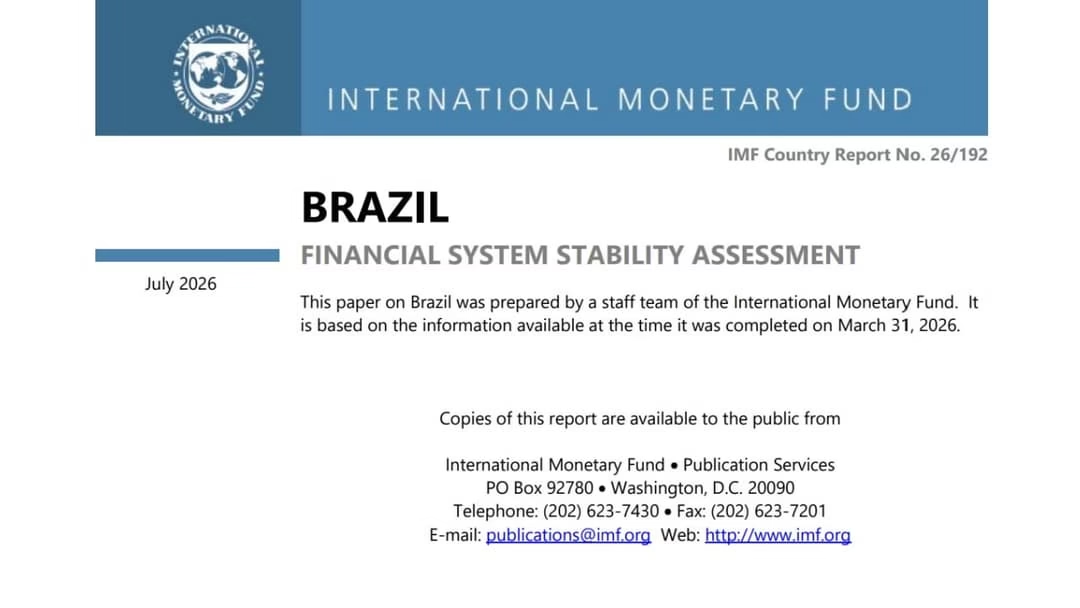
The assessment covers Brazil’s entire financial system, banks, insurers, investment funds, payments infrastructure, with crypto singled out as one of several areas where regulation hasn’t kept pace with growth.
The IMF found that Brazil’s crypto market, particularly dollar-pegged stablecoins, has expanded rapidly since 2017, with cross-border flows outpacing both traditional capital flows and nominal GDP growth.
Between one-third and two-thirds of the variation in stablecoin purchases can be traced to external factors, the VIX, bitcoin prices, and the S&P 500 among them, making these flows two to three times more sensitive to global market shocks than ordinary portfolio or foreign direct investment flows, according to the report.
On the domestic side, the fund also linked stablecoin demand to the exchange rate, interest rates, policy uncertainty, and changes to Brazil’s IOF financial transaction tax.
The report credits Brazil’s central bank, the Banco Central do Brasil (BCB), with introducing oversight of crypto-asset service providers (CASPs) and improving how it monitors crypto flows. But the IMF is explicit that this doesn’t yet add up to a complete regulatory framework. Two gaps stand out in the report:
On the anti-money-laundering side, the IMF found that while new rules have introduced AML/CFT obligations for CASPs, incomplete rollout of the international Travel Rule standard, plus the suspension of CASPs from Brazil’s financial intelligence unit reporting portal, means the current regime doesn’t yet meet international requirements.
The report’s formal recommendation table puts three crypto-specific asks to Brazil’s Finance Ministry and central bank, all marked “short term” (1–2 years):
A fourth recommendation, also short-term, calls on the BCB to implement AML/CFT requirements for CASPs that actually meet international standards.
Crypto is a relatively small piece of a much larger assessment. The IMF’s overall verdict on Brazil’s financial system was reassuring: banks are “profitable, well-capitalized, and liquid,” and stress tests show the system can absorb even severe shocks, including a hypothetical sovereign debt crisis.
Brazilian authorities, for their part, welcomed the report and said they’re “at the forefront of laying out a regulatory framework for the emerging crypto asset industry” and would continue updating it.
Still, the report treats crypto as a genuine, if contained, source of forward-looking risk, the kind regulators need to move on now, before the market gets bigger. As the IMF put it in its own risk framing: systemic financial stability risks from crypto currently appear contained, but the pace of growth “warrants close monitoring.”



Copyright © 2025 - The Bit Gazette.