

- Trending
- Comments
- Latest

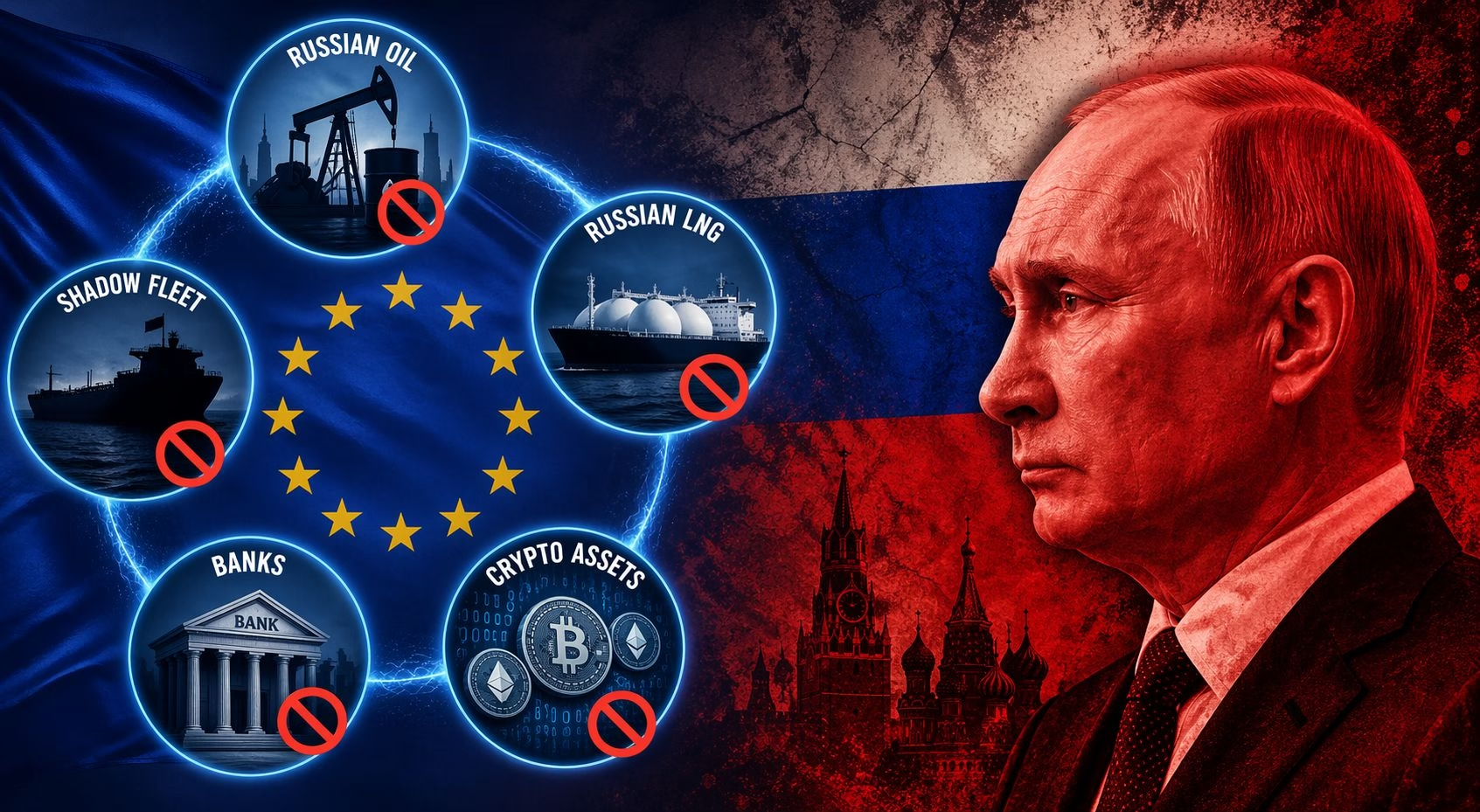
The European Union has announced its largest sanctions package against Russia in two years, extending restrictions for the first time into decentralised finance infrastructure and banning Russian crypto service providers, the ruble-pegged stablecoin RUBx, and participation in the digital ruble project.
In its April 23 announcement, the European Union described the new measures as its “biggest package” of restrictions in recent years. At the center of the update is a sweeping crypto ban designed to close emerging loopholes in cross-border finance.
According to the statement, EU Russia sanctions now include a total prohibition on cryptocurrency service providers and platforms operating out of Russia. This marks a significant tightening of digital asset rules, extending restrictions beyond banks into blockchain-based financial systems.
> “Russia is becoming increasingly reliant on cryptocurrencies for international transactions,” the EU said, confirming that the new EU Russia sanctions are aimed at cutting off these alternative payment channels.
A major component of the updated EU Russia sanctions package is the outright ban on crypto service providers linked to Russia, including platforms facilitating asset transfers and exchanges.
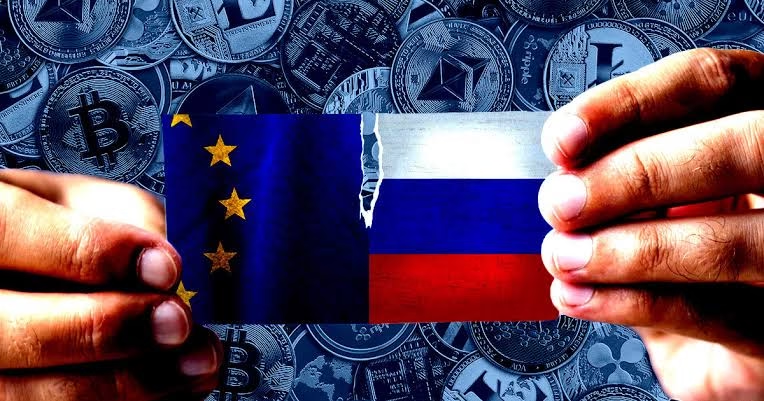
The EU also moved to block involvement in Russia’s central bank digital currency (CBDC), alongside restrictions on the ruble-pegged stablecoin RUBx and any support for the development of a digital ruble system.
These steps effectively extend EU Russia sanctions into both centralized and decentralized financial infrastructure, closing off multiple pathways for digital settlement.
The sanctions are not limited to crypto. They also extend to 20 Russian banks and four third-country financial institutions connected to Russia’s System for Transfer of Financial Messages (SPFS), the country’s alternative banking communication network.
According to blockchain intelligence firm Chainalysis, the updated EU Russia sanctions package is designed to disrupt both traditional and digital financial rails simultaneously.
Chainalysis noted that the measures represent one of the most coordinated attempts yet to restrict Russia’s access to global liquidity channels through EU Russia sanctions enforcement.
One of the more technical elements of the EU Russia sanctions package involves targeting regional crypto ecosystems that have allegedly facilitated cross-border flows.
The EU has sanctioned TengriCoin, a Kyrgyz crypto exchange operating as Meer.kg, which reportedly handles significant volumes of the government-linked stablecoin A7A5.
Chainalysis reports that A7A5 has processed over $119.7 billion in total volume, functioning as a settlement mechanism designed to route funds through sanctioned networks. This makes it a key focus of EU Russia sanctions enforcement efforts.

The intelligence firm also highlighted that earlier tracking of the Garantex–Grinex–A7A5 ecosystem shows a long-running pattern of adaptation to sanctions pressure, reinforcing the need for expanded EU Russia sanctions coverage.
Chainalysis described the latest measures as a structural shift in enforcement.
> “The new measures now create an ecosystem-wide crypto restriction on Russia and Belarus,” the firm stated, referring to the broadened scope of EU Russia sanctions.
Under the updated rules, individuals and entities within the EU are prohibited from interacting with Russian or Belarusian crypto service providers and decentralized finance (DeFi) platforms. This effectively extends EU Russia sanctions into decentralized infrastructure for the first time at scale.
The EU also confirmed that firms operating under the Markets in Crypto-Assets Regulation (MiCA) framework are barred from offering services to Belarus-linked entities, reinforcing the cross-border reach of EU Russia sanctions.
Another key element of the package is the prohibition of netting transactions involving Russian agents. The EU stated that this measure is designed to prevent indirect settlement mechanisms from being used to bypass EU Russia sanctions.
By restricting both direct and indirect financial flows, regulators aim to eliminate remaining channels of circumvention that have emerged through crypto and hybrid financial systems.
The updated EU Russia sanctions also reference multiple jurisdictions tied to financial activity and trade flows, including Kyrgyzstan, China, the United Arab Emirates, Uzbekistan, Kazakhstan, and Belarus.
While these countries are not necessarily targeted directly, their inclusion signals heightened scrutiny of intermediary networks that may facilitate sanctions evasion under the expanded EU Russia sanctions regime.
Experts say the latest round of EU Russia sanctions reflects a growing challenge for regulators: tracking financial activity across decentralized systems.
Crypto’s borderless nature allows value to move quickly across platforms, jurisdictions, and protocols. This makes enforcement under EU Russia sanctions significantly more complex than traditional banking restrictions.
Chainalysis and other analytics firms are increasingly playing a central role in identifying transaction flows tied to sanctioned entities, reinforcing the importance of blockchain intelligence in modern EU Russia sanctions enforcement.
The latest EU Russia sanctions package marks a turning point in how digital assets are treated in geopolitical enforcement.
What began as targeted financial restrictions has now evolved into a broad digital containment strategy, with crypto infrastructure firmly in the crosshairs.



Copyright © 2025 - The Bit Gazette.