

- Trending
- Comments
- Latest

Arbitrum’s Security Council froze $71.1 million in ETH after attackers drained roughly $292 million from Kelp DAO last month. Now the DAO is voting on what to do with it, and within the first hour, 16.9 million ARB tokens backed the recovery proposal with no opposition recorded.
The funds in question were transferred by an attacker during the Kelp DAO exploit and later locked by Arbitrum’s Security Council. The Kelp recovery vote seeks to determine whether these frozen assets should be allocated to DeFi United, a collaborative fund designed to stabilize the ecosystem following the breach.
The Kelp recovery vote follows swift action by the Arbitrum Security Council, which intervened on April 20 to contain the fallout from the exploit. Approximately $71.1 million worth of ETH was locked after being transferred to a designated address, preventing further movement of the funds.
The council stated that the decision was made under the direction of law enforcement and emphasized that the action was taken to protect the ecosystem without disrupting regular users. The intervention required approval from 9 out of 12 council members, sparking debate over decentralization and governance authority within the network.
While some critics questioned the concentration of power, others viewed the move as necessary to preserve trust and prevent additional losses. The Kelp recovery vote now represents the next step in determining how those locked assets will be used.
At the center of the Kelp recovery vote is a complex exploit that unfolded across multiple protocols. Days before the incident was fully contained, attackers withdrew approximately 18% of Kelp DAO’s rsETH supply, valued at around $292 million, using a cross chain bridge mechanism.
The stolen assets were then moved across platforms, including Aave, Compound, and Euler, where they were used as collateral to borrow additional funds. This activity created a debt exposure estimated at $236 million.
In response, affected protocols paused certain operations to limit further damage. The scale and coordination of the exploit have raised concerns among security analysts, particularly amid suspicions that the attacker may be linked to the Lazarus Group.
The Kelp recovery vote is therefore not only about reallocating funds but also about restoring confidence in systems that were exposed during the attack.
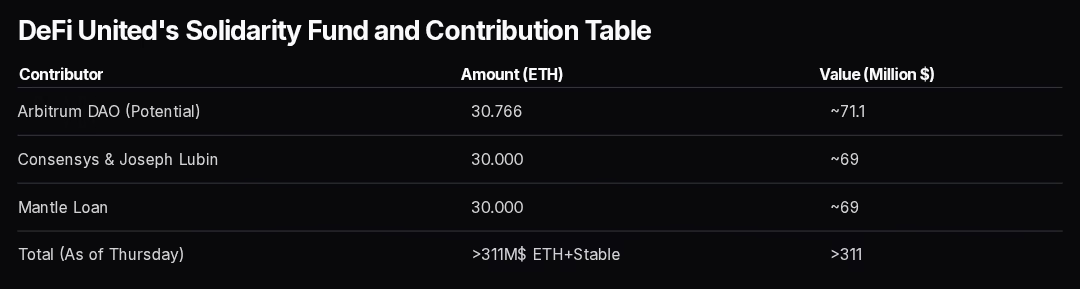
The outcome of the Kelp recovery vote will directly impact DeFi United, a collective initiative led by the Aave ecosystem to support recovery efforts. As of Thursday, the fund has accumulated more than $311 million in ETH and stablecoins from multiple contributors.
If approved, Arbitrum DAO’s contribution would represent one of the largest allocations to the fund. Other participants include Aave DAO, LayerZero, and Kelp stakeholders, signaling a broad industry effort to mitigate the effects of the exploit.
The Kelp recovery vote reflects a growing trend of coordinated responses within decentralized finance, where protocols collaborate to address systemic risks rather than operate in isolation.
The Kelp recovery vote is also being closely watched by market participants, particularly in relation to the performance of Aave and other lending protocols affected by the exploit. AAVE is currently trading at $91.97, reflecting a slight decline amid broader uncertainty in the sector.
Technical indicators suggest mixed sentiment, with neutral momentum but persistent bearish pressure. Analysts note that the resolution of the Kelp recovery vote could influence short term price movements, especially if it strengthens confidence in recovery mechanisms and governance processes.
Beyond price action, the vote underscores the importance of robust risk management systems within DeFi. The incident has renewed calls for stronger safeguards, including improved cross chain security and more effective emergency response frameworks.
The Kelp recovery vote has become a defining moment for the decentralized finance sector. It demonstrates how quickly communities can mobilize in response to crises, but also highlights the structural weaknesses that such events expose.
As voting continues, the decision will shape not only the immediate recovery effort but also broader perceptions of governance, accountability, and resilience in DeFi. Whether the proposal is ultimately approved or not, the Kelp recovery vote is likely to influence how future incidents are handled across the ecosystem.



Copyright © 2025 - The Bit Gazette.