

- Trending
- Comments
- Latest

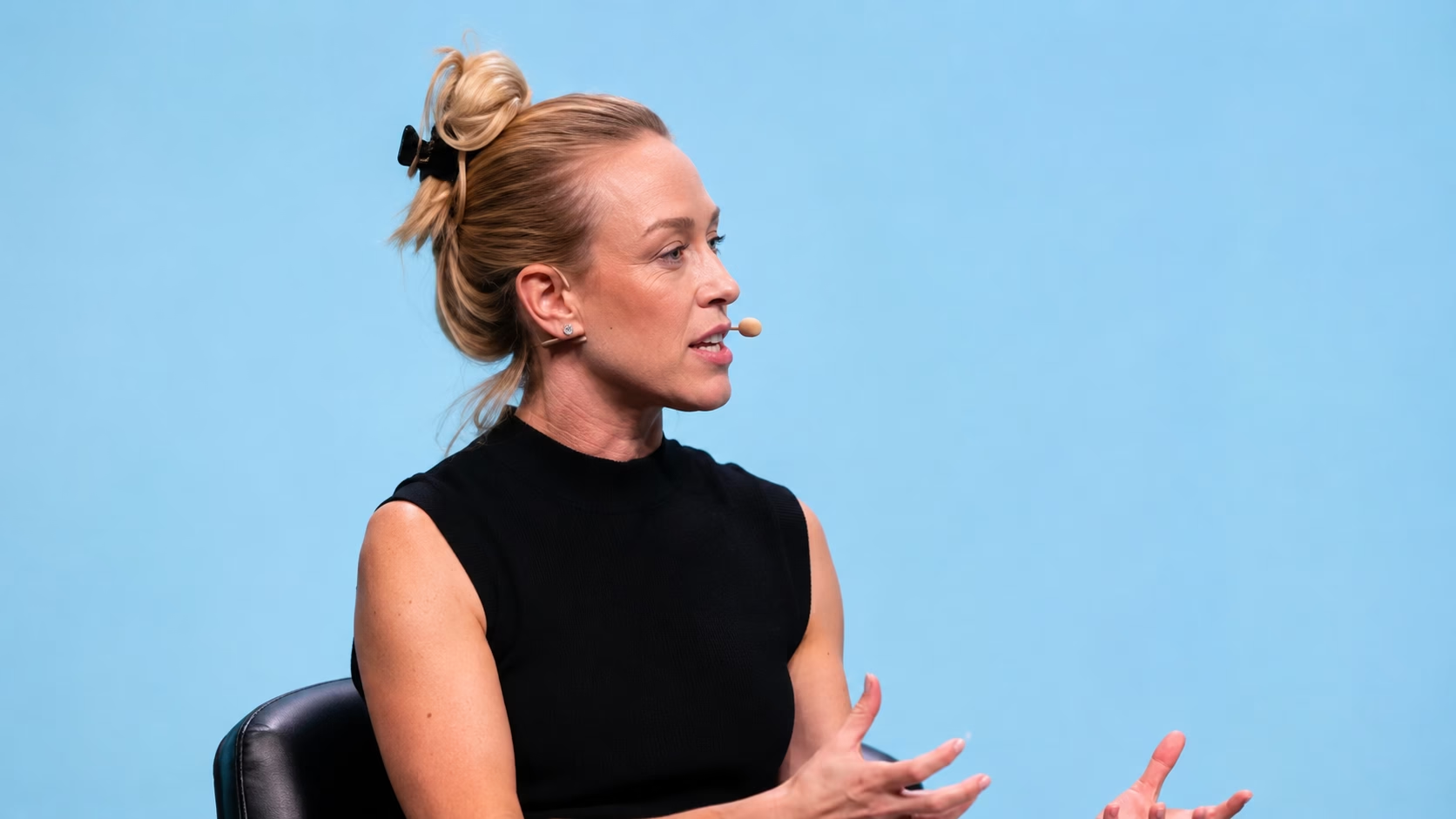
Equity perpetual futures could overtake crypto perps in offshore volume within two to three years, according to Galaxy’s Mike Harvey, who made the projection during a derivatives panel at Consensus 2026 in Toronto. The claim marks a significant shift in how institutional players are framing the convergence trade, no longer as a prediction, but as an active build.
According to Mike Harvey, the trajectory is unmistakable. “There has been a lot of talk about tokenized equities, and within the next two or three years, the volume of offshore traded equity perps will be greater than crypto perps,” he said at Consensus 2026.
That prediction underscores a structural shift. Markets are no longer separated by asset class or geography—they are increasingly unified by infrastructure. Consensus 2026 made clear that what began as a crypto innovation is now reshaping global finance itself.
Perpetual futures—contracts without expiry—have long dominated crypto derivatives trading. By early 2026, they accounted for over 70% of total crypto market activity, with monthly volumes reaching trillions of dollars.
But Consensus 2026 revealed a new phase: these instruments are expanding beyond digital assets into traditional markets. Platforms like Binance and Hyperliquid are already experimenting with perpetuals tied to equities, commodities, and indices.
Despite early traction, these non-crypto perps still represent a small slice of total volume. However, Consensus 2026 emphasized that this imbalance may not last long. The infrastructure supporting these trades—liquidity networks, custody solutions, and settlement rails—is already mature.
Harvey explained that firms like Galaxy are actively bridging markets in real time. “As dealers, we’re the glue that holds those markets together. We have to move seamlessly between offshore exchanges, onshore venues, futures, and ETFs,” he said during Consensus 2026.
The implication is straightforward: the technical barriers have largely disappeared. What remains is for liquidity and user demand to catch up.
Another key theme at Consensus 2026 was regulation—not as a constraint, but as a catalyst.
Krista Lynch pointed to evolving guidance from the U.S. Securities and Exchange Commission as a major driver of convergence. In particular, generic listing standards are helping establish a formal relationship between derivatives markets and spot ETF eligibility.
“Having a derivative tied to a crypto asset is often a signal that a spot product should exist as well,” Lynch noted at Consensus 2026.
She outlined three pathways for assets to qualify for ETF inclusion, two of which depend directly on derivatives markets. One requires a regulated futures market with sufficient history, while another allows eligibility through derivative-based exposure such as swaps.
This framework reinforces the idea that derivatives are no longer secondary instruments—they are foundational. Consensus 2026 highlighted how these regulatory pathways are effectively linking crypto and traditional finance at a structural level.
For Griffin Sears, the real opportunity discussed at Consensus 2026 lies in capital efficiency.
He pointed to cross-margining—the ability to use different asset classes as collateral within a single account—as a breakthrough enabled by tokenization. “What’s really powerful is the cross-margining potential that real-world assets can unlock,” Sears said.
This approach allows traders to deploy capital more efficiently across markets, reducing fragmentation and improving liquidity. Consensus 2026 framed this as a major step toward a unified financial system where crypto and traditional assets coexist seamlessly.
Sears also made a bold projection: a traditional financial asset could soon rank among the top five traded instruments on a crypto exchange. That would mark a symbolic and practical turning point.
Consensus 2026 didn’t stop at derivatives—it pointed toward a broader transformation of capital markets.
Sears suggested that the evolution could culminate in fully on-chain equity listings. “We’re going to see direct IPOs and listings happen entirely on blockchain rails,” he said. “That’s when you’ll see billion-dollar IPOs executed completely on-chain.”
This vision aligns with trends already visible in ETF markets. Options tied to BlackRock’s spot Bitcoin ETF—commonly known as IBIT—have surged in popularity, becoming one of the most actively traded ETF options globally in under two years.
Consensus 2026 used this example to illustrate how quickly crypto-native innovation can scale into mainstream finance.
Importantly, panelists challenged the prevailing narrative that traditional finance is absorbing crypto. Instead, Consensus 2026 framed the shift in reverse: crypto infrastructure is forcing legacy systems to evolve.
The rise of 24/7 trading and real-time settlement—once unique to crypto—is now a benchmark that traditional exchanges are racing to match.
If there was a single takeaway from Consensus 2026, it is that convergence is no longer a future scenario—it is an active process already reshaping markets.
Equity perpetual futures represent the next frontier, but they are only part of a broader transformation. From regulatory alignment to cross-margining and on-chain listings, the foundations of a unified financial system are being laid in real time.
Consensus 2026 made one point unmistakably clear: the distinction between crypto and traditional finance is fading, and the institutions that adapt fastest will define the next era of global markets.



Copyright © 2025 - The Bit Gazette.