

- Trending
- Comments
- Latest

The U.S. Commodity Futures Trading Commission is being asked to oversee a multi-trillion-dollar digital asset market with fewer employees than at any point in the last 15 years.
By February 2026, the agency’s workforce had reportedly fallen from roughly 708 employees at the end of fiscal year 2024 to approximately 535, a decline of nearly 25%. At the same time, Congress is advancing the CLARITY Act, legislation that would significantly expand the CFTC’s authority over digital commodity spot markets.
The contradiction is becoming impossible to ignore.
The agency’s Chicago office has reportedly lost all 20 of its trial attorneys. Four of the CFTC’s five commissioner seats remain vacant. The enforcement division is operating with substantially fewer lawyers just as lawmakers prepare to place much of the global crypto market under its supervision.
Meanwhile, prediction markets and tokenized assets are growing rapidly, creating entirely new categories of financial surveillance challenges that the agency was never originally designed to handle.
The result is a growing concern in Washington: the regulator tasked with overseeing America’s crypto future may not have the manpower to do the job.
| Key Metric | Value |
|---|---|
| CFTC staff (FY2024) | ~708 employees |
| CFTC staff (Feb. 2026) | ~535 employees |
| Workforce reduction | ~25% |
| Enforcement division reduction | ~23% |
| Chicago trial attorneys lost | 20 |
| Active commissioners | 1 of 5 |
| SEC staff comparison | ~4,200 employees |
| Proposed FY27 CFTC budget | $410 million |
| Global digital asset market | ~$3 trillion |
| Offshore crypto market share | ~88% |
| Tokenized U.S. Treasuries | $15.5 billion |
| Total tokenized RWA market | ~$25 billion |
The Commodity Futures Trading Commission was designed to operate with five commissioners, with no political party controlling more than three seats.
Today, it effectively functions as a one-person commission.
Michael Selig has remained the agency’s only sitting commissioner since late 2025 following multiple departures. The absence of a full bipartisan commission has triggered growing alarm among lawmakers who argue that sweeping digital asset rules written by a single commissioner are legally fragile and politically vulnerable.
In May 2026, bipartisan leaders of the House Agriculture Committee formally urged President Donald Trump to fill the vacant seats, warning that durable crypto regulation requires broader institutional legitimacy.
The concern is not theoretical.
Rules approved by a fully staffed commission are generally viewed as more resistant to legal challenge and policy reversals. A single-chair structure creates the perception — and potentially the legal reality — that major regulatory decisions could be overturned by future administrations or challenged in federal court.
Senator Amy Klobuchar has reportedly proposed an amendment that would delay implementation of the CLARITY Act until at least four commissioners are seated.
Selig, however, has argued that the agency cannot afford to slow down.
“Our statute does not require a quorum,” he said during Consensus 2026. “At the same time, we cannot slow down.”
That urgency reflects the scale of what Congress may soon place under the agency’s authority.
The proposed CLARITY Act is designed to resolve the long-running jurisdictional conflict between the SEC and the CFTC by defining which digital assets qualify as commodities and which qualify as securities.
If passed, the legislation would hand the CFTC broad oversight over digital commodity spot markets, including large portions of Bitcoin and Ethereum trading activity.
The scale is enormous.
Industry estimates suggest that roughly 88% of the global crypto market currently operates offshore. Bringing even a fraction of that market under U.S. regulatory oversight would dramatically expand the CFTC’s responsibilities.
The agency is already requesting a FY27 budget increase to approximately $410 million, but even that increase would leave it smaller than it was during much of the previous decade.
The enforcement division arguably the most important unit for policing fraud, insider trading, and market manipulation is expected to operate with roughly 108 positions, down from approximately 140 filled roles in 2025.
Lawmakers increasingly see the contradiction.
Congress is preparing to give the CFTC more authority over digital assets while simultaneously leaving it with fewer lawyers, fewer investigators, and fewer commissioners.
The agency’s staffing collapse is not simply a bureaucratic statistic. It directly affects enforcement capacity.
The most striking example is the CFTC’s Chicago office, historically one of the agency’s most important enforcement hubs due to the city’s central role in U.S. futures markets.
According to multiple reports, all 20 trial attorneys in the Chicago office were lost during broader federal workforce reductions tied to the Trump administration’s Department of Government Efficiency initiative, commonly referred to as DOGE.
Former officials have described the cuts as especially damaging because many departures involved experienced enforcement lawyers and litigation specialists.
That matters because crypto enforcement is not automated.
Artificial intelligence tools can identify suspicious trades or unusual market activity, but they cannot:
Those tasks still require experienced attorneys — precisely the personnel categories most affected by the cuts.
Crypto is not the only fast-growing market on the CFTC’s desk.
The agency is also the primary regulator overseeing prediction markets such as Kalshi and Polymarket.
These platforms allow users to trade contracts tied to elections, wars, court rulings, economic data, central bank decisions, and geopolitical events.
The sector has expanded from relatively niche volumes into billions of dollars in trading activity.
That growth introduces an entirely new category of market surveillance complexity.
Prediction markets generate thousands of rapidly expiring event contracts, many operating around the clock on blockchain-based systems with pseudonymous users and international participation.
The CFTC has already acknowledged multiple ongoing investigations involving suspicious trading activity tied to geopolitical events and government actions.
Yet the agency’s existing enforcement structure was originally designed for conventional derivatives markets operating within more limited and predictable frameworks.
Prediction markets are fundamentally different:
The institutional mismatch is becoming increasingly obvious.
Chairman Selig has argued that automation and AI-assisted surveillance tools can partially offset staffing losses.
The agency has reportedly integrated systems such as Microsoft Copilot and other automated monitoring technologies into internal workflows.
Supporters argue that modern surveillance software can dramatically improve efficiency by identifying suspicious transactions faster than traditional methods.
Critics remain unconvinced.
Representative Andrea Salinas questioned whether the agency’s proposed staffing increases were remotely sufficient for the scale of digital asset oversight Congress is considering.
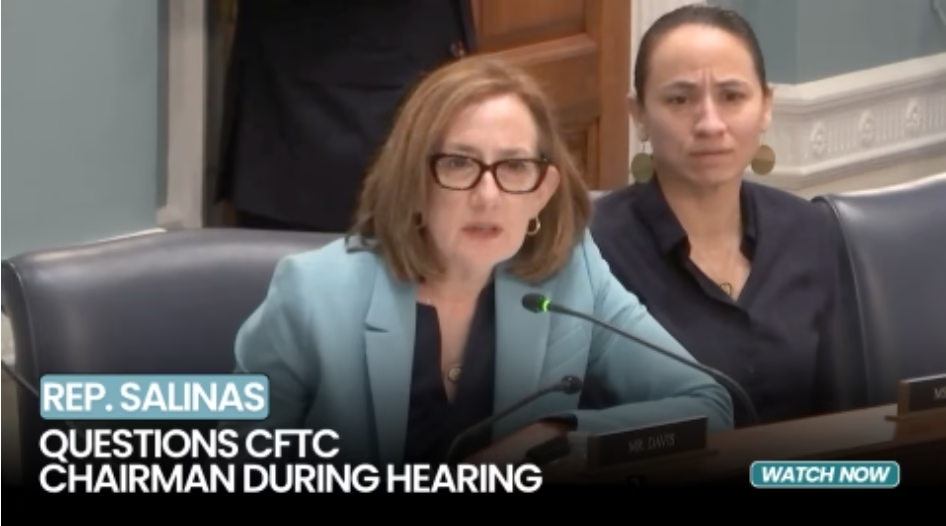
Her concern reflects a broader reality: AI can detect patterns, but it cannot fully replace human enforcement infrastructure.
A regulator overseeing a $3 trillion market still requires:
Without those human systems, enforcement risks becoming reactive rather than preventative.
The comparison with the U.S. Securities and Exchange Commission is increasingly difficult to ignore.
The SEC employs approximately 4,200 people.
The CFTC has roughly 535.
Both agencies maintain overlapping jurisdiction over digital assets, but the CLARITY Act would place much of the crypto spot market primarily under CFTC oversight.
That means the smaller agency could soon become the lead regulator for a global digital asset industry worth trillions.
In 2025:
Both agencies remain important to the broader regulatory framework. But the staffing disparity illustrates the scale mismatch embedded in the proposed system.
The CFTC’s staffing crisis is operational. Its commissioner vacancy crisis is constitutional and legal.
Major crypto rulemaking under the CLARITY Act would require extensive regulatory drafting and interpretation. Doing that work through a single commissioner invites lawsuits that could delay implementation for years.
Several prediction market lawsuits are already active across multiple U.S. states.
Legal analysts warn that courts may scrutinize one-person commission decisions more aggressively, particularly if those decisions reshape multi-trillion-dollar markets.
The result could be regulatory instability at precisely the moment lawmakers are attempting to establish long-term clarity for digital assets.
Supporters of the CLARITY Act face a narrowing legislative calendar.
The bill has already gained bipartisan momentum in Congress, but unresolved disputes remain, particularly around ethics provisions related to government officials holding crypto-related financial interests.
At the same time, lawmakers face an August recess and an approaching midterm election cycle that could dramatically slow legislative activity.
Even if the bill passes this year, rebuilding the CFTC’s staffing capacity will take considerably longer.
Replacing experienced litigators, reopening enforcement offices, and restoring institutional expertise cannot happen overnight.
The phrase “regulation by enforcement” has often been used to criticize U.S. crypto policy. The CFTC’s problem is different.
Its challenge is increasingly one of institutional capacity.
Four empty commissioner seats. A quarter of the workforce gone. An enforcement division operating with significantly fewer attorneys. A critical Chicago litigation office effectively erased.
Yet Congress is preparing to hand the agency oversight responsibility for large sections of the global crypto economy.
Technology can improve surveillance efficiency. Automation can identify suspicious patterns. But no algorithm can fully replace the institutional machinery required to regulate trillion-dollar markets.
The risk is not merely that the CFTC becomes aggressive or overreaching.
The greater risk may be that it becomes overwhelmed.
And if the first major crisis under the new crypto regulatory framework arrives before the agency rebuilds its manpower, the market may discover that regulatory clarity means little without regulators capable of enforcing it.



Copyright © 2025 - The Bit Gazette.