

- Trending
- Comments
- Latest

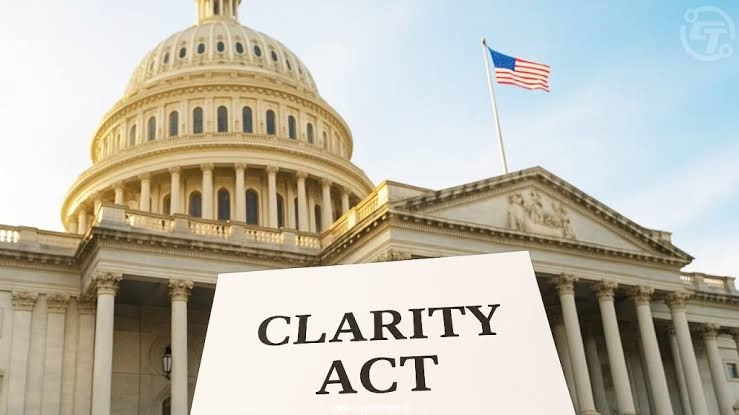
The U.S. Senate Banking Committee voted 15–9 on May 14, 2026, to advance the CLARITY Act, signaling what lawmakers and market participants describe as a decisive challenge to years of “regulation by enforcement” in the digital asset industry.
The legislation, which still faces significant political and procedural hurdles before becoming law, seeks to establish clear jurisdictional boundaries between the U.S. Securities and Exchange Commission and the Commodity Futures Trading Commission while creating legal definitions for digital assets.
For more than a decade, crypto firms operating in the United States have faced an uncertain regulatory environment shaped largely by lawsuits, enforcement actions and overlapping agency claims. The CLARITY Act attempts to replace that system of regulation by enforcement with statutory guidance that companies and institutional investors can follow directly.
The market reaction was immediate. Bitcoin maintained support above $80,000 despite broader macroeconomic pressure tied to inflation concerns, reinforcing investor expectations that a formal regulatory framework could unlock larger institutional participation in crypto markets.
At the center of the legislation is a long-running dispute over which federal agency should oversee digital assets. Under the current system, both the SEC and CFTC have asserted overlapping authority over different parts of the crypto sector, leaving companies vulnerable to enforcement actions even when compliance expectations remained unclear.
The CLARITY Act seeks to resolve that conflict by creating statutory distinctions between digital asset securities and digital commodities. Assets classified as securities would remain under SEC jurisdiction, while commodity-based assets would fall under CFTC oversight.
Supporters of the bill argue that this shift effectively weakens regulation by enforcement by replacing case-by-case litigation with written legal standards.
The legislation also introduces protections for non-custodial software developers and blockchain validators by clarifying that they should not automatically be classified as money transmitters. Industry advocates say this provision is critical for protecting open-source blockchain development in the United States.
Senators backing the bill contend that enforcement powers would still remain intact for cases involving fraud or investor harm, but that agencies would no longer rely on unclear legal interpretations to determine jurisdiction.
One of the most contested parts of the negotiations centered on stablecoin yield provisions. The final version of the CLARITY Act includes a compromise negotiated by Thom Tillis and Angela Alsobrooks.
Under the compromise, stablecoin issuers would be prohibited from offering passive, deposit-like interest payments that resemble traditional bank savings accounts. However, the bill still permits activity-based rewards tied to staking, transactions and other blockchain participation mechanisms.
The compromise helped secure bipartisan backing while addressing objections from traditional banking groups concerned about competition with federally insured deposits.
The American Bankers Association reportedly submitted more than 8,000 letters opposing aspects of the legislation, arguing that expanded stablecoin usage could divert deposits away from banks.
Despite the lobbying effort, the committee advanced the bill with support from some Democrats, including Ruben Gallego and Alsobrooks, both of whom participated in negotiations over investor protections and decentralized finance definitions.
Alsobrooks nevertheless cautioned that her support was not guaranteed for a final Senate floor vote.
“I’m voting yes to continue good-faith negotiation, not as a promise for the floor vote,” — Angela Alsobrooks, U.S. Senator.
The market interpreted the compromise as a sign that Congress may be moving toward regulated crypto integration rather than broad industry restrictions. Shares of Circle Internet Group reportedly surged nearly 20% following news of the agreement.
Although the committee vote represents a major milestone, the CLARITY Act still faces significant uncertainty before reaching the president’s desk.
One of the largest unresolved disputes involves proposed ethics provisions that would restrict senior government officials from maintaining financial ties to crypto-related businesses.
Democrats have pushed for stronger ethics language amid concerns about political conflicts of interest connected to crypto investments and projects linked to public officials. The White House has reportedly opposed provisions perceived as specifically targeting the president.
The disagreement could determine whether the legislation can secure the 60 Senate votes needed to advance.
At the same time, lawmakers face growing time pressure. Senators involved in the negotiations have warned that failure to pass the bill before the August congressional recess could delay comprehensive crypto legislation for years due to midterm election campaigning and legislative gridlock.
The timing concerns have added urgency to ongoing bipartisan negotiations behind closed doors.
Beyond the political battle, financial institutions are closely monitoring how the CLARITY Act could reshape digital asset markets.
Supporters argue that the end of regulation by enforcement would remove one of the largest barriers preventing traditional financial firms from expanding crypto exposure. According to industry analysts, institutional investors have largely waited for regulatory clarity before committing substantial capital to digital assets.
Financial adviser Ric Edelman recently argued that institutional demand could accelerate rapidly once clear rules are established.
Edelman described a potential “flywheel effect” in which institutional adoption drives price appreciation, attracting additional investors and further increasing demand for Bitcoin and other digital assets.
The theory has gained traction as firms like Morgan Stanley begin allowing advisers to introduce limited crypto exposure into client portfolios.
Some analysts believe that even a small percentage allocation from large wealth management platforms into Bitcoin could create substantial buying pressure across the market.
Still, regulatory implementation would likely take years even if the CLARITY Act becomes law. Federal agencies including the SEC, CFTC and Treasury Department would still need to draft detailed rules, conduct public consultations and finalize enforcement procedures.
Industry observers expect the earliest full implementation phase to stretch into late 2027 or beyond.
For now, the committee vote represents a symbolic shift away from regulation by enforcement and toward a rules-based framework that could reshape the future of crypto regulation in the United States.



Copyright © 2025 - The Bit Gazette.