

- Trending
- Comments
- Latest

AllUnity, backed by DWS, Flow Traders, and Galaxy Digital, plans to launch SEKAU, a Swedish krona-backed stablecoin, in June, as European financial firms push to build regulated local-currency alternatives to dollar-backed tokens that currently control 99% of the global stablecoin market.
The Frankfurt-based company, backed by major financial players including DWS, Flow Traders, and Galaxy Digital, announced plans Wednesday to debut the SEKAU stablecoin in June, pending final regulatory and operational approvals. The launch comes as European financial firms accelerate efforts to reduce dependence on U.S. dollar-backed stablecoins, which continue to dominate the global digital asset economy.
According to AllUnity, the SEKAU stablecoin will be fully backed by Swedish krona reserves and issued under the European Union’s Markets in Crypto-Assets framework, better known as MiCA. The project marks another major step in Europe’s attempt to create regulated local-currency alternatives capable of competing with dollar-pegged tokens like USDT and USDC.
The timing of the SEKAU stablecoin launch reflects a wider shift taking place across Europe’s digital finance sector.
European banks, fintech firms, and payment providers are increasingly concerned about the growing dominance of U.S.-issued stablecoins in blockchain settlements and decentralized finance. Industry data shows dollar-backed stablecoins account for roughly 99% of the global stablecoin market, leaving euro and other local-currency alternatives with only a tiny fraction of adoption.
That imbalance has triggered renewed efforts across Europe to establish sovereign digital payment infrastructure under clear regulatory oversight.
“Sweden has long been a global leader in the transition toward a cashless economy, but that transition also requires a new form of digital money that is interoperable and globally accessible,” said AllUnity CEO Alexander Höptner in the company’s announcement.
The SEKAU stablecoin is expected to play a role in that transformation by enabling blockchain-based settlements tied directly to the Swedish krona while remaining compliant with Europe’s regulatory standards.
One reason the SEKAU stablecoin is attracting attention is the growing importance of MiCA, Europe’s comprehensive crypto regulatory framework.
MiCA provides legal clarity for stablecoin issuers operating across the European Union, covering reserve management, licensing requirements, consumer protections, and operational standards. Analysts say the framework is helping institutional players enter the digital asset space with greater confidence.
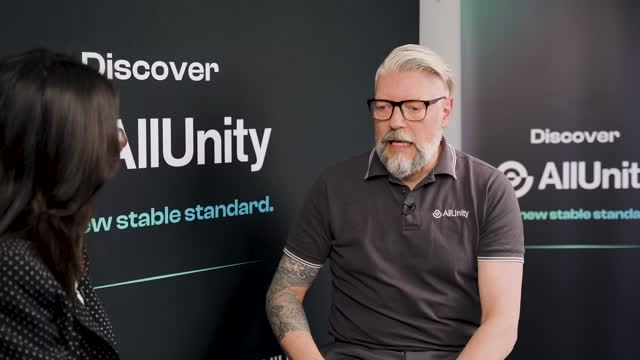
AllUnity already operates under the supervision of Germany’s financial watchdog BaFin, one of Europe’s most respected regulators. The company has also rolled out euro- and Swiss franc-backed stablecoins over the past year, positioning itself as a serious contender in Europe’s emerging regulated stablecoin market.
The launch of the SEKAU stablecoin could further strengthen that position by giving Nordic markets a compliant blockchain payment option linked directly to the Swedish currency.
Industry observers believe regulated stablecoins may become increasingly important as tokenized finance expands globally.
“Institutions need trusted infrastructure before they move large-scale activity onto blockchain rails,” said Patrick Hansen, EU strategy director at Circle, in recent remarks about Europe’s evolving stablecoin market. “Regulatory certainty is becoming a competitive advantage.”
Alongside the SEKAU stablecoin, AllUnity also unveiled a new payment infrastructure focused on AI-powered commerce.
The system, called “Agentic Payments,” is designed to support transactions initiated by autonomous software agents rather than human users. Businesses will be able to accept payments triggered by AI systems and settle those transactions directly into local bank accounts.
The infrastructure uses Coinbase’s x402 payment standard, which was created specifically for machine-to-machine transactions and automated internet payments.
The move places the SEKAU stablecoin9 at the center of another fast-growing trend: AI-driven digital payments.
Experts say AI agents are increasingly being developed to handle subscriptions, cloud computing services, content licensing, and automated online purchases without constant human approval. Stablecoins are viewed as an ideal payment mechanism because they enable instant programmable transfers across blockchain networks.
“Europe needs regulated, trusted rails built for this new reality,” said Peter Grosskopf, AllUnity’s chief technology officer and chief operating officer. “AllUnity is the gateway for businesses in Europe enabling them to accept, settle, and operationalize agentic payments at scale.”

The integration of the SEKAU stablecoin into AI payment infrastructure could give the token additional utility beyond standard crypto trading or remittance applications.
Sweden’s reputation as one of the world’s most cashless societies could provide fertile ground for the SEKAU stablecoin rollout.
The Nordic country has spent years reducing dependence on physical cash, with digital payment systems already deeply embedded in daily commerce. Blockchain-based settlement infrastructure may represent the next stage of that evolution.
The Swedish central bank has also explored its own central bank digital currency initiative, known as the e-krona, though that project remains under evaluation.
Private-sector alternatives such as the SEKAU stablecoin could move faster by leveraging existing blockchain infrastructure and market-driven adoption.
Analysts say local-currency stablecoins may become especially valuable for cross-border trade, decentralized finance applications, and tokenized asset settlements within Europe.
Still, competing against established dollar-backed giants remains a difficult challenge.
The launch of the SEKAU stablecoin comes just as other European initiatives gain momentum.
Earlier this week, banking consortium Qivalis expanded its euro-backed stablecoin initiative to 37 banks across 15 countries, signaling growing institutional demand for European-controlled blockchain payment systems.
Together, these developments suggest Europe is entering a new phase of digital finance competition where regulated local-currency stablecoins could become strategic financial infrastructure.
While dollar-backed stablecoins still dominate global crypto markets, Europe’s banking sector appears increasingly determined to build alternatives capable of supporting tokenized finance, automated commerce, and AI-powered transactions.



Copyright © 2025 - The Bit Gazette.