


- Trending
- Comments
- Latest

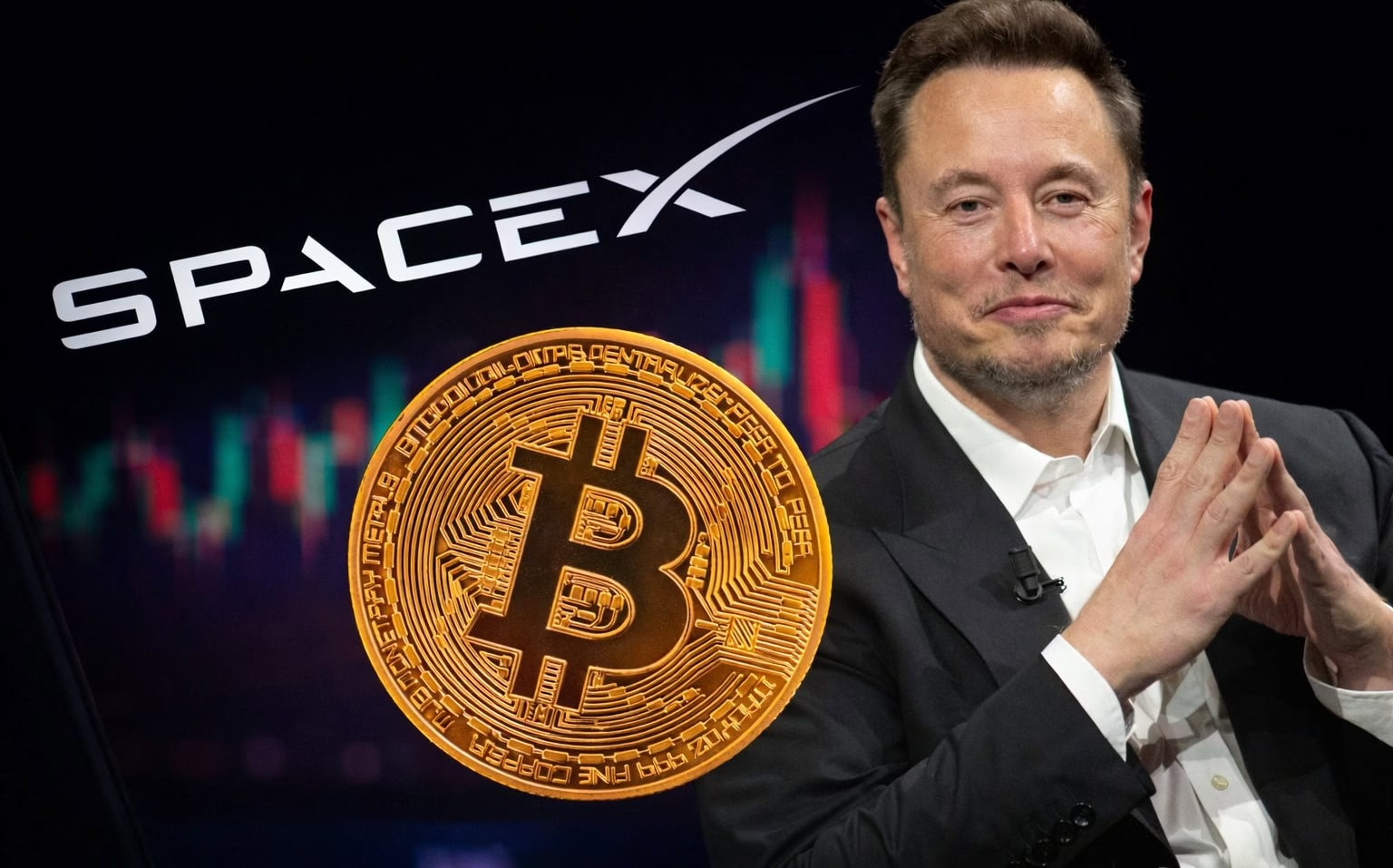
SpaceX is holding approximately 8,285 BTC on its balance sheet through Coinbase Prime, and if that position appears inside a formal S-1 filing when the company goes public, it could force every future IPO candidate to answer a question traditional finance has never had to face: is holding zero Bitcoin the riskier choice?
Much of the crypto market’s attention has focused on the possibility of a SpaceX IPO becoming the largest public offering in modern history. But buried beneath the excitement surrounding valuation estimates and Nasdaq inclusion speculation is a more important development: the normalization of Corporate Bitcoin Treasuries inside elite institutional finance.
Reports indicate SpaceX holds approximately 8,285 BTC on its balance sheet through Coinbase Prime custody infrastructure. At current market prices, that stash is worth hundreds of millions of dollars.
On paper, those holdings may appear relatively small compared to SpaceX’s rumored valuation. Strategically, however, they represent something much bigger.
For years, firms like MicroStrategy dominated conversations around Corporate Bitcoin Treasuries because they explicitly structured themselves around Bitcoin accumulation. Traditional institutions often dismissed those models as highly concentrated and speculative.
This is not a software company turning itself into a leveraged Bitcoin proxy. It is a globally recognized aerospace and satellite infrastructure firm using Bitcoin as part of a broader sovereign-style treasury framework.
The evolution of Corporate Bitcoin Treasuries has closely mirrored Bitcoin’s own journey from fringe asset to institutional macro instrument.
Initially, companies holding Bitcoin were viewed as anomalies. Then came the ETF era. Spot Bitcoin ETFs normalized regulated exposure for pension funds, asset managers, and traditional brokers. What remained unclear was whether operating companies outside the crypto sector would ever seriously integrate Bitcoin into treasury architecture.
Unlike earlier corporate adopters, the company does not need Bitcoin exposure to attract relevance, liquidity, or attention. Its core business already dominates launch systems, satellite communications, and defense-adjacent infrastructure.

When a company with strategic geopolitical relevance adopts Corporate Bitcoin Treasuries, Bitcoin begins looking less like speculation and more like reserve diversification.
Michael Saylor spent years arguing that Bitcoin was “digital property.” SpaceX’s rumored positioning moves that theory closer to institutional reality.
The most important detail surrounding the SpaceX narrative is not simply that it owns Bitcoin. It is how those holdings may appear inside public market disclosures.
If SpaceX formally integrates Bitcoin into its S-1 filings and financial statements under updated fair-value accounting standards, it could create a precedent that future issuers are forced to confront.
That is where the concept of Corporate Bitcoin Treasuries becomes politically and financially disruptive.
Traditional treasury management revolves around cash equivalents, short-term government securities, and conservative reserve allocation. But inflation, currency debasement concerns, and sovereign debt expansion have weakened confidence in fiat-only reserve strategies.
A SpaceX IPO would expose millions of traditional equity investors to Bitcoin indirectly, not through ETFs, but through corporate ownership embedded inside a high-growth industrial technology company.
One of the biggest mistakes analysts still make is treating crypto and equities as separate liquidity ecosystems.
Bitcoin now trades alongside macro risk assets. ETF flows increasingly overlap with technology-sector positioning. AI stocks, semiconductor giants, and crypto assets often move together because they compete for the same speculative and institutional capital.
SpaceX sits directly at the intersection of all three narratives: aerospace dominance, AI infrastructure, and Bitcoin exposure.
That convergence explains why Corporate Bitcoin Treasuries may become increasingly common among growth-focused technology firms.
Once Bitcoin becomes politically acceptable on a balance sheet, competitive dynamics begin to emerge. Public companies start asking whether holding zero Bitcoin becomes the riskier decision over the next decade.
That does not mean every corporation will suddenly adopt crypto reserves. But it does mean treasury diversification conversations are no longer theoretical.
What makes the SpaceX situation different is the scale of the company involved. For smaller firms, Bitcoin treasury strategies are often viewed as survival mechanisms or speculative growth plays. For SpaceX, Bitcoin looks more like sovereign reserve management.
Sovereign wealth funds diversify into commodities, foreign currencies, infrastructure, and strategic reserves because concentration risk is dangerous over long time horizons. Large corporations increasingly face similar realities.
Inflationary monetary policy, rising debt burdens, and geopolitical fragmentation are pushing companies toward harder reserve assets.
Bitcoin is beginning to benefit from that transition. If SpaceX succeeds publicly while maintaining Bitcoin exposure, the stigma around Corporate Bitcoin Treasuries weakens significantly.
The market often focuses too heavily on immediate price action. The deeper transformation usually happens slowly.
The significance of SpaceX’s Bitcoin exposure is not whether BTC rallies next week or next month. It is whether future IPO candidates begin viewing Bitcoin allocation as strategically normal.
That is the real long-term threat to traditional treasury orthodoxy. The next generation of growth companies may not ask whether to adopt Corporate Bitcoin Treasuries. They may ask how much exposure is appropriate.
SpaceX may not have intended to rewrite the rules of corporate finance. But if its IPO moves forward with Bitcoin firmly embedded inside the company’s financial architecture, that may be exactly what happens.



Copyright © 2025 - The Bit Gazette.