


- Trending
- Comments
- Latest

Polymarket has appointed a Japan country head and is targeting formal regulatory approval in the country by 2030, according to people familiar with the matter, a long-term bet on one of Asia’s largest crypto markets despite Japanese law broadly prohibiting online gambling.
According to a Bloomberg report citing people familiar with the matter, Polymarket has appointed Mike Eidlin, the Japan head at crypto company Jupiter, to spearhead local operations and policy engagement in the country.
The reported initiative underscores how seriously the company views Japan as part of its global Polymarket expansion roadmap, particularly as growth slows in some existing markets.
Japan has long been considered one of Asia’s most lucrative but difficult markets for online financial and gaming-related platforms. While the country has embraced blockchain innovation in several areas, its strict stance on gambling remains a significant barrier for prediction market operators.
Under Japanese law, online gambling is largely prohibited outside a narrow range of government-approved activities, including horse racing, lotteries, and certain public sporting events.
Authorities in Japan have intensified enforcement efforts in recent years, especially against unauthorized online casino platforms. Violations linked to illegal gambling activities can reportedly result in fines of up to $3,400, while repeat offenders may face prison sentences of as long as three years.
That legal framework creates obvious complications for Polymarket expansion in the country, particularly because prediction markets often blur the line between financial speculation and betting.
According to Bloomberg, Polymarket reportedly said it has seen “meaningful organic interest from users” in Japan and across the broader Asian market, adding that the company is “always evaluating opportunities to expand access globally in compliant and locally appropriate ways.”

The statement reflects a cautious but determined approach toward Polymarket expansion, especially at a time when regulators worldwide are paying closer attention to prediction-based trading platforms.
Despite not yet being authorized to operate in Japan, Polymarket already appears to have developed a sizable local audience.
The platform’s Japan-focused X account reportedly has more than 53,000 followers, an unusually large regional community compared with many of the company’s other localized social media channels.
That level of engagement suggests demand for prediction markets may already exist among Japanese crypto users, even as the legal environment remains uncertain.
The growing community also demonstrates why Polymarket expansion into Japan could become strategically important over the next several years. Japan remains one of Asia’s largest digital asset markets, with a sophisticated retail investor base and relatively high crypto awareness compared with several neighboring countries.
However, Polymarket officially lists Japan among its restricted jurisdictions alongside the United States and dozens of other regions under its country access policy.
Past reports have indicated that some users in restricted markets continue accessing prediction platforms through VPN services, though companies publicly maintain restrictions to remain aligned with local compliance requirements.
The timing of the Polymarket expansion effort is particularly notable because the global regulatory environment for prediction markets is becoming increasingly hostile.
Authorities in several jurisdictions have begun examining whether prediction-based trading platforms should be categorized as gambling services, financial products, or entirely separate instruments.
That uncertainty has exposed companies like Polymarket and Kalshi to mounting legal and political pressure.
India has emerged as one of the latest countries moving against the sector. Reports suggest authorities are preparing blocking orders targeting Kalshi after earlier enforcement measures against Polymarket.
Meanwhile, regulatory concerns continue to shape the operating environment in the United States and Europe as governments debate how prediction markets should be supervised.

The broader crackdown has become a central challenge for ongoing Polymarket expansion efforts globally, particularly as access restrictions continue to grow.
According to Start Polymarket data, the platform is now blocked in roughly 34 countries and subject to “close-only” limitations in several others.
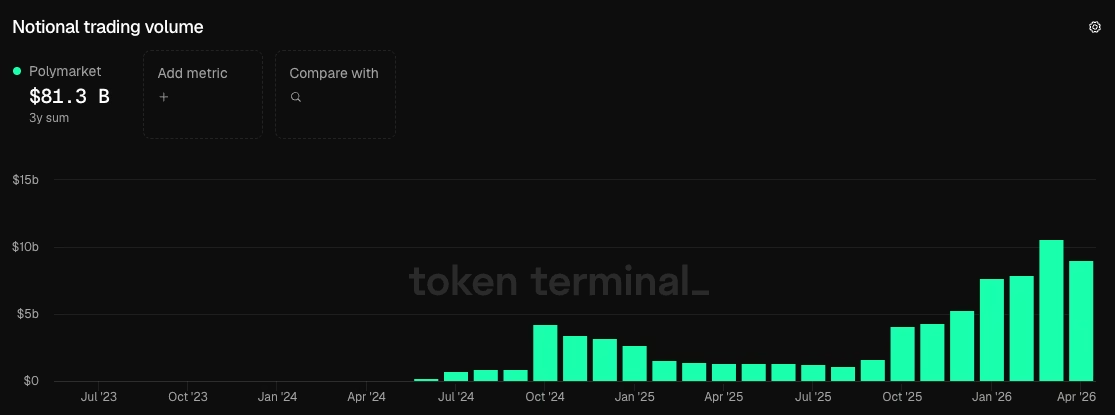
The company’s push into Japan also comes during a period of declining trading activity.
Data from Token Terminal shows Polymarket’s monthly notional trading volume fell by nearly 15% in April. Rival platform Kalshi, by contrast, reportedly recorded a trading increase of approximately 13% during the same period.
The slowdown has raised questions about whether the prediction market boom that surged during major political and macroeconomic events can sustain momentum long term.
For Polymarket, expansion into new markets may therefore be about more than geographic growth. It could also represent an attempt to reignite user activity and strengthen the platform’s global positioning amid intensifying competition.
The company has increasingly faced pressure not only from regulators but also from rival firms seeking to dominate the rapidly evolving prediction market space.
Despite the challenges, Polymarket expansion into Japan signals that the company still sees substantial long-term potential in prediction markets as a mainstream digital asset category.
Industry supporters argue that prediction markets can serve as powerful information tools capable of aggregating public sentiment on politics, economics, sports, and world events more efficiently than traditional polling methods.
Critics, however, continue to argue that many of these platforms operate too closely to online gambling models and may require stricter oversight.
That debate is unlikely to disappear anytime soon, particularly as prediction markets attract more mainstream attention.



Copyright © 2025 - The Bit Gazette.