
- Trending
- Comments
- Latest

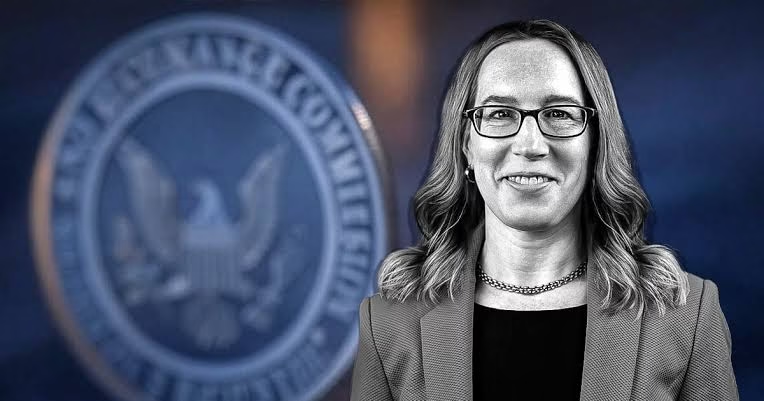
SEC Commissioner Hester Peirce has moved to cool speculation around the agency’s upcoming tokenization rule, stating publicly that the proposal will be “limited in scope” and will not open the door to unrestricted trading of synthetic tokens, pushing back on what she called “hyperbole” surrounding recent reports about the framework.
Peirce, who leads the SEC’s Crypto Task Force and has long advocated for regulatory safe harbors around tokenization, issued a series of statements on X aimed at countering what she described as exaggerated interpretations of the pending rule.
The comments come as anticipation builds around the SEC’s upcoming framework for tokenized securities, a proposal widely viewed as one of the most consequential crypto regulatory developments in recent years.
At the center of the controversy is whether the rule could legitimize synthetic tokens that provide market exposure to equities without granting investors actual ownership rights tied to the underlying securities.
According to Peirce, the proposal currently under discussion is expected to focus only on digital representations of traditional securities already available in secondary markets, rather than synthetic tokens that merely mimic exposure to stocks.
In one of her public posts, Peirce explained that the proposal would likely remain “limited in scope” and facilitate trading of digital representations of real equity securities rather than synthetic instruments detached from ownership rights.
Her clarification was widely interpreted as an attempt to calm speculation triggered by recent reports suggesting the SEC could approve broader pathways for synthetic tokens to trade on decentralized crypto platforms.
The commissioner later followed up by directing market participants to review the SEC’s January guidance on tokenized securities, which distinguishes issuer-backed tokenized stocks from synthetic tokens designed purely to track price movements.
The distinction is critical because synthetic tokens have become one of the most controversial concepts in digital finance.
Unlike tokenized securities backed directly by shares held in custody, synthetic tokens generally provide economic exposure without granting voting rights, dividends, or legal ownership claims attached to the original asset.
Critics argue that widespread adoption of synthetic tokens could create regulatory loopholes, increase market fragmentation, and complicate investor protections.
Supporters, however, view synthetic tokens as a powerful innovation capable of expanding global access to financial markets through decentralized infrastructure.
The SEC’s upcoming decision therefore carries major implications not just for crypto markets, but for the broader future of tokenized finance.
The controversy intensified after Bloomberg reported that the SEC was considering mechanisms that could allow synthetic tokens to trade on decentralized platforms under specific regulatory exemptions.
Peirce appeared frustrated by how quickly those reports escalated. In one of her posts, she said she appreciated public interest in the proposal “but not the hyperbole” surrounding the discussions.
Although earlier reports suggested the SEC could release the proposal this week, Bloomberg later reported that the agency had delayed the rollout once again.
Even with the delay, the anticipated framework is expected to mark the most significant shift in U.S. crypto regulation under SEC Chairman Paul Atkins.
Atkins has spent months signaling that the agency intends to adopt a more flexible and innovation-focused approach toward blockchain technology and tokenized finance.
During remarks at the DC Blockchain Summit in March, Atkins outlined several possible safe harbor measures that could reshape how crypto startups and tokenized products operate in the United States.
Those proposals included temporary registration exemptions for developers, fundraising exemptions for certain crypto projects, and safe harbor mechanisms that could prevent some blockchain-based assets from immediately being classified as securities.
The debate over synthetic tokens has therefore become part of a much larger conversation about how far regulators are willing to go in modernizing U.S. financial rules for blockchain markets.
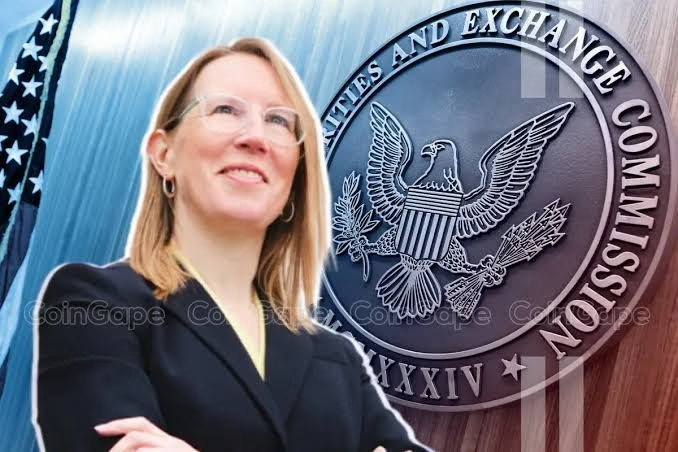
Industry observers have long considered Peirce one of the most crypto-friendly voices within the SEC.
Nicknamed “Crypto Mom” by parts of the digital asset industry, she has repeatedly criticized regulatory uncertainty and argued that blockchain innovation requires clearer compliance pathways.
Atkins himself acknowledged Peirce’s influence earlier this year, stating that her “fingerprints are all over” the agency’s crypto rulemaking process.
That influence appears especially visible in discussions surrounding synthetic tokens and tokenized securities.
Rather than fully embracing decentralized synthetic markets, Peirce’s comments suggest the SEC may initially pursue a more conservative tokenization framework focused on legally recognized securities infrastructure.
That approach could allow regulators to support blockchain-based settlement and trading innovation while limiting risks tied to synthetic tokens operating outside traditional investor protections.
Despite growing SEC and Commodity Futures Trading Commission activity around digital asset regulation, officials continue emphasizing that Congress ultimately holds the authority to establish permanent market structure rules.
Atkins reiterated that position during his March speech, arguing that only federal legislation can fully “future-proof” digital asset regulation in the United States.
Lawmakers are currently considering the Digital Asset Market Clarity Act, proposed legislation intended to establish clearer jurisdictional boundaries between the SEC and CFTC while creating long-term rules for crypto trading platforms and tokenized products.
The outcome of those discussions could directly influence how synthetic tokens are eventually treated under U.S. law.
Some policymakers remain wary that synthetic tokens could introduce systemic risks similar to poorly regulated derivatives markets, while others believe tokenization could strengthen efficiency and accessibility in capital markets.
The SEC’s effort to clarify its position on synthetic tokens reflects how rapidly tokenized finance is moving from theory into regulatory reality.
Major financial institutions, crypto startups, and decentralized platforms are all racing to develop blockchain-based trading infrastructure that could fundamentally reshape securities markets over the next decade.
At the same time, regulators are attempting to balance innovation with investor protection, a challenge made even more complicated by emerging products like synthetic tokens.



Copyright © 2025 - The Bit Gazette.