

- Trending
- Comments
- Latest

A senior Bank of Russia official has called on Visa and Mastercard to formally exit the Russian market, saying the networks no longer provide meaningful functionality while domestic infrastructure bears the cost of maintaining their legacy systems.
The statement comes as Mir, Russia’s state-backed payment network, now accounts for more than 83% of domestic card transactions following Visa and Mastercard’s suspension of operations after 2022 sanctions.
Visa and Mastercard suspended operations in Russia following global sanctions tied to the conflict in Ukraine, prompting banks and consumers to accelerate adoption of domestic alternatives.
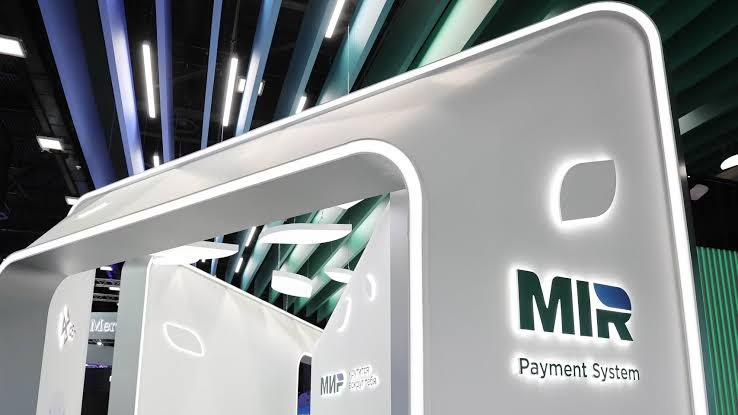
With Russia continuing to prioritize payment independence and high cashless transaction volumes, the Mir payment system is now increasingly viewed as both a financial and strategic infrastructure asset.
Speaking through comments reported by Russian state news agency TASS, Bakina said Visa and Mastercard no longer provide the same functions they once handled in the country, while domestic infrastructure continues carrying operational costs tied to legacy systems.
“They should leave our market because they no longer carry out or provide the functionality they always ensured, while the National Payment Card System continues to bear the costs of supporting these cards,” — Alla Bakina, Director of the National Payment System Department, Bank of Russia.
Bakina said the decline in Visa and Mastercard usage has been gradual over the past four to five years as Russian banks substituted other payment tools, led by the Mir payment system.
“The people had a sizable number of cards but the share of these instruments declined in the market during four-five years. The banks are performing the gradual substitution by other instruments, including Mir cards,” she said.
While Visa and Mastercard still technically exist in limited capacity inside Russia, the transition toward the Mir payment system has steadily accelerated as banks prioritize locally controlled infrastructure.
Russian officials say the Mir payment system has helped preserve stability despite economic pressure and restrictions affecting the broader financial system.
“Our payment market continues to demonstrate its resilience and a high level of adaptation to all the challenges facing our economy, society and economic entities. We see that the share of cashless payments remains at a consistently high level,” — Alla Bakina, Bank of Russia.
According to the central bank, cashless payments accounted for roughly 88% of retail turnover in 2025. That figure reflects continued reliance on digital transactions and reinforces the role of the Mir payment system as Russia’s primary domestic payment rail.
The Mir network was launched in 2014 after earlier geopolitical tensions prompted Russia to create a sovereign payments infrastructure.
Central bank figures show the Mir payment system had issued more than 476.5 million cards as of January 2026.
Officials have also discussed extending Mir acceptance internationally through partnerships with select countries, though expansion remains limited compared with Visa and Mastercard’s global footprint.
Despite the Bank of Russia’s strong support for the Mir payment system, analysts say the transition is expected to remain measured rather than disruptive.
Ilya Grashchenkov described the shift as a “calm phased transition,” suggesting consumers are unlikely to face sudden interruptions.
Experts also note that some Visa and Mastercard cards still operating domestically continue functioning beyond their original expiration periods, creating added pressure to move toward newer infrastructure.
Sergey Vasilkovsky said broader use of Mir could strengthen payment security and reduce dependence on systems outside Russia’s direct control.
For policymakers and financial institutions, the Mir payment system now represents more than a substitute for international networks.
It has become a key part of Russia’s long-term payments strategy as the country adapts to sanctions, reshapes consumer banking behavior, and builds domestic alternatives designed to withstand external pressure.
As Visa and Mastercard’s market share continues shrinking, the Mir payment system is positioned to remain at the center of Russia’s payment ecosystem, reinforcing the country’s push for financial independence in an increasingly fragmented global economy.



Copyright © 2025 - The Bit Gazette.