

- Trending
- Comments
- Latest

A software bug introduced in Sui’s 1.72 network upgrade halted block production on the Sui mainnet for nearly six hours on Thursday, freezing decentralised finance activity across the ecosystem and marking the second major outage the network has recorded in 2026.
According to onchain data from Suiscan, the Sui mainnet stopped producing checkpoints for exactly five hours and 55 minutes, effectively preventing new transactions from finalizing across the network.
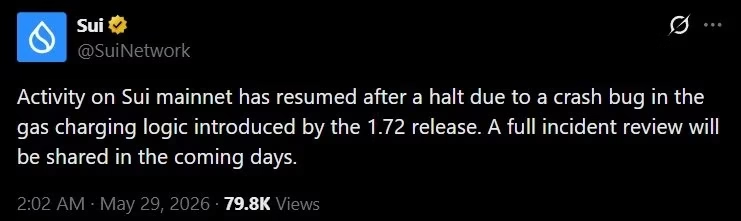
The Sui core development team later confirmed that a crash bug tied to the network’s gas charging logic caused the outage.
During the incident, the blockchain’s native SUI token fell roughly 6.6%, dropping to around $0.90 before partially recovering once the network resumed normal operations.
Developers said the Sui network outage originated from an edge-case bug introduced during the blockchain’s 1.72 software release.
The problem reportedly emerged inside the gas charging logic, a critical system responsible for calculating and processing transaction fees across the network.
According to the Sui core team, the issue escalated into a broader consensus failure involving conflicting transaction handling among validators.
At the center of the Sui network outage was a disagreement between validator nodes regarding consensus commit calculations.
Because different validators reached different conclusions when processing the same transaction data, the network lost the ability to certify blocks correctly.
The blockchain’s architecture detected that more than one-third of validator stake was signing conflicting transaction digests, making further certification impossible without risking a chain split.
As a result, the network froze block production entirely rather than allowing inconsistent transaction histories to emerge.
While the Sui network outage caused major operational disruption, developers emphasized that the blockchain’s safety-first design functioned as intended.
Instead of allowing conflicting states to propagate across the network, Sui’s consensus system halted checkpoint production completely.
That decision prevented a visible user-facing fork, which could have created even more severe long-term issues for applications and asset balances.
The Sui network outage therefore demonstrated both the strengths and weaknesses of modern blockchain consensus systems.
On one hand, the network successfully protected state integrity during a software failure. On the other, the complete freeze showed how consensus-layer bugs can rapidly disable even highly scalable blockchain environments.
Developers were ultimately forced to manually identify the divergence point, remove incorrect consensus data, and deploy corrected logic before validators could resume coordinated operations.
The Sui network outage had immediate consequences for decentralized finance users operating on the blockchain.
Because checkpoint production stopped entirely, DeFi protocols running on Sui were unable to finalize swaps, lending operations, liquidity movements, and other transaction activity during the disruption.
The incident affected a rapidly growing ecosystem that currently secures approximately $536 million in total value locked across more than 130 protocols.
The Sui network outage therefore created temporary operational paralysis for traders, liquidity providers, and decentralized application users across the chain.
Although no major exploit or fund loss was reported during the incident, outages of this scale often damage market confidence because users rely on constant transaction availability for financial activity.
Several blockchain analysts noted that network stability remains one of the most important factors influencing long-term institutional adoption.
The latest Sui network outage also revived concerns about the platform’s operational maturity because it represents the second major network stall recorded this year.
Earlier in January, validators reportedly remained offline for more than six hours during another serious disruption.
Repeated outages can become particularly damaging for newer blockchain ecosystems attempting to position themselves as scalable alternatives to established networks such as Ethereum.
The Sui network outage highlights a broader challenge facing many next-generation blockchain platforms: balancing speed, scalability, and reliability under increasingly complex network conditions.
High-throughput architectures often rely on advanced consensus systems and parallel execution models designed to maximize performance.

However, those same optimizations can introduce additional technical complexity that becomes difficult to manage during unexpected edge-case scenarios.
The response to the Sui network outage depended heavily on validator coordination.
Because validators observed conflicting transaction digests across consensus commits, the network effectively lost agreement on canonical state progression.
Developers and validators reportedly worked together to identify the divergence and implement fixes capable of restoring deterministic execution consistency.
Even after the network resumed operations, some nodes reportedly continued experiencing degraded performance while synchronization processes stabilized.
The Sui network outage therefore illustrated how validator communication and rapid operational response remain essential during consensus-layer emergencies.
Unlike centralized systems, decentralized blockchain networks depend on distributed coordination among multiple independent operators during technical failures.
That structure can improve resilience in some situations but may also slow recovery during highly complex incidents.
The Sui network outage also impacted broader market sentiment surrounding blockchain infrastructure reliability.
The SUI token’s sharp intraday decline reflected investor concerns over repeated network interruptions, particularly at a time when competition among Layer-1 blockchains remains intense.
Crypto investors increasingly evaluate not only transaction speed and ecosystem growth but also uptime consistency and operational stability.
The Sui network outage reinforced how quickly technical disruptions can influence token prices and user confidence, especially when DeFi infrastructure depends entirely on uninterrupted consensus functionality.
Although prices recovered somewhat after the network resumed operations, the incident may continue shaping market perceptions regarding the platform’s reliability profile.
The latest Sui network outage also contributes to a larger industry debate surrounding blockchain scalability.
Many next-generation Layer-1 networks market themselves as faster and more efficient alternatives to earlier blockchain designs.
Yet achieving extremely high throughput often requires increasingly sophisticated transaction processing systems that may introduce hidden operational risks.
The Sui network outage demonstrates how consensus-layer bugs can rapidly escalate inside high-performance architectures.
While the network successfully avoided a visible chain split, the full halt in block production still exposed the fragility that can emerge when consensus systems encounter unexpected transaction conflicts.

For blockchain developers, the incident may become another important case study in balancing scalability ambitions with operational resilience.
As blockchain adoption expands, expectations surrounding uptime and reliability continue increasing.
Institutional participants, developers, and users increasingly expect blockchain infrastructure to operate with standards closer to traditional financial systems.
The repeated Sui network outage incidents may therefore increase pressure on the project’s developers to strengthen testing procedures, validator coordination frameworks, and upgrade deployment safeguards.



Copyright © 2025 - The Bit Gazette.