• Trending
  • Comments
  • Latest
The Louvre needed police escorts to move crypto attendees: Decentralised money just decentralised the danger

The Louvre needed police escorts to move crypto attendees: Decentralised money just decentralised the danger

04/18/2026 - Updated on 05/25/2026
AI People joins Dubai’s innovation one — Declares war on the forgetting of humanity

AI People joins Dubai’s Innovation One program: Declares war on the forgetting of humanity

07/22/2025 - Updated on 07/23/2025
XRP community

Ripple CEO reassures community after SWIFT selects rival blockchain for pilot

02/10/2026
Polygon Discord Channel Hacked, Throws Crypto Community in Turmoil

Polygon Discord Channel Hacked, Throws Crypto Community in Turmoil

2
Bitcoin reclaims $107,000 as Iran-Israel ceasefire cools market tensions

Bitcoin reclaims $107,000 as Iran-Israel ceasefire cools market tensions

2

Hello world!

1
World Cup ticket scam

How FIFA turned World Cup ticket chaos into a $60 million blockchain play

06/11/2026
Japan crypto bill

Japan classifies crypto as financial instruments, cuts tax rate to 20%

06/11/2026
Smoke rises over Tehran as the Israeli Air Force begins a new wave of airstrikes on the Iranian capital, marking a significant escalation in regional hostilities.

Every missile fired at Hormuz is also landing in crypto’s derivatives markets

06/11/2026
  • Trending
  • Comments
  • Latest
The Louvre needed police escorts to move crypto attendees: Decentralised money just decentralised the danger

The Louvre needed police escorts to move crypto attendees: Decentralised money just decentralised the danger

04/18/2026 - Updated on 05/25/2026
AI People joins Dubai’s innovation one — Declares war on the forgetting of humanity

AI People joins Dubai’s Innovation One program: Declares war on the forgetting of humanity

07/22/2025 - Updated on 07/23/2025
XRP community

Ripple CEO reassures community after SWIFT selects rival blockchain for pilot

02/10/2026
Polygon Discord Channel Hacked, Throws Crypto Community in Turmoil

Polygon Discord Channel Hacked, Throws Crypto Community in Turmoil

2
Bitcoin reclaims $107,000 as Iran-Israel ceasefire cools market tensions

Bitcoin reclaims $107,000 as Iran-Israel ceasefire cools market tensions

2

Hello world!

1
World Cup ticket scam

How FIFA turned World Cup ticket chaos into a $60 million blockchain play

06/11/2026
Japan crypto bill

Japan classifies crypto as financial instruments, cuts tax rate to 20%

06/11/2026
Smoke rises over Tehran as the Israeli Air Force begins a new wave of airstrikes on the Iranian capital, marking a significant escalation in regional hostilities.

Every missile fired at Hormuz is also landing in crypto’s derivatives markets

06/11/2026
Thursday, June 11, 2026
  • Login
The Bit Gazette
  • Home
  • Crypto News
  • Expert Analysis
  • Finance
  • Tech
  • Sponsored
  • Press Release
  • Opinion
No Result
View All Result
The Bit Gazette
No Result
View All Result
Home Opinion

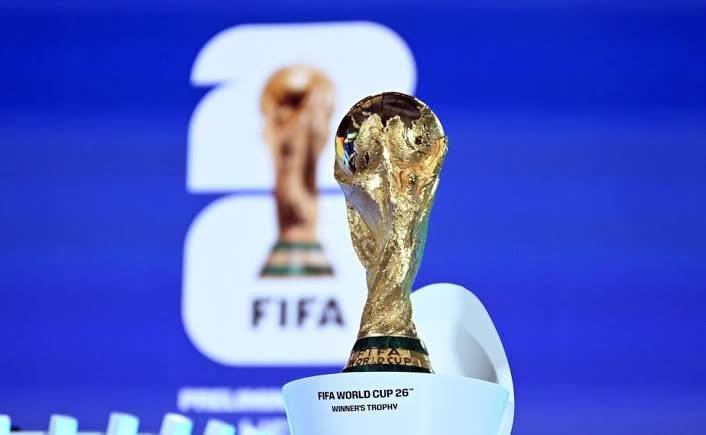
How FIFA turned World Cup ticket chaos into a $60 million blockchain play

Fans accused FIFA of exploiting supporters through blockchain ticketing, but the controversial strategy generated more than $60 million and reshaped the economics of sports events.

by Moses Edozie
1 hour ago
in Opinion
Reading Time: 6 mins read
0
World Cup ticket scam
Share on FacebookShare on Twitter

On the surface, FIFA’s 2026 World Cup ticketing operation looked like a masterclass in how not to treat fans. The global governing body was accused of running a “crypto scam”, hit with subpoenas from two state attorneys general, and accused of treating an entire continent “like an ATM”. Fans reported hours-long digital queues, bait-and-switch seat reclassifications, and a process so frustrating that one columnist described their glazed-over expressions as “like they just walked out of divorce court”.

But beneath the chaos and outrage, FIFA executed one of the most financially successful and strategically innovative ticketing campaigns in sports history. By combining blockchain technology, dynamic pricing, and a ruthless understanding of supply and demand, FIFA generated an estimated $60+ million in additional revenue, transferred ticket risk to fans, and created a new digital asset class around the world’s biggest sporting event.

The “scam” wasn’t a scam at all. It was a financial engineering masterclass, one that traditional ticketing platforms will likely copy for decades to come.
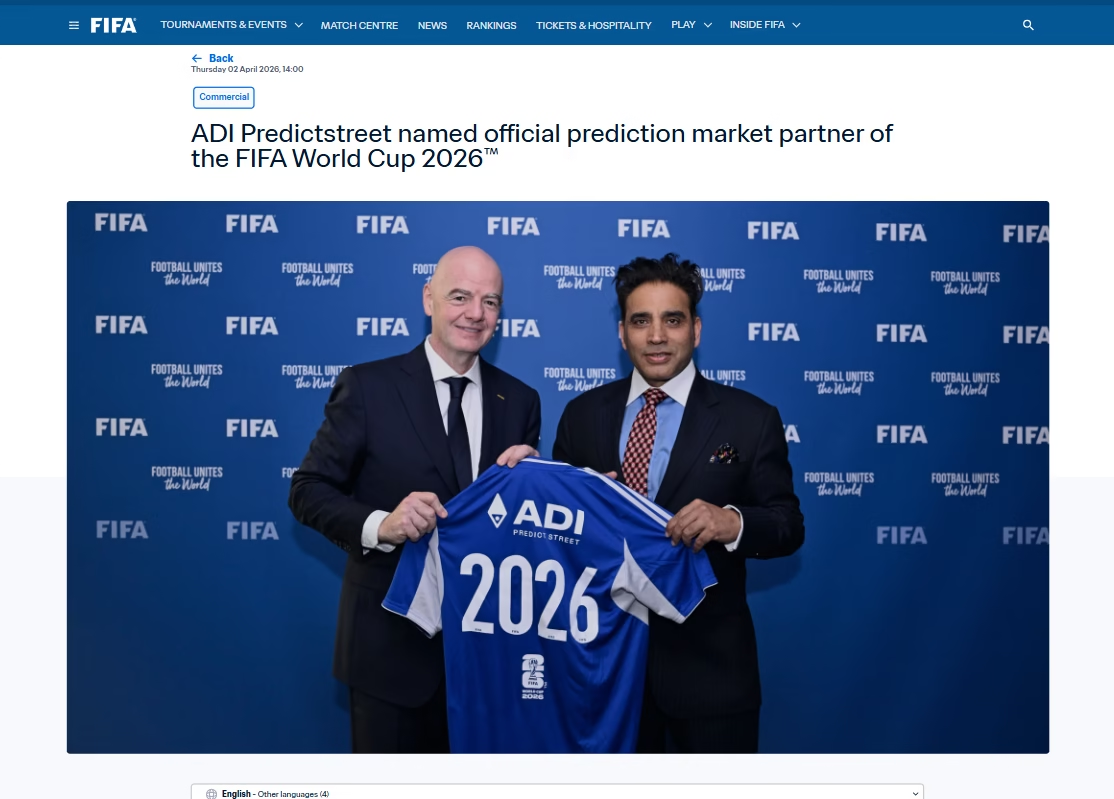

FIFA has signed a landmark multi-year partnership with ADI Predictstreet, which has been appointed as the first-ever Official Partner for the prediction market category

The “scam”: how FIFA sold nothing for millions

The controversy begins with FIFA Collect, the organization’s blockchain-based digital collectibles platform built in partnership with Modex . Long before a single ticket was available for purchase, FIFA began selling “Right to Buy” (RTB) digital tokens.
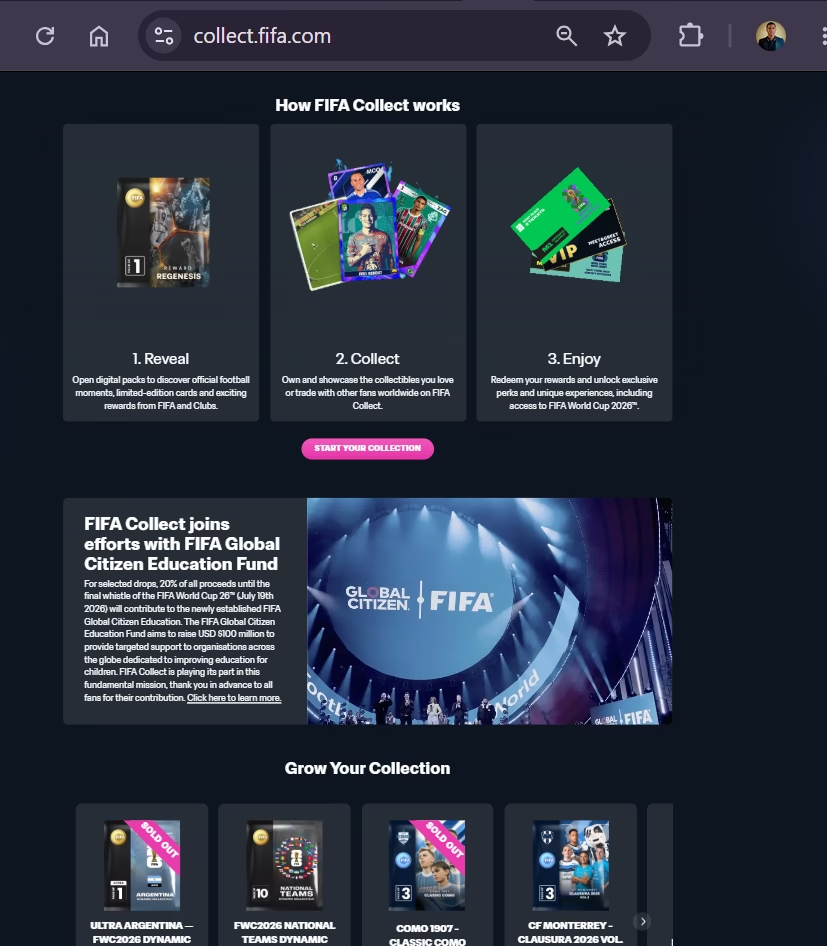
FIFA Collect
Source; FIFA

What fans actually bought

Feature What the RTB Token Provided
Guaranteed access The right to purchase 1-2 tickets for a specific match
Timing At a “to-be-determined later date”
Location In an “unknown section” of the stadium
Price Excluding the ticket price itself (which FIFA “hadn’t yet set”)
Total cost to fan Hundreds of dollars for the RTB + full ticket price later

Fans who purchased these tokens were not buying tickets. They were buying the privilege of possibly buying tickets later — at a price they did not know, for seats they could not choose, on a schedule FIFA controlled .

The financial haul

Data compiled by The Athletic and tracked through spinoff websites monitoring FIFA Collect sales revealed staggering figures :

  • 30,000+ RTB tokens sold
  • $10–20 million in direct RTB sales
  • $25+ million, including secondary market activity
  • ~70,000 tickets promised via RTBs
  • ~1% of the total 6 million World Cup tickets

Even conservative estimates placed FIFA’s profit from the RTB scheme at $15 million+. More comprehensive analyses suggested the total haul approached $60 million when including premium packages, dynamic pricing adjustments, and resale platform fees.

FIFA made tens of millions of dollars selling nothing but a promise.

The fan outrage: why everyone called it a scam

The backlash was immediate and vicious. Fans who had paid hundreds of dollars for RTB tokens felt “ripped off”, “scammed”, and “taken advantage of”. The complaints fell into four categories.

Opacity and exploitation of anxiety

FIFA deliberately withheld nearly all ticketing details until September 2025, almost a full year later than previous World Cups. For fans desperate to attend the first North American World Cup in 32 years, the uncertainty created an environment FIFA could monetise.

“Fifa, many fans argue, then preyed on that anxiety by selling digital tokens called ‘Right To Buy’s.” — The Athletic

The bait-and-switch

Perhaps the most damaging accusation was that FIFA systematically downgraded ticket categories. Fans who purchased lower-bowl tickets allegedly had their seats reclassified as “hospitality seating” for premium buyers, with FIFA offering no discounts for the forced upgrade to nosebleed sections.

“You thought you bought lower-bowl seats near the middle of the pitch? That section is now ‘hospitality’ seating for high rollers who might not even show up. Enjoy your new view from the upper corner. No, there will not be a discount.” — Dieter Kurtenbach, The Mercury News

Technical failures

The actual sales process was a technical nightmare. Fans faced:

  • Hours-long digital queues
  • Error messages that cost them shots at coveted tickets
  • Strict rate limits that booted innocent fans back to the queue ends
  • Erroneous emails and misdirected links
  • Seat assignments that separated families

Record-high prices

FIFA’s ticket prices were the highest in World Cup history. Football Supporters Europe called it a “monumental betrayal of the tradition of the World Cup”.

The legal blowback: subpoenas and scrutiny

The outrage was not confined to social media. Two state attorneys general took formal action.

Jurisdiction Action
California AG Rob Bonta sent a letter seeking answers
New York / New Jersey Issued subpoenas over ticketing practices

Swiss authorities also reviewed FIFA’s RTB NFT programme for potential gambling implications. Meanwhile, the SEC and CFTC classified fan tokens as “digital collectibles and tools,” legitimising the broader ecosystem.

The “gamble”: why this wasn’t a scam but genius

Despite backlash, FIFA’s strategy proved financially effective through four key mechanisms.

Risk transfer

FIFA shifted demand uncertainty onto fans. RTB buyers effectively funded early demand discovery, allowing FIFA to observe market appetite before final pricing.

Artificial scarcity

FIFA engineered urgency through staggered ticket drops. This controlled perception of scarcity, even as inventory later flooded the market.

By June 2026, resale prices had dropped around 15%, with some tickets available for as low as $69.

Resale platform control

FIFA’s official resale marketplace charged 15%–30% fees on transactions. While intended to capture secondary-market value, the system faced leakage as tickets appeared on external platforms like SeatGeek.

Dynamic pricing

By releasing prices after matchups were known, FIFA maximised revenue through price discrimination — charging more for high-demand fixtures and less for lower-demand ones.

The crypto connection: NFT RTBs and fan tokens

FIFA Collect extended beyond tickets into a full blockchain ecosystem, including RTB NFTs and digital collectibles.

Fan token performance

Token Nation Performance
$SNFT Spain +61.1%
$POR Portugal +56.8%
$ARG Argentina +46.6%
$FRA France Double-digit gains
$ITA Italy +30% despite failing to qualify

Even non-qualified nations saw token surges, driven by speculation rather than performance.

Market reality: supply glut arrives

By June 2026, supply overwhelmed demand:

  • ~180,000 tickets on resale platforms
  • 98% of them are group-stage tickets
  • Median resale prices down ~20%
  • Some matches are priced as low as $69

Tickets initially framed as scarce became widely available as kickoff approached.

Winners and Losers

Winners

  • FIFA (estimated $60M+ revenue gain)
  • Early secondary-market traders
  • Fan token speculators
  • Late buyers of discounted tickets

Losers

  • RTB token buyers
  • Fans who paid inflated early prices
  • Families split by seating glitches
  • Premium NFT collectors expecting scarcity premiums

What this teaches us about crypto in sports

Lesson 1: opacity drives monetization

FIFA used uncertainty as a revenue tool.

Lesson 2: risk transfer works

Fans absorbed the demand risk that traditionally sits with organizers.

Lesson 3: secondary markets always re-emerge

Attempts at monopoly resale inevitably leak.

Lesson 4: regulation is catching up

Authorities are increasingly scrutinising sports crypto experiments.

Lesson 5: timing matters more than event day

Most speculative gains occur before the event, not during it.

The bottom line

Financial Outcome Estimate
RTB sales $10–20 million
Secondary market effects $25+ million
Pricing and premium packages Tens of millions
Resale fees Multi-million revenue stream
Total impact $60+ million

For FIFA, the strategy worked.

For fans, outcomes varied from bargain tickets to expensive uncertainty.

For the broader industry, FIFA’s experiment proved something uncomfortable but important: modern ticketing is no longer just about access; it is about financial engineering at scale.

The real lesson is simple: demand has no loyalty.

Tags: blockchain ticketingChilizCHZ tokencrypto in sportsdynamic pricingfan tokensFIFA CollectFIFA crypto controversyFIFA resale platformFIFA ticketing controversyFIFA World Cup 2026ModexNFT ticketingRight to Buy tokensSEC fan tokenssports cryptoWorld Cup 2026World Cup NFT ticketsWorld Cup resale marketWorld Cup ticket prices
Share197Tweet123
Moses Edozie

Moses Edozie

Moses Edozie is a writer and storyteller with a deep interest in cryptocurrency, blockchain innovation, and Web3 culture. Passionate about DeFi, NFTs, and the societal impact of decentralized systems, he creates clear, engaging narratives that connect complex technologies to everyday life.

  • Trending
  • Comments
  • Latest
The Louvre needed police escorts to move crypto attendees: Decentralised money just decentralised the danger

The Louvre needed police escorts to move crypto attendees: Decentralised money just decentralised the danger

04/18/2026 - Updated on 05/25/2026
AI People joins Dubai’s innovation one — Declares war on the forgetting of humanity

AI People joins Dubai’s Innovation One program: Declares war on the forgetting of humanity

07/22/2025 - Updated on 07/23/2025
XRP community

Ripple CEO reassures community after SWIFT selects rival blockchain for pilot

02/10/2026
Polygon Discord Channel Hacked, Throws Crypto Community in Turmoil

Polygon Discord Channel Hacked, Throws Crypto Community in Turmoil

2
Bitcoin reclaims $107,000 as Iran-Israel ceasefire cools market tensions

Bitcoin reclaims $107,000 as Iran-Israel ceasefire cools market tensions

2

Hello world!

1
World Cup ticket scam

How FIFA turned World Cup ticket chaos into a $60 million blockchain play

06/11/2026
Japan crypto bill

Japan classifies crypto as financial instruments, cuts tax rate to 20%

06/11/2026
Smoke rises over Tehran as the Israeli Air Force begins a new wave of airstrikes on the Iranian capital, marking a significant escalation in regional hostilities.

Every missile fired at Hormuz is also landing in crypto’s derivatives markets

06/11/2026
The Bit Gazette

Copyright © 2025 - The Bit Gazette.

Navigate Site

  • About
  • Advertise
  • Privacy & Policy
  • Contact

Follow Us

Welcome Back!

Login to your account below

Forgotten Password?

Retrieve your password

Please enter your username or email address to reset your password.

Log In
No Result
View All Result
  • Home
  • Crypto News
  • Expert Analysis
  • Finance
  • Tech
  • Sponsored
  • Press Release
  • Opinion

Copyright © 2025 - The Bit Gazette.