

- Trending
- Comments
- Latest

For generations, access to the most lucrative investment opportunities followed a familiar pattern. Institutional investors, venture capital firms, and wealthy clients were often granted privileged entry into high-profile companies before public listings, while retail investors waited on the sidelines.
That long-standing model is now facing disruption from an unlikely source.
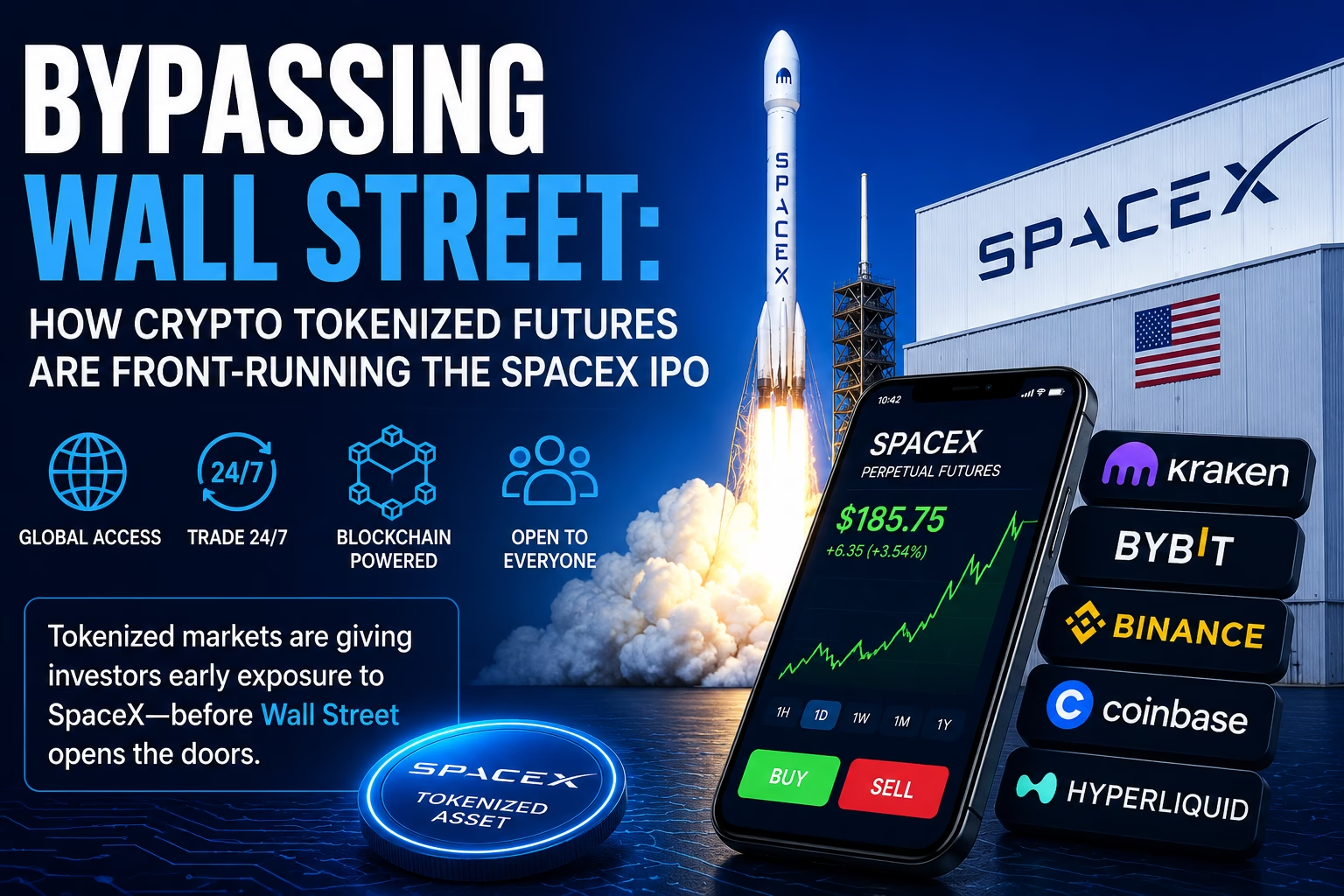
The rise of blockchain-based financial products tied to private companies has sparked a new chapter in capital markets, and nowhere is that shift more visible than in the growing market for SpaceX-linked tokenized assets. The phenomenon highlights how Bypassing Wall Street is evolving from a crypto slogan into a real-world market trend.
Long before any official public offering by SpaceX, crypto exchanges and decentralized trading platforms began offering instruments designed to mirror the company’s value, creating a parallel marketplace where investors could speculate on one of the world’s most sought-after private firms.
The excitement surrounding SpaceX stems from more than its status as a private aerospace giant. Founded by Elon Musk, the company has become one of the world’s most valuable private enterprises through its launch business and the rapid expansion of Starlink.
Historically, gaining exposure to a company like SpaceX before an IPO required access to private funding rounds or specialized secondary markets. Those opportunities were typically limited to accredited investors and institutional players.
Crypto platforms sought to change that equation.
Exchanges including Kraken, Bybit, Binance, Coinbase and Hyperliquid have introduced various forms of SpaceX-related exposure, ranging from tokenized equity products to perpetual futures and synthetic contracts that track the company’s perceived valuation.
The significance extends beyond investor demand. For the first time, crypto markets effectively began pricing a highly anticipated company before traditional financial markets could provide access.
This development underscores how Bypassing Wall Street is becoming one of the defining themes of the digital asset industry’s next phase.
Supporters of tokenization argue that blockchain technology is helping level the playing field.
By converting ownership claims and financial contracts into digital assets that can be traded globally, tokenization lowers barriers that have historically excluded millions of investors from private market opportunities.
Larry Fink, CEO of BlackRock, has repeatedly described tokenization as the future of markets. In his 2024 annual letter to investors, Fink wrote that “the next step going forward will be the tokenization of financial assets.”
That vision aligns closely with the philosophy driving many crypto entrepreneurs today. Advocates believe that anyone with an internet connection and a digital wallet should have the ability to participate in wealth-creation opportunities traditionally reserved for financial insiders.
In that sense, Bypassing Wall Street is not merely about trading technology. It is about reshaping who gets access to investment opportunities and when they gain that access.
The appeal has resonated strongly across crypto communities, where many investors view tokenized pre-IPO products as a direct response to what they see as decades of exclusivity in traditional finance.
Despite the enthusiasm, industry observers caution that investors must understand what they are actually buying.
One of the biggest misconceptions surrounding tokenized products is the assumption that ownership of a token automatically translates into ownership of company stock.
In many cases, that assumption is incorrect.
Some products are structured as synthetic derivatives designed solely to track price movements. Others rely on custodial arrangements in which a third party holds underlying shares. Many offer no voting rights, dividend entitlements, or direct ownership claims.
These distinctions are critical because traditional securities markets operate under well-established legal frameworks governing investor protections and ownership rights.
Former U.S. Securities and Exchange Commission Chair Gary Gensler has repeatedly emphasized that many digital asset products may fall under existing securities regulations and should provide comparable investor protections.
As a result, critics argue that some tokenized futures products resemble speculative instruments more than genuine equity ownership.
A trader purchasing a synthetic SpaceX perpetual contract is not directly investing in rocket launches, satellite deployments, or future company earnings. Instead, they are speculating on how other market participants value those prospects.
This reality reveals that Bypassing Wall Street can introduce new layers of risk even as it expands access.
Even with those limitations, dismissing the movement would overlook a broader transformation taking place across global finance.
History shows that major financial innovations rarely emerge in perfect form. Exchange-traded funds, online brokerages, and even cryptocurrencies themselves faced skepticism during their early years before gaining widespread acceptance.
The deeper significance of the SpaceX phenomenon lies in changing investor expectations.
Modern investors increasingly expect markets to operate continuously, provide global accessibility, and remove geographic and institutional barriers. Blockchain infrastructure is uniquely positioned to meet those demands.
That is why Bypassing Wall Street has become more than a niche crypto narrative. It reflects a growing belief that capital markets should be open to anyone, regardless of location or wealth status.
SpaceX may ultimately be remembered not only for its future IPO ambitions but also for serving as the testing ground where traditional finance and blockchain-based markets collided at scale.
Whether regulators embrace this shift or seek to slow it, momentum appears difficult to ignore.
The trend of Bypassing Wall Street is accelerating, and crypto firms are no longer waiting for permission to participate in the future of finance. Instead, they are building alternative pathways that increasingly challenge the dominance of traditional market gatekeepers.
For now, one thing is becoming clear: when it comes to innovation in market access, crypto is no longer following Wall Street’s lead—it is attempting to set the pace itself.



Copyright © 2025 - The Bit Gazette.