

- Trending
- Comments
- Latest

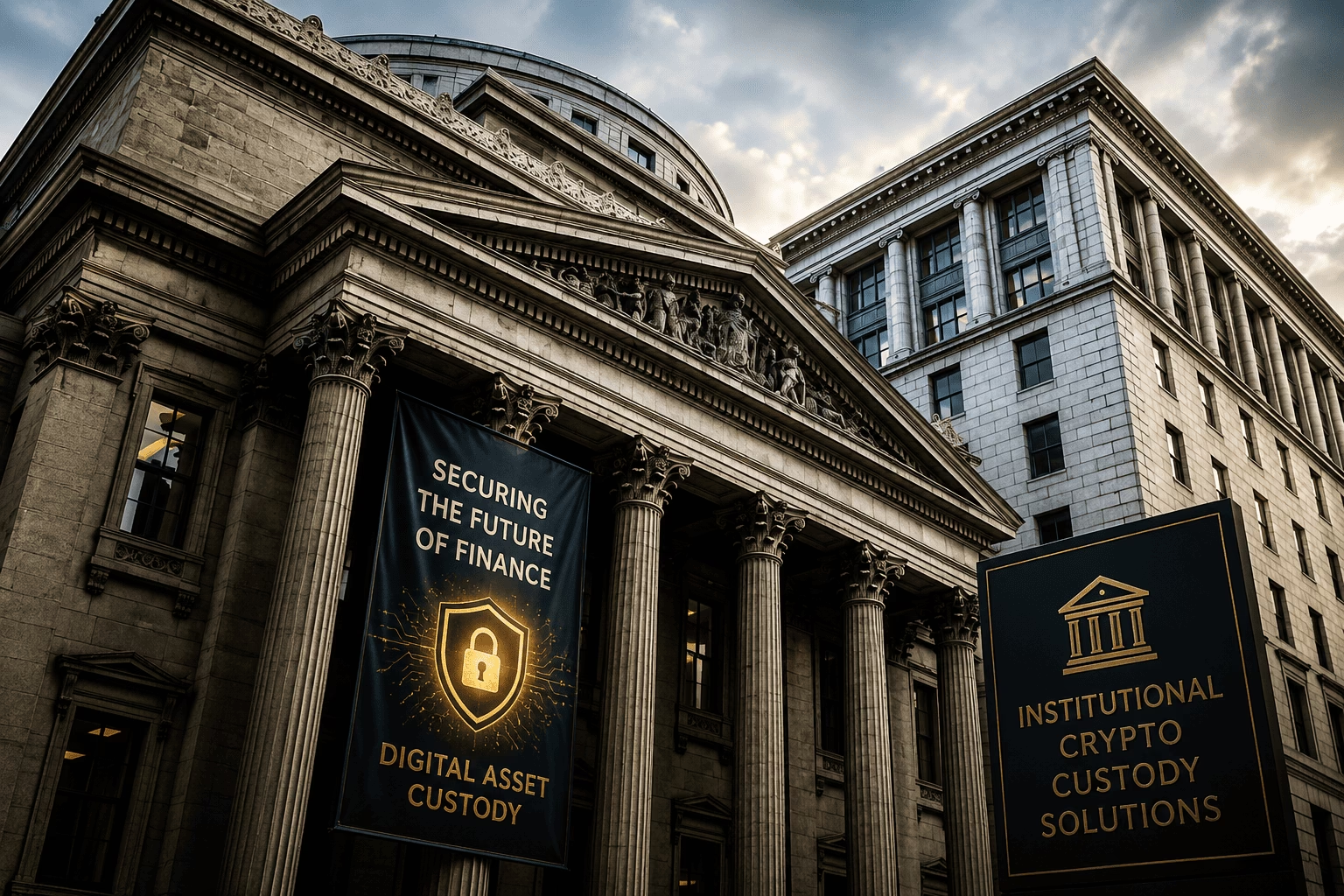
While traders watch prices fall and headlines obsess over market sentiment, some of the world’s largest banks are doing something far more consequential: building the vaults, custody systems, and settlement infrastructure that could make them indispensable to crypto’s next chapter. They are not speculating. They are constructing.
While traders remain preoccupied with declining prices, weak market sentiment, and regulatory uncertainty, some of the world’s largest financial institutions are making strategic moves that could reshape the industry’s future. Instead of chasing speculative returns, banks are investing in custody technology, digital asset safekeeping systems, and institutional-grade crypto storage.
This emerging trend can be described as the Quiet Colonization of Crypto.
Rather than fighting digital assets, traditional financial institutions are increasingly positioning themselves to become indispensable players within the ecosystem. Their focus is not on speculation but on building the infrastructure that enables large-scale participation.
One of the biggest shifts in recent years is the changing attitude of traditional finance toward digital assets.
Financial institutions that once dismissed cryptocurrencies as risky experiments now acknowledge that blockchain technology and tokenized assets are likely to play an important role in future financial markets. Instead of launching highly speculative products, banks are focusing on services that institutional investors require before allocating substantial capital.
These services include secure custody, regulatory compliance, insurance protection, settlement mechanisms, and risk management frameworks.
The approach reflects a broader institutional strategy. Rather than attempting to compete directly with decentralized networks, banks are building the foundational systems that connect traditional capital with blockchain-based markets.
As investment giant CEO Larry Fink has repeatedly argued, tokenization has the potential to transform how financial assets are owned, transferred, and managed. In recent years, Fink has described tokenization as the next generation of financial markets, suggesting that stocks, bonds, and other assets could eventually move onto blockchain rails.
If that future materializes, institutions that control custody and settlement infrastructure may hold significant influence within the new financial ecosystem.
That reality sits at the heart of the Quiet Colonization of Crypto.
Historically, major institutions rarely enter emerging industries when excitement is at its peak. Instead, they tend to move during periods of uncertainty when valuations are lower, competition is reduced, and long-term investments can be made away from public scrutiny.
The cryptocurrency sector appears to be following that familiar pattern.
Market downturns provide an opportunity for institutions to develop infrastructure without the intense spotlight that accompanies bull markets. Costs are often lower, regulatory frameworks are more mature, and strategic planning can take place without daily pressure from speculative headlines.
This approach mirrors investment strategies seen across multiple industries. Infrastructure is frequently built during periods of pessimism and fully utilized once market confidence returns.
The current wave of custody development suggests that banks view digital assets as a long-term opportunity rather than a short-term trend.
In that sense, the Quiet Colonization of Crypto is less about acquiring tokens and more about establishing strategic positions before widespread adoption accelerates.
For institutional investors, custody remains one of the most critical challenges in digital asset investing.
Pension funds, sovereign wealth funds, hedge funds, family offices, and publicly traded companies collectively oversee trillions of dollars in assets. Most of these organizations cannot rely on personal hardware wallets or lightly regulated platforms to secure large holdings.
They require trusted custodians.
They require regulatory compliance.
They require insurance and operational safeguards.
Traditional banks already possess decades of experience protecting valuable financial assets. Extending that expertise into digital asset custody represents a logical evolution of their business models.
The implications are significant.
Control over custody often means influence over liquidity, lending activity, settlement processes, and access to emerging financial products. Institutions responsible for safeguarding digital assets may ultimately become gatekeepers for tokenized securities, blockchain-based investment vehicles, and future digital markets.
This is why many analysts believe the Quiet Colonization of Crypto extends far beyond simple storage solutions. It represents a battle for control over the infrastructure layer that supports the next generation of finance.
Not everyone welcomes this development.
Many long-time cryptocurrency advocates argue that self-custody remains one of the industry’s most important innovations. The ability to control assets without relying on banks was central to Bitcoin’s original vision and remains a core principle of decentralized finance.
From that perspective, the growth of institutional custody appears to conflict with crypto’s founding ideals.
However, the reality may be more complex.
The digital asset ecosystem is increasingly diverse, serving both individual investors and large organizations with vastly different requirements. While self-custody remains a viable option for users who prioritize financial sovereignty, institutional investors often need regulated service providers to satisfy legal, operational, and fiduciary obligations.
As a result, both models are likely to coexist.
What is becoming increasingly clear is that the next phase of crypto adoption may be driven less by retail speculation and more by infrastructure development, compliance frameworks, and institutional participation.
The Quiet Colonization of Crypto is already underway, even if it remains largely invisible to the average investor.
History shows that transformative financial shifts often begin quietly. By the time the public recognizes their significance, the foundations have already been laid.
Today, while headlines continue to focus on market volatility, traditional banks are building crypto vaults, strengthening custody networks, and preparing for a future in which digital assets become a permanent fixture of global finance.
Whether that evolution represents progress, pragmatism, or a departure from crypto’s original mission remains a matter of debate.
What is no longer up for debate is that banks are no longer watching from the sidelines.
They are moving into the ecosystem, constructing the infrastructure, and positioning themselves at the center of what could become the next chapter of global finance.
That is the Quiet Colonization of Crypto.



Copyright © 2025 - The Bit Gazette.