







- Trending
- Comments
- Latest

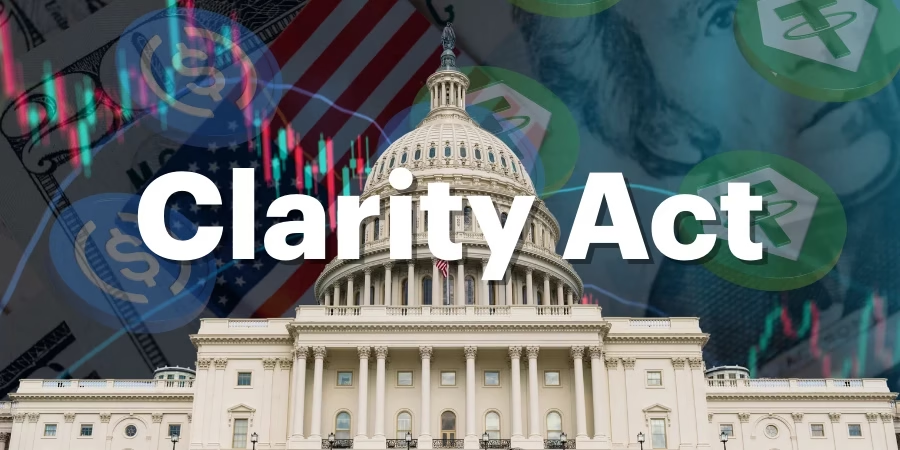
US lawmakers have scheduled a July hearing on the CLARITY Act as the Senate Banking Committee advances its own version of crypto market structure legislation, bringing the United States closer than it has been in years to a unified digital asset regulatory framework.
The hearing, expected to take place in July before members of the House Financial Services Committee, comes as policymakers, crypto companies, and institutional investors increasingly push for legal certainty around digital assets.
The legislation seeks to clarify which cryptocurrencies fall under the jurisdiction of the Securities and Exchange Commission (SEC) and which should be regulated by the Commodity Futures Trading Commission (CFTC).
The timing is significant. After years of enforcement actions, court battles, and regulatory ambiguity, market participants view the CLARITY Act as a potential turning point for the U.S. digital asset industry.
The CLARITY Act has already demonstrated bipartisan appeal. The bill passed the House in July 2025 with support from both Republicans and Democrats, reflecting growing consensus that the existing regulatory approach has failed to keep pace with innovation in blockchain markets.
More recently, the Senate Banking Committee advanced its own version of crypto market structure legislation, bringing lawmakers closer to reconciling competing proposals.
“This landmark bill brings long-overdue certainty to the digital asset ecosystem and solidifies the United States as the global leader in the future of blockchain use in financial services.”
Chairmen Glenn “GT” Thompson and French Hill, in a joint statement following Senate Banking Committee action.
Supporters argue that the legislation would replace the SEC’s widely criticized “regulation-by-enforcement” strategy with a framework that establishes clear rules for token issuers, exchanges, brokers, and decentralized finance projects.
One of the bill’s most closely watched provisions is the so-called “mature blockchain” test, which could allow certain crypto assets to transition from securities oversight to commodity treatment once networks demonstrate sufficient decentralization.
The legislation could have significant implications for major digital assets and blockchain projects that have faced years of legal uncertainty.
The crypto industry has largely welcomed congressional efforts to move market structure legislation forward.
Rep. French Hill, Chairman of the House Financial Services Committee, recently suggested that market structure reform remains a bipartisan priority in Washington and could pave the way for broader blockchain adoption initiatives, including tokenization efforts.
Hill told CoinDesk in May that he expected the CLARITY Act to secure bipartisan consensus, while emphasizing that tokenization is becoming a major policy focus for lawmakers.
Industry executives believe regulatory clarity could encourage greater participation from traditional financial institutions, pension funds, and asset managers that have remained cautious amid uncertain compliance requirements.
The debate arrives as U.S. regulators appear increasingly willing to coordinate their oversight efforts.
Reports indicate the SEC and CFTC have strengthened cooperation mechanisms in anticipation of future legislation, reducing concerns over overlapping enforcement actions.
For investors, passage of a comprehensive market structure bill could help lower legal risks associated with exchange listings, custody services, and token issuance, potentially supporting broader institutional adoption.
Despite growing momentum, several obstacles could still delay final approval.
Lawmakers continue to negotiate provisions related to stablecoin rewards, decentralized finance exemptions, and ethics requirements governing public officials’ cryptocurrency holdings.
Critics also argue that some provisions may favor established market participants while leaving unresolved questions surrounding investor protections.
Senator Elizabeth Warren has previously sought amendments aimed at tightening oversight standards and strengthening safeguards against illicit finance.
Meanwhile, Senate Banking Committee Chairman Tim Scott has remained optimistic about advancing crypto legislation.
“We must get a strong, durable framework that reflects the priorities of both Chambers across the finish line,” — Sen. Tim Scott, Chairman, Senate Banking Committee.
For now, market participants will be watching the July hearing closely, viewing it as a critical milestone in determining whether the United States can finally establish a unified digital asset rulebook.
Should lawmakers reach consensus later this year, the CLARITY Act could become the most significant piece of U.S. cryptocurrency legislation since the approval of spot Bitcoin exchange-traded funds.



Copyright © 2025 - The Bit Gazette.

