

- Trending
- Comments
- Latest

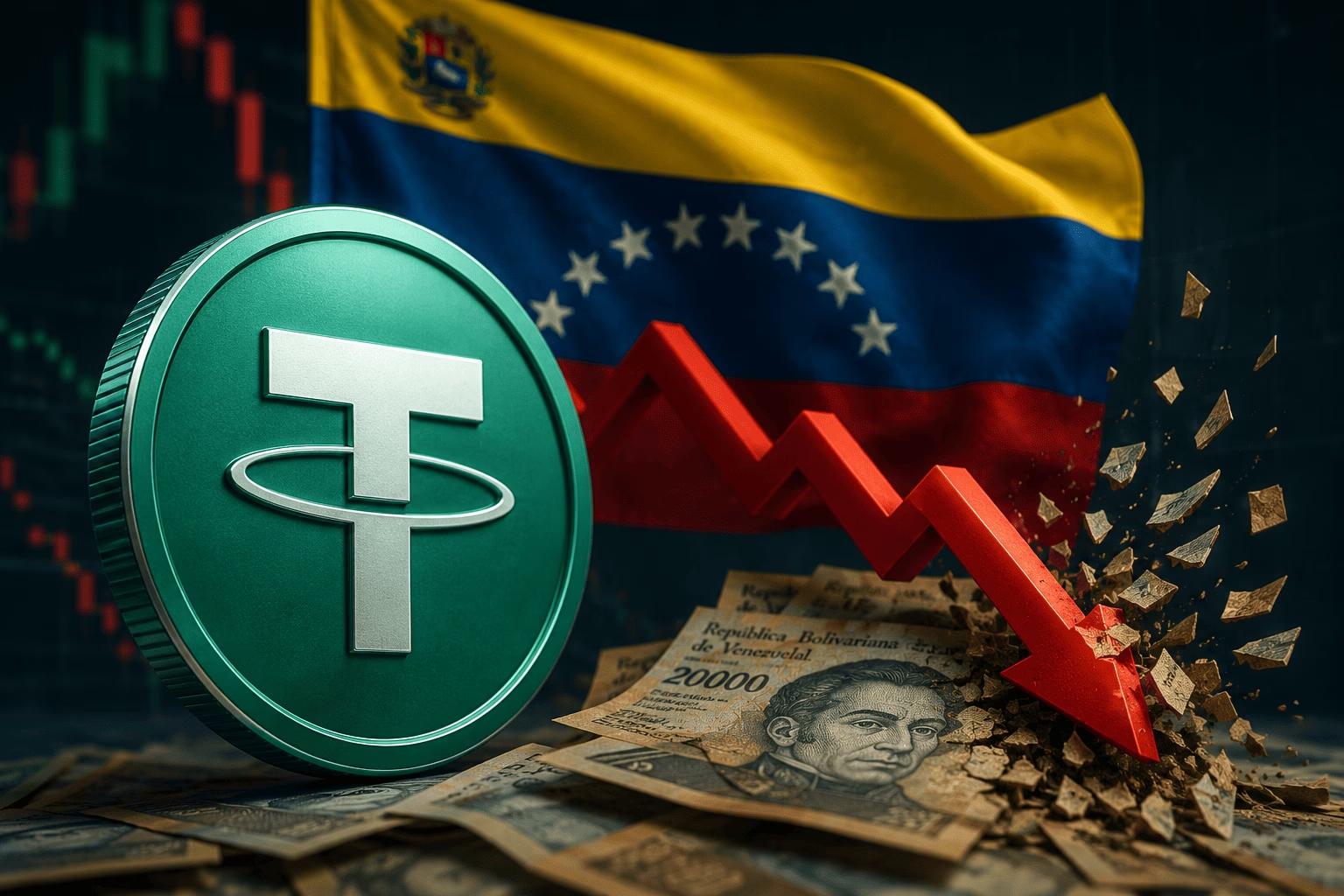
Venezuelans are turning to dollar-pegged stablecoins at a sharply accelerating rate as the country’s currency crisis deepens, with Tether’s USDT trading at more than 800 bolivars on peer-to-peer markets in mid-June, roughly 16% above the previous month’s levels.
The move comes amid rapid growth in Venezuela’s money supply, tightening restrictions on foreign currency purchases, and persistent shortages of physical U.S. dollars available through formal banking channels.
The surge in demand underscores a broader trend emerging across distressed economies: stablecoins are increasingly being used as savings instruments, payment rails and hedges against local currency depreciation.
The premium attached to USDT purchases in Venezuela does not reflect a change in the stablecoin’s dollar peg but rather a sharp deterioration in confidence in the bolivar.
According to market data compiled by P2P.Army and referenced by several industry publications, USDT prices on Binance’s peer-to-peer marketplace climbed from approximately 690 bolivars to more than 800 bolivars within 30 days before stabilizing near 790 bolivars.
Venezuela’s central bank liquidity indicators suggest that bolivars in circulation expanded substantially during the first half of 2026, increasing pressure on the local currency.
Commercial banks have simultaneously tightened access to dollars. Authorities reportedly introduced limits allowing individuals to purchase no more than $1,000 per month through official channels beginning June 15, prompting businesses and households to seek alternatives.
“Demand for dollar exposure among businesses and residents is intense and the formal channels are failing them.” Binance News wrote in a market update published on Binance Square.
The trend mirrors behavior observed in previous periods of hyperinflation, where citizens increasingly rely on digital assets linked to stronger currencies to preserve purchasing power.
Peer-to-peer marketplaces have become a crucial component of Venezuela’s informal dollar economy.
Unlike regulated foreign exchange systems, P2P platforms allow buyers and sellers to transact directly using local payment methods, reducing reliance on banks with limited access to hard currency.
Industry observers say Binance remains the dominant venue for these transactions.
Binance community contributors noted in commentary discussing Venezuela’s P2P ecosystem, highlighting growing demand from both retail users and small businesses.
The phenomenon also demonstrates how stablecoins have evolved beyond speculative trading instruments.
The European Central Bank recently acknowledged the role stablecoins can play during periods of economic stress, noting that demand for USDT in Venezuela has previously surged amid episodes of political uncertainty and financial disruption.
“In January, demand for USDT surged due to the U.S. attack on Venezuela, causing the token to trade as high as roughly USD 1.40 on some peer-to-peer exchanges.”
The European Central Bank stated in a speech on stablecoins and the future of money.
Analysts argue that Venezuela presents one of the clearest real-world use cases for stablecoins, particularly in countries where inflation, capital controls and dollar shortages coexist.
For crypto investors, the Venezuelan experience offers insight into one of the fastest-growing segments of digital assets.
While institutional interest in stablecoins has expanded through tokenized treasury products, payment networks and cross-border settlement solutions, emerging markets continue to drive grassroots adoption.
Research cited by industry analysts suggests that countries including Venezuela, Argentina, Turkey and Nigeria increasingly use USDT as a savings mechanism and remittance tool whenever local currencies come under pressure.
The latest spike in Venezuela’s P2P markets reinforces the thesis that stablecoins may become a cornerstone of financial infrastructure in economies struggling with monetary instability.
For Tether, which already dominates the global stablecoin market by circulation, the trend highlights the growing importance of non-trading demand and everyday financial utility.
Whether regulators ultimately embrace or constrain the expansion of stablecoins, Venezuela’s experience suggests that in environments where traditional banking systems fail to meet consumer needs, digital dollars can rapidly become a parallel monetary network.



Copyright © 2025 - The Bit Gazette.