

- Trending
- Comments
- Latest

Agawam Mayor Christopher C. Johnson wants to ban cryptocurrency ATMs in the city after police fielded roughly half a dozen fraud complaints this year, including one case in which a scammed resident deposited $17,000 into one of the machines.
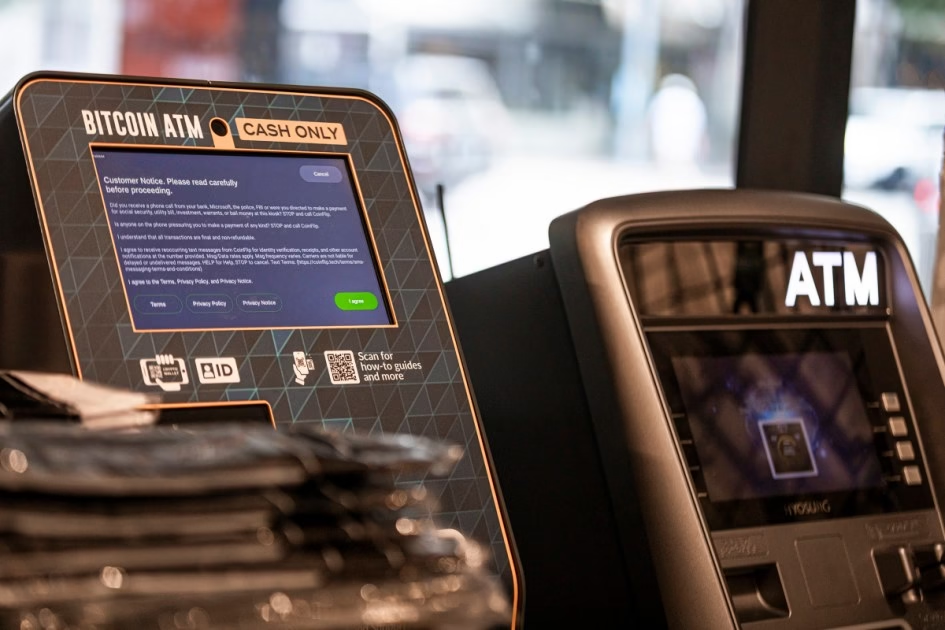
Johnson asked the Agawam City Council this month to prohibit the installation and operation of cryptocurrency automated teller machines, arguing that the machines have become an effective tool for scammers. At least three cryptocurrency kiosks have appeared in Agawam convenience stores since last year, according to the mayor.
“There’s no legitimate purpose for them,” — Christopher C. Johnson, Mayor of Agawam.
Johnson said local police have received about half a dozen complaints involving the machines so far in 2026. He said scammers frequently persuade victims to deposit cash into cryptocurrency ATMs, after which the funds are transferred to wallets controlled by the criminals.
“They’re the perfect tool for people perpetrating fraud, convincing people to go put money into the cryptocurrency ATM, and once it’s in there, it’s gone, and it’s untraceable,” — Christopher C. Johnson, Mayor of Agawam.
The proposed ordinance would prohibit a “self-service kiosk” that allows users to purchase blockchain-based currencies that are not backed by a national central bank, including Bitcoin and Ethereum.
Violators would face a $300-per-day fine for each device under the proposed ordinance.
The proposed crypto kiosk ban is expected to receive a vote from the City Council in September. Approval would require positive votes at two separate meetings.
Agawam’s proposal follows similar action elsewhere in Western Massachusetts, where communities have increasingly considered restrictions on cryptocurrency ATMs amid concerns over fraud.
Westfield’s City Council approved a comparable ordinance on June 18. South Hadley and Longmeadow voters also endorsed cryptocurrency ATM bans in November 2025 and May 2026, respectively.
The Longmeadow measure has not yet taken effect because it still requires approval from the Massachusetts attorney general. Once approved, the operator of the town’s known cryptocurrency ATM would have 60 days to remove the machine before facing a $300 daily fine.
Longmeadow Police Chief Robert Stocks has backed the measure, citing the financial losses associated with cryptocurrency scams investigated by his department.
“Over the past 24 months, our department investigated cryptocurrency scams in which victims lost a combined total of $400,000,” — Robert Stocks, Longmeadow Police Chief.
Stocks cautioned that the department’s figure likely does not capture the full scale of the problem because some victims may not report fraud or may be stopped before completing a transaction.
He said scammers typically contact victims by telephone and use high-pressure tactics to convince them to travel to a cryptocurrency kiosk. Victims are often instructed to remain on the phone while depositing cash into a cryptocurrency wallet controlled by the fraudsters.
“Once they put that money into the kiosk, it’s usually gone,” — Robert Stocks, Longmeadow Police Chief.
Stocks acknowledged that eliminating local cryptocurrency ATMs would not prevent criminals from using machines in neighboring communities. However, he argued that removing immediate access could give potential victims more time to question suspicious instructions.
The Longmeadow police chief said the absence of a nearby kiosk could create an opportunity for victims to stop, seek advice or contact someone they trust before transferring money.
That reasoning has become central to the broader crypto kiosk ban debate. Supporters argue that cryptocurrency ATMs provide scammers with a convenient mechanism for turning victims’ cash into digital assets that can be transferred quickly and are difficult to recover.
Johnson said merchants hosting cryptocurrency ATMs in Agawam have cooperated with police. Store owners have allowed authorities to place warnings on the machines advising customers about cryptocurrency scams.
The mayor also emphasized that the businesses hosting the machines are not being accused of participating in fraudulent activity.
Instead, the proposed crypto kiosk ban is focused on the machines themselves and the way criminals exploit them.
Many victims are older adults, according to Johnson, and organizations involved in elder advocacy, including AARP, have supported efforts to restrict cryptocurrency ATMs. Johnson also said Massachusetts lawmakers are considering a statewide prohibition.
Recent cases in the region have added urgency to the discussion. In June, New York suspects were arrested in Westfield after allegedly using a Bitcoin kiosk to defraud a senior of $1,200. In Raynham, a 73-year-old woman reportedly nearly lost $20,000 after scammers instructed her to withdraw money and deposit it through a Bitcoin ATM.
Federal prosecutors have also pursued cryptocurrency connected to fraud cases, including an investigation involving alleged computer-support scammers who collected more than $100,000 in Bitcoin payments, including $15,950 from a Ware resident.
Agawam’s proposed crypto kiosk ban now moves toward a formal decision by the City Council.
The measure would make it unlawful to install or operate the covered cryptocurrency kiosks within the city and impose a daily penalty for devices that remain in operation.
The proposal comes as Massachusetts communities weigh whether restricting access to cryptocurrency ATMs can reduce fraud or merely push scammers toward neighboring jurisdictions and other payment methods.
The experience in Longmeadow is likely to remain relevant as Agawam considers the measure. Stocks acknowledged that criminals have alternatives but argued that eliminating a convenient local option could still make a difference.
For Johnson, the issue is primarily one of consumer protection. The mayor maintains that the machines have little legitimate value compared with the risks they present to residents vulnerable to increasingly sophisticated financial scams.
Primary source: MassLive original report



Copyright © 2025 - The Bit Gazette.