







- Trending
- Comments
- Latest

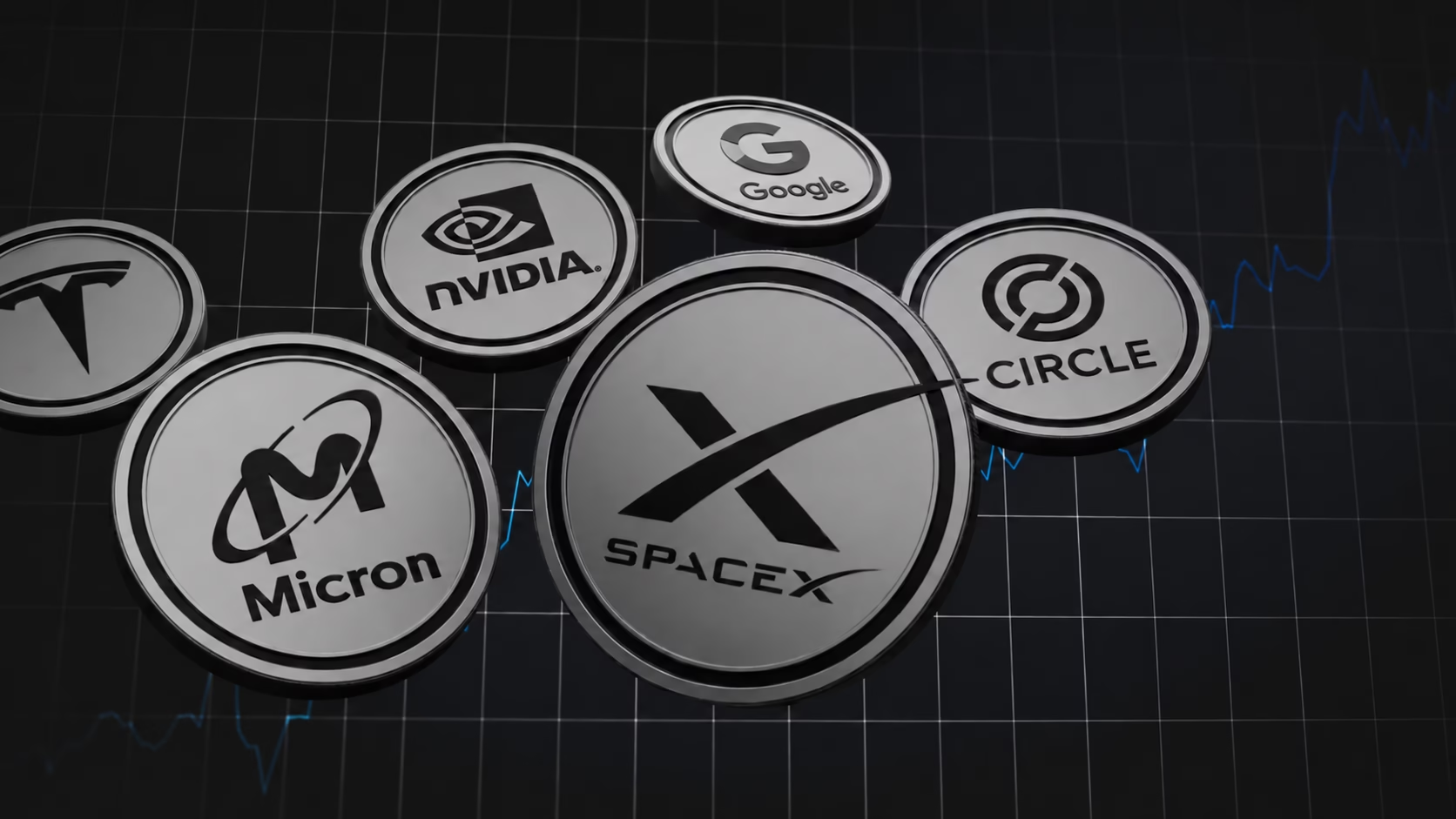
Solana settled nearly 98% of a record $565 million in tokenized stock trading on June 24, as SpaceX IPO activity and Micron Technology’s earnings release drove the largest single-day volume ever recorded for on-chain equities on spot decentralised exchanges, according to data from Blockworks.
The record comes only days after the sector also posted a new weekly transfer volume milestone, signaling accelerating adoption among traders seeking around-the-clock access to traditional financial assets.
While the overall figure was impressive, one trend stood out even more than the record itself. Nearly every trade settled on a single blockchain.
Data shows that Solana overwhelmingly dominated the day’s trading activity, settling approximately $553.3 million, or 97.8%, of all tokenized stock transactions executed on spot decentralized exchanges.
By comparison, BNB Chain processed around $7 million, Base recorded approximately $5.2 million, while Ethereum accounted for just $94,000 in trading volume.
The concentration reflects Solana’s growing position as the preferred blockchain for tokenized equity issuers and traders alike. Its low transaction costs and rapid settlement speeds have made it particularly attractive for investors looking to react quickly to corporate events that often trigger sharp price movements.
“The future of finance is on-chain,” Anatoly Yakovenko, co-founder of Solana Labs, has previously argued when discussing blockchain-based financial infrastructure, emphasizing the advantages of high-throughput networks for capital markets.
The dominance also highlights how liquidity naturally follows infrastructure. As more tokenized equity issuers launched products on Solana, traders increasingly migrated to the ecosystem, reinforcing its leadership through deeper liquidity and more efficient price discovery.
The latest Tokenized equity volume figures suggest that Solana’s network effects continue to strengthen as institutional interest in tokenized financial products grows.
The record-breaking trading session did not occur in isolation.
Market data indicates that the sharp increase in activity closely aligned with two significant traditional finance events.
Trading volumes began climbing noticeably on June 12, the same day that a tokenized representation linked to SpaceX (SPCX) attracted heightened market attention following its IPO-related activity. Momentum accelerated again as a token tracking Micron Technology (MU) became available shortly before the semiconductor giant released its June 24 earnings results.
These events reinforced one of the primary value propositions of tokenized stocks.
Unlike traditional equities that trade only during market hours, tokenized versions allow investors to gain exposure around the clock, including evenings, weekends and holidays. This continuous availability gives traders an opportunity to respond immediately to breaking corporate developments without waiting for stock exchanges to reopen.
Larry Fink, CEO of BlackRock, has repeatedly described tokenization as “the next generation for markets,” arguing that digitizing financial assets has the potential to improve efficiency, accessibility and settlement across global capital markets.
The latest spike in Tokenized equity volume demonstrates how blockchain infrastructure is increasingly serving traders who want uninterrupted access to equity markets during high-impact news events.
Despite the impressive daily record, the broader tokenized equity market remains relatively small compared to traditional financial markets.
Research from Delphi Digital estimates the sector’s total market capitalization at approximately $1.49 billion.
The distribution of capital also remains highly concentrated.
The ten largest tokenized equities represent roughly 60% of the entire market, while the top twenty account for nearly 75% of total capitalization.
Such concentration means that a small number of new listings or heavily traded assets can significantly influence overall Tokenized equity volume, particularly during periods of heightened investor interest.
However, market concentration is common during the early stages of emerging financial sectors. Similar patterns were observed during the initial growth phases of decentralized finance, exchange-traded funds and even cryptocurrency markets themselves before broader participation diversified liquidity.
As additional issuers expand their tokenized stock offerings, analysts expect market breadth to gradually improve, reducing dependence on a limited number of assets.
While June 24 established a new benchmark, industry observers believe the bigger question is whether trading activity can remain elevated without headline-grabbing corporate events driving investor participation.
So far, the largest spikes in Tokenized equity volume have closely coincided with major catalysts such as IPOs and quarterly earnings announcements.
That creates an important test for the second half of the year.
If trading volumes consistently retreat during quieter market periods, tokenized stocks may continue to function primarily as an event-driven product rather than a mature market offering continuous liquidity.
Conversely, if Tokenized equity volume remains strong between major corporate events, it would provide stronger evidence that investor demand for on-chain equity exposure is becoming structural rather than cyclical.
The June 24 record undoubtedly demonstrates growing enthusiasm for blockchain-based stock trading. Whether that momentum evolves into a sustainable market will depend on continued issuer participation, expanding liquidity and broader investor adoption beyond the next IPO or earnings season.
For now, Solana remains firmly at the center of that story, while the broader tokenized equity market enters its next stage of development with fresh attention from both crypto participants and traditional finance observers.
As the industry continues to mature, maintaining elevated Tokenized equity volume during ordinary trading periods may become the clearest indicator that tokenized stocks are transitioning from a niche innovation into a permanent fixture of digital capital markets.



Copyright © 2025 - The Bit Gazette.

