





- Trending
- Comments
- Latest

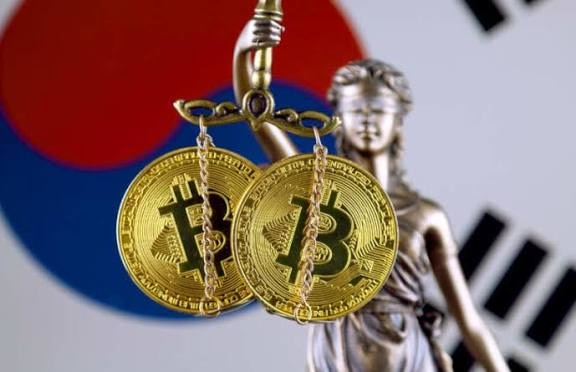
South Korea’s Financial Services Commission approved the criminal referral of two suspected cryptocurrency manipulation cases to prosecutors on July 1, alleging one whale investor purchased nearly 50% of a token’s global supply to manipulate its price.
The crypto whale case has become the latest example of how regulators are tightening oversight as authorities move to protect retail investors from increasingly sophisticated market manipulation tactics that have been spreading across digital asset markets worldwide.
South Korea’s Financial Services Commission (FSC) announced on July 1 that it approved the criminal referral of suspects involved in two separate cryptocurrency manipulation schemes during its 12th regular meeting, marking another major escalation in the country’s regulatory crackdown.
At the center of the first crypto whale case is a suspected large-scale investor commonly referred to in crypto circles as a “whale” — an entity holding enough capital to significantly influence market prices.
According to the FSC, the suspect allegedly deployed tens of billions of Korean won over a period of nearly two months to manipulate the value of a digital token listed on both domestic South Korean exchanges and international trading platforms.
Regulators allege the suspect purchased nearly 50% of the token’s global circulating supply, creating artificial scarcity while generating aggressive buying pressure.
The commission explained that the whale initially inflated the token price on overseas exchanges before triggering corresponding price surges on domestic Korean platforms.
As retail investors rushed in, believing momentum was genuine, the suspect allegedly dumped assets for profit.
The FSC stated:
“Investors should refrain from chasing virtual assets whose prices and trading volumes surge without any reasonable cause.”
The agency warned that such crypto whale case activity often leaves retail traders absorbing the majority of losses once manipulation schemes collapse.
A second crypto whale case under investigation involves what regulators described as ultra-short-term manipulation involving a small-cap “kimchi coin,” a term often used for South Korea-focused cryptocurrency tokens.
Authorities allege the suspect exploited API trading systems to rapidly place repeated buy and sell orders within seconds, creating the illusion of heightened trading demand.
In addition, investigators say the trader simultaneously placed high-priced limit buy orders through web trading channels to artificially push prices higher.
Once unsuspecting investors entered the market, the suspect allegedly sold holdings in stages to secure profits.
The FSC noted that smaller cryptocurrencies with thin liquidity remain highly vulnerable to these manipulation strategies.
This latest crypto whale case follows broader regulatory actions already underway in South Korea.
Earlier in January 2025, South Korean prosecutors arrested two individuals connected to alleged cryptocurrency price manipulation activities involving major exchange Bithumb.
That earlier investigation involved suspected violations under the country’s Virtual Asset User Protection Act, one of Asia’s strongest digital asset investor protection frameworks.
South Korea has also established a dedicated crypto crime investigation unit, giving authorities expanded powers to detect suspicious market activity faster.
Industry observers believe these enforcement moves reflect growing urgency among regulators worldwide.
Gary Gensler previously warned:
“Markets only work when investors trust that there are rules against manipulation.”
The warning mirrors growing concerns across global regulators about coordinated pump-and-dump schemes dominating smaller crypto markets.
The ongoing crypto whale case also arrives as South Korea tightens oversight on financial influencers promoting cryptocurrencies and stocks online.
Authorities recently proposed new disclosure requirements forcing influencers to reveal compensation arrangements and personal holdings whenever discussing investment products publicly.
The FSC confirmed it will strengthen monitoring systems capable of detecting concentrated trading activity among small groups of coordinated accounts.
Officials also announced plans to deploy more advanced investigative tools designed to identify unfair crypto trading practices in real time.
Analysts say the latest crypto whale case proves South Korea intends to become one of the strictest jurisdictions globally when policing digital asset misconduct.
For investors, the message is becoming increasingly clear: market manipulation will face far tougher consequences moving forward.



Copyright © 2025 - The Bit Gazette.

