




- Trending
- Comments
- Latest

Pakistan’s virtual assets regulator has asked the country’s top Islamic seminary to distinguish speculative cryptocurrencies from asset-backed digital tokens, after a June fatwa ruled that crypto does not qualify as wealth under Shariah law.
The request follows a June fatwa that questioned whether cryptocurrencies qualify as wealth under Islamic law, creating fresh uncertainty around Pakistan crypto regulation as the government moves to license crypto exchanges, explore tokenized state assets, and expand its digital finance strategy.
The latest debate surrounding Pakistan crypto regulation stems from a ruling issued in June by Jamia Darul Uloom Karachi, one of the country’s most influential Islamic seminaries. The institution concluded that, in its current form, cryptocurrency does not constitute wealth under Shariah and therefore cannot be considered a permissible means of payment.
The ruling has raised questions about the government’s accelerated embrace of digital assets in Pakistan, an Islamic nation of more than 240 million people that consistently ranks among the world’s largest retail cryptocurrency markets.
Recognizing the implications of the fatwa, the Pakistan Virtual Assets Regulatory Authority (PVARA) has formally approached the seminary for further clarification. Rather than treating all digital assets as a single category, the regulator wants scholars to distinguish between speculative cryptocurrencies and blockchain-based assets backed by tangible value.
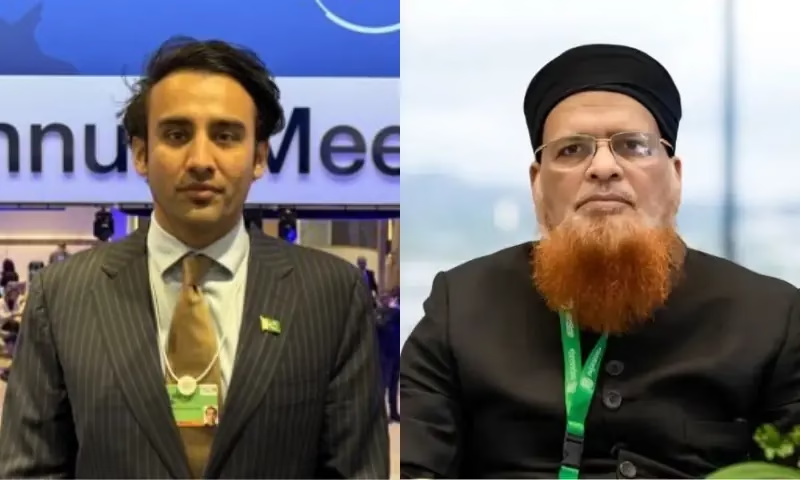
Bilal bin Saqib, chairman of PVARA, told Reuters that the discussion should focus on the nature of each digital asset rather than applying a blanket religious judgment to the entire sector.

“The central question the fatwa raises is whether a digital asset constitutes recognised wealth under Shariah (Islamic law). That is precisely the right question, and it is why these instruments must be examined individually.” — Bilal bin Saqib, Chairman, Pakistan Virtual Assets Regulatory Authority (PVARA)
The seminary did not immediately respond to Reuters’ request for comment.
Despite the religious concerns, Pakistan crypto regulation continues to move forward through a series of government-backed initiatives designed to formalize the country’s rapidly growing crypto market.
Islamabad is pursuing tokenization of state-owned assets while also developing a licensing framework for cryptocurrency exchanges, with licenses expected to be issued in the coming months. The government is additionally working on stablecoins and broader real-world asset tokenization as part of its long-term digital finance strategy.
Crypto has also become an increasingly visible component of Pakistan’s international economic engagement. The country recently entered an agreement with an affiliate of World Liberty Financial-the principal cryptocurrency business linked to U.S. President Donald Trump’s family to explore the use of its USD1 stablecoin for cross-border payments, an initiative Pakistani officials have described as part of their broader “crypto diplomacy.”
Saqib emphasized that blockchain technology itself should not be viewed as a financial asset but rather as infrastructure capable of supporting different classes of digital financial products.
“We will continue working closely with our scholars as Pakistan develops its licensing framework and advances work on stablecoins and real-world asset tokenisation.” — Bilal bin Saqib, Chairman, Pakistan Virtual Assets Regulatory Authority (PVARA)
He explained that blockchain-recorded sukuk represent ownership in genuine income-generating assets, while gold-backed tokens and fully reserved stablecoins provide enforceable claims on tangible, redeemable assets. Purely speculative cryptocurrencies, however, deserve separate consideration.
While the fatwa has introduced uncertainty into Pakistan crypto regulation, analysts say its immediate impact on cryptocurrency trading has so far been limited.
Waqas Ghani, Head of Research at JS Global Capital, said the religious ruling could eventually influence mainstream financial institutions more than retail investors.
“The edict as it stands could become a hurdle to broader, bank-led crypto adoption beyond Pakistan’s urban trading community.” — Waqas Ghani, Head of Research, JS Global Capital
According to Ghani, however, cryptocurrency trading volumes have thus far remained largely unaffected despite the ruling.
The fatwa itself was issued in response to a question regarding whether cryptocurrency could be used to purchase books and an online educational course. Among the scholars involved in issuing the ruling was Mufti Muhammad Taqi Usmani, a widely respected authority in Islamic finance. Reuters reported that Usmani did not respond to requests for comment.
The episode illustrates the unique intersection between religious scholarship and financial regulation in Pakistan, where Islamic legal interpretations often play an influential role in shaping public policy and financial practices.
As Pakistan crypto regulation evolves, officials appear focused on building a framework that satisfies both regulatory requirements and Islamic financial principles.
Rather than abandoning its digital asset ambitions, PVARA is working with religious scholars to establish distinctions between speculative crypto assets and blockchain-based financial instruments backed by real-world value. That approach could provide greater legal and religious certainty for financial institutions considering blockchain adoption.
Saqib believes this collaborative process could position Pakistan as a global leader in Islamic digital finance rather than placing it at odds with emerging financial technologies.
“Pakistan has the opportunity to lead the world in Shariah-compliant digital finance, and that leadership must be built with our scholars.” — Bilal bin Saqib, Chairman, Pakistan Virtual Assets Regulatory Authority (PVARA)
The outcome of these consultations may shape not only the future of Pakistan crypto regulation but also how other Muslim-majority nations approach digital assets within the framework of Islamic finance.
Primary source: Reuters



Copyright © 2025 - The Bit Gazette.